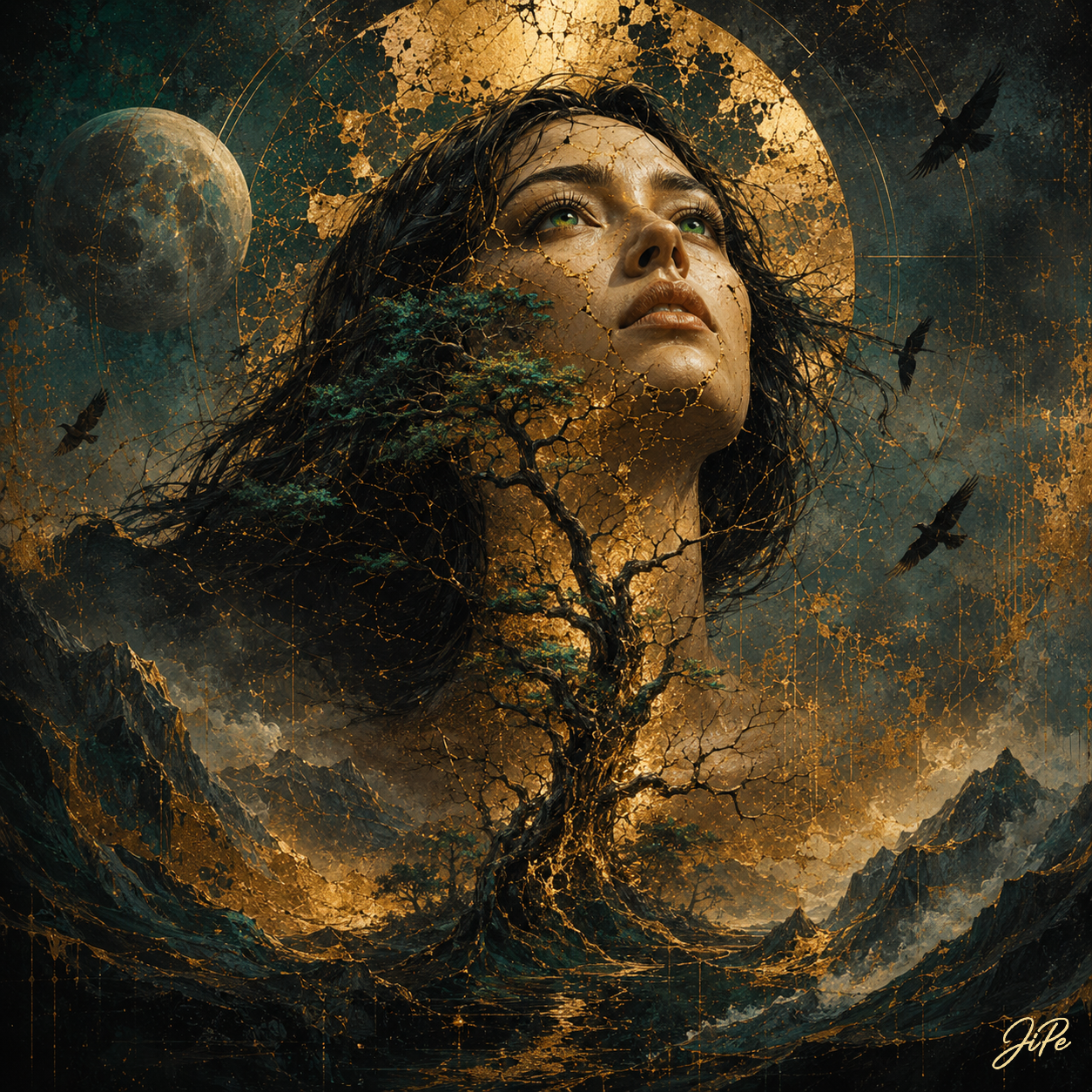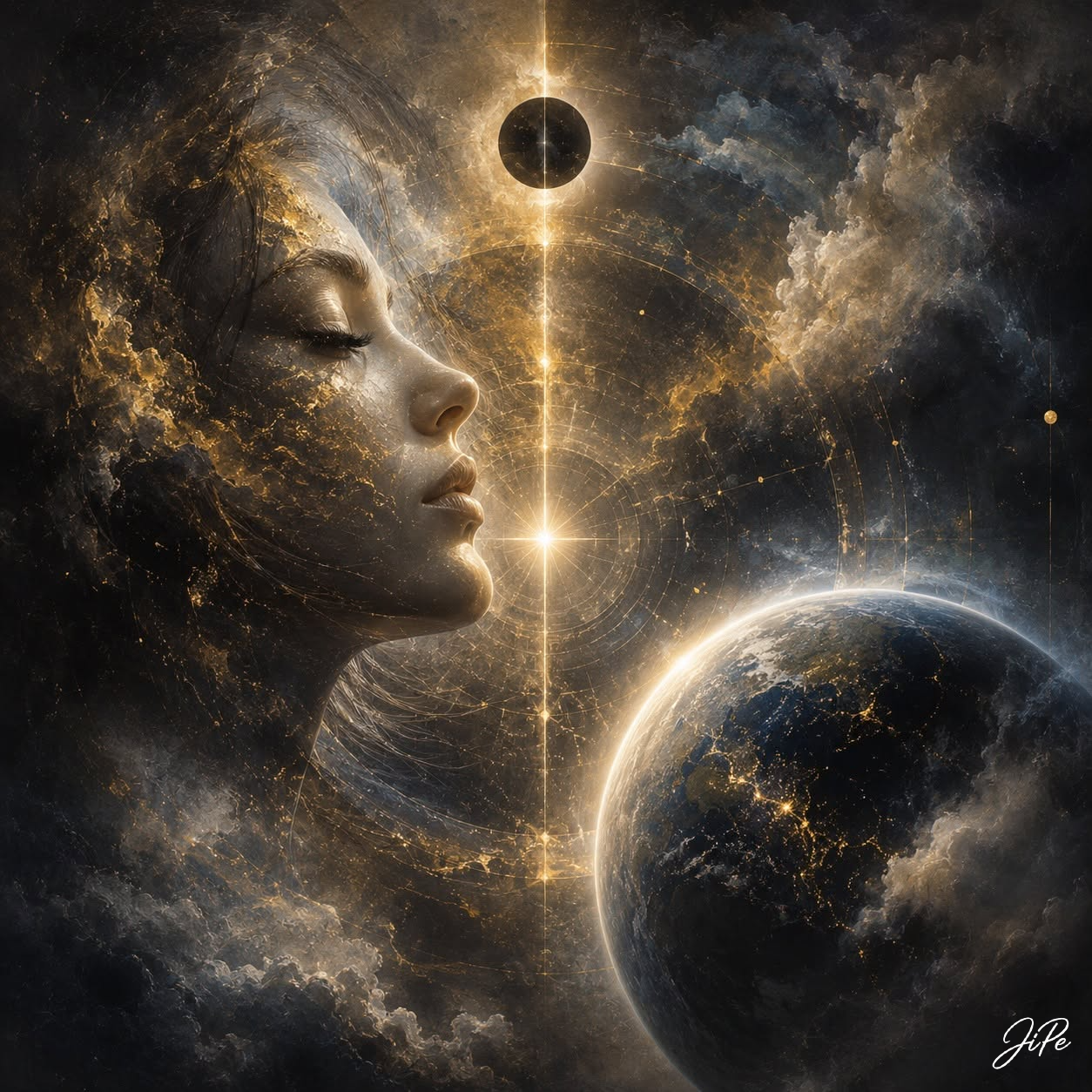
The Moment of Becoming

The Moment of Becoming is a monumental meditation on transformation, creation, and the extraordinary instant in which one identity dissolves so that another may emerge. Existing between figurative realism and abstract symbolism, the painting captures not a conclusion but a beginning—the fragile, explosive, and often painful threshold where change becomes irreversible. Rather than depicting destruction, the work reveals creation in its most elemental form: the continuous process of becoming.
The title emphasizes this idea. Becoming is never a single event but an unfolding state of existence. Every human life is shaped by countless invisible transitions—moments when certainty fractures, old beliefs collapse, and new possibilities emerge. These transformations are rarely dramatic from the outside, yet internally they redefine who we are. The Moment of Becoming captures this precise instant: the silent collision between what has been and what is about to exist.
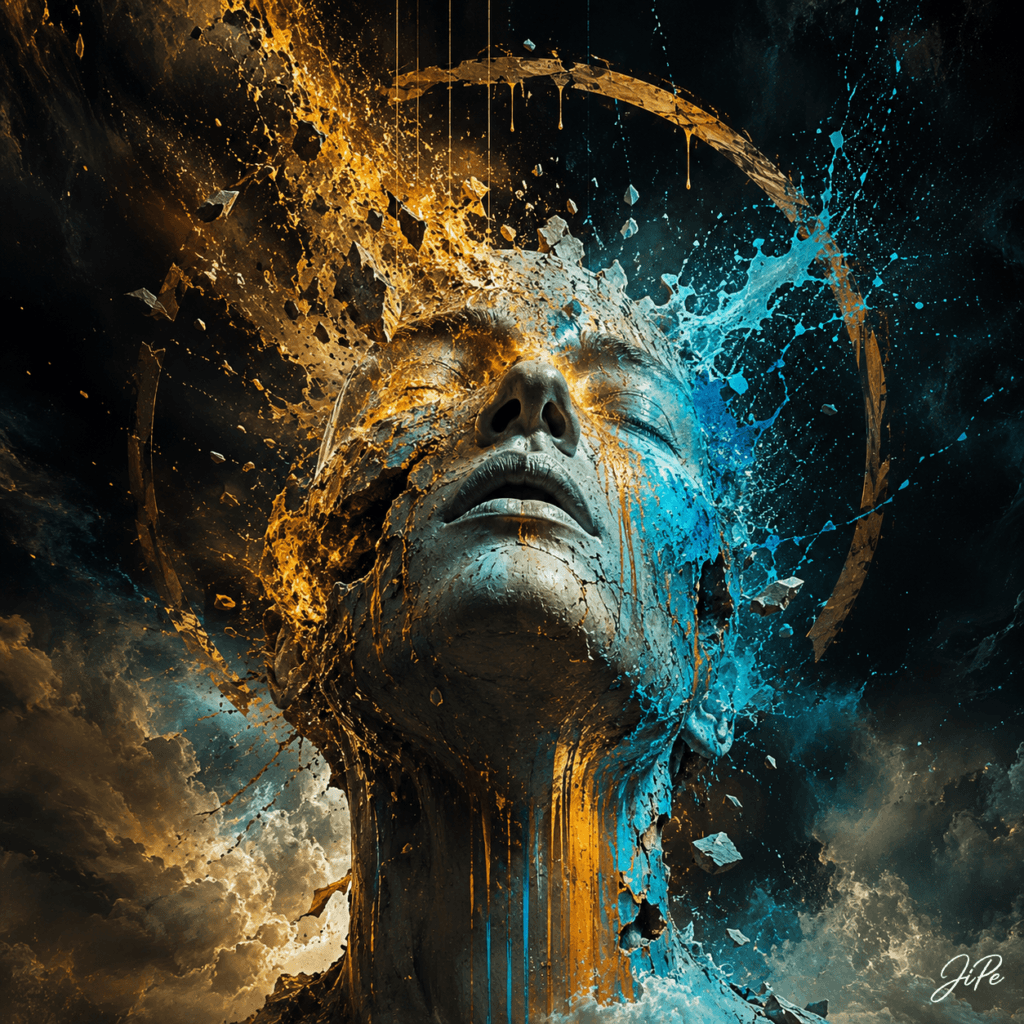
At the center of the composition rises a monumental human face emerging from darkness with closed eyes turned toward the heavens. The upward orientation immediately removes the portrait from ordinary reality. The figure appears neither asleep nor lifeless, but suspended within an intimate dialogue between surrender and awakening. The closed eyes suggest that true transformation begins inwardly, long before it becomes visible to the outside world.
The face itself is deliberately incomplete. Rather than presenting an intact portrait, the figure appears to dissolve into fragments of paint, stone, light, and atmosphere. The surface simultaneously cracks apart and reforms, suggesting that identity is never fixed but continuously reconstructed through experience. Every fracture becomes an opening through which new life enters.
This paradox forms the conceptual heart of the painting. The work proposes that creation and destruction are not opposing forces but complementary aspects of the same universal process. The collapse of one structure becomes the foundation for another. What appears to be disintegration is, in fact, transformation.
One of the painting’s most striking visual elements is the dramatic collision between luminous gold and vibrant blue. These opposing colors establish a symbolic dialogue that extends far beyond aesthetics.
Gold represents consciousness, memory, transcendence, spiritual illumination, and the timeless search for meaning. Throughout history, gold has served as the visual language of sacred art, iconography, and divine presence. Here it becomes the energy of awakening—the fire through which transformation is initiated.
Blue introduces an entirely different emotional vocabulary. It evokes intuition, emotion, the unconscious, the infinite sky, and the immeasurable depth of water. It represents the unknown dimensions of existence where imagination, vulnerability, and possibility reside. Rather than opposing the gold, the blue completes it. Together they suggest that authentic transformation requires both fire and water, intellect and intuition, action and surrender.
The explosive painterly gestures surrounding the portrait reinforce this dynamic tension. Paint no longer behaves like pigment but like energy itself. Thick splashes, cascading drips, fractured fragments, and explosive bursts create the impression that the figure is being born from the very material of the painting. Every gesture conveys movement while the face itself remains astonishingly calm. This contrast between external chaos and internal stillness becomes one of the work’s defining emotional qualities.
Behind the figure, a weathered golden circle establishes the painting’s symbolic architecture. Throughout the artist’s visual language, the circle functions as an image of eternity, cosmic order, and spiritual wholeness. Here it may simultaneously be interpreted as a halo, an eclipse, the sun, or a celestial gateway. Its incomplete form reinforces the central theme of becoming: completeness is never static but always evolving.
The dramatic sky surrounding the portrait expands the symbolic narrative beyond the individual. Towering clouds illuminated by distant light evoke creation myths, cosmic landscapes, and the primordial atmosphere from which existence itself emerges. The figure no longer belongs merely to human experience but becomes part of a larger universal rhythm where transformation governs everything from stars to consciousness.
The visible fragments of stone and debris suspended throughout the composition further deepen this symbolism. These shattered pieces suggest that old identities, rigid beliefs, and established structures must occasionally break apart before genuine growth becomes possible. Yet none of these fragments fall toward destruction. Instead, they appear suspended within an invisible gravitational field, becoming participants in creation rather than victims of collapse.
Compositionally, The Moment of Becoming is built around extraordinary vertical movement. The elongated neck, upward gaze, rising splashes of paint, and celestial halo all direct the viewer’s attention toward transcendence. Yet this upward motion is balanced by cascading drips descending toward the lower edge of the canvas. The composition therefore establishes a visual dialogue between ascent and descent, heaven and earth, spirit and matter. The figure exists precisely at their intersection.
The painting demonstrates remarkable harmony between realism and abstraction. The anatomy of the face is rendered with exceptional sensitivity, preserving emotional intimacy despite the monumental scale. Around it, recognizable form gradually dissolves into expressive textures and gestural brushwork, blurring the distinction between physical reality and emotional experience. The portrait becomes less a representation of a person than a manifestation of consciousness itself.
Texture plays an essential role throughout the work. Thick impasto, weathered surfaces, fractured pigment, and visible brushwork create a powerful tactile presence. Rather than concealing the artist’s process, the painting celebrates materiality as an active participant in meaning. Every crack, splash, and erosion becomes analogous to memory, carrying visible traces of time and transformation.
The restrained palette of charcoal black, luminous gold, muted ivory, and brilliant turquoise intensifies the emotional impact. Every color serves symbolic as well as compositional purposes. Black introduces mystery and infinite space. Gold embodies illumination and resilience. Blue evokes emotional depth and possibility. Ivory preserves humanity amidst cosmic abstraction.
From an art historical perspective, The Moment of Becoming occupies a distinctive position within contemporary symbolic realism. It synthesizes influences from Symbolism, Abstract Expressionism, visionary art, monumental figurative painting, and sacred iconography into a visual language that feels both timeless and unmistakably contemporary. Echoes of Renaissance spirituality coexist with the expressive freedom of modern abstraction, allowing the work to transcend stylistic categories.
Conceptually, the painting reflects one of humanity’s most universal experiences: transformation through uncertainty. Modern culture often celebrates finished identities, completed achievements, and visible success. The Moment of Becoming instead honors the unfinished. It recognizes that life’s most meaningful moments occur not after transformation has been completed, but during the vulnerable interval when everything familiar is dissolving and the future remains unknown.
The work intentionally resists a single interpretation. Some viewers may encounter a vision of spiritual awakening or resurrection. Others may perceive emotional healing, personal rebirth, or the psychological integration of opposing aspects of the self. The explosive colors may symbolize elemental forces, creative energy, or the perpetual tension between order and chaos. Every interpretation remains valid because the painting ultimately reflects the inner landscape of its observer.
Rather than presenting transformation as a peaceful evolution, The Moment of Becoming reveals it as both beautiful and demanding. Growth requires surrender. Illumination requires vulnerability. Every new beginning carries within it the visible remains of what came before. Yet the painting refuses tragedy. Instead, it celebrates the extraordinary resilience of the human spirit and its endless capacity to reinvent itself.
Ultimately, The Moment of Becoming is an invitation to embrace change not as loss, but as creation. It reminds us that identity is never finished, wisdom is never complete, and every ending quietly prepares the conditions for another beginning. Standing before this work, the viewer encounters more than a portrait—they witness the universal process through which life continually transforms itself. It is the silent instant where fear gives way to possibility, where fragmentation becomes wholeness, and where the human spirit discovers that becoming is not a destination, but the most profound expression of being itself.