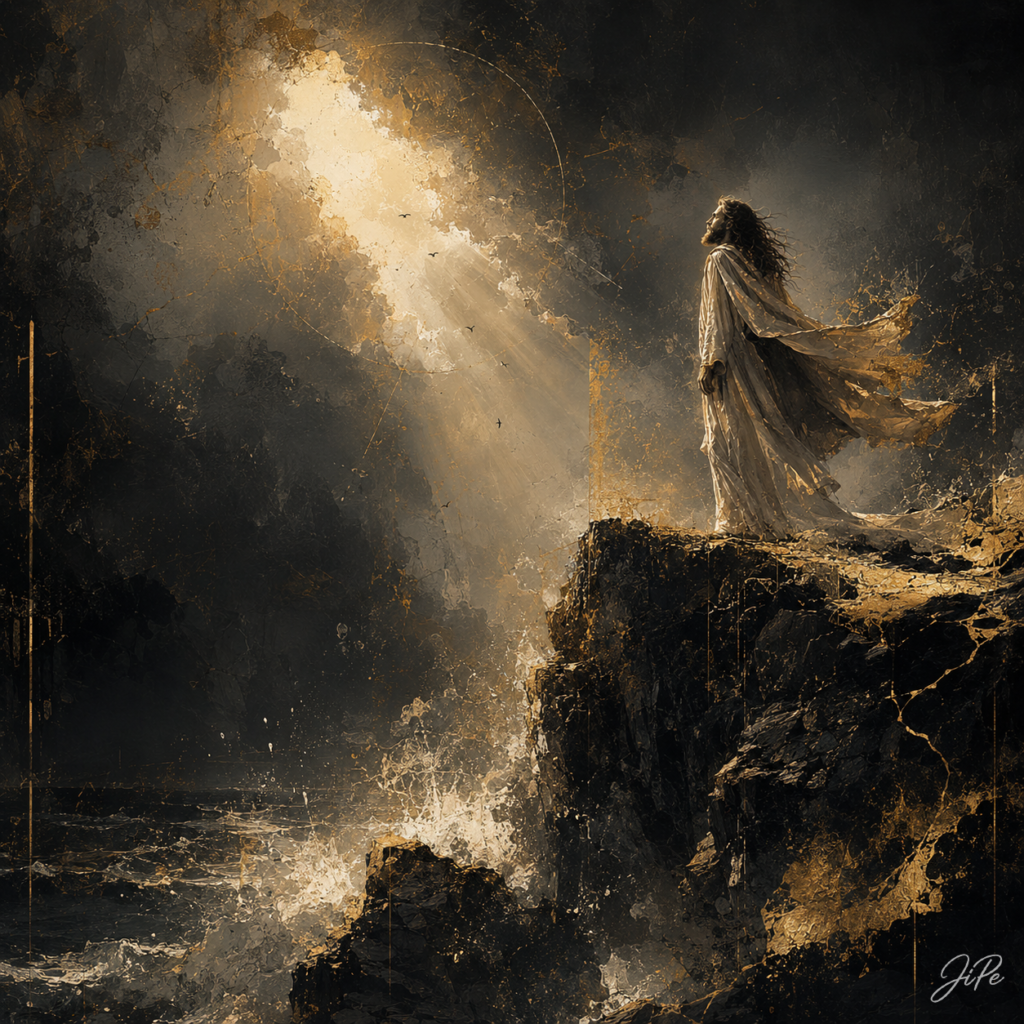
The Prophet on the Cliffside holds a solitary presence at the boundary between certainty and the unknown. The figure stands not as master of the surrounding immensity, but as something exposed within it—small enough to remain vulnerable, yet still enough to alter the emotional scale of the entire space.
Darkness gathers with extraordinary weight, while light enters as an interruption rather than a resolution. Between them lies a charged interval of sea, stone, and distance, where the visible world seems momentarily opened onto something that cannot be fully approached. The figure’s upward attention intensifies this threshold: revelation feels possible, but never assured.
The title introduces the idea of prophecy while withholding its message. Perhaps the prophet is one who sees beyond the present; perhaps he is simply the one condemned to remain attentive when others have turned away. Knowledge, faith, doubt, and solitude become difficult to separate. The cliff itself suggests the precarious position of anyone who waits for meaning at the edge of what can be known.
Nothing confirms whether the light answers him. It may be arrival, departure, memory, or silence given form. The Prophet on the Cliffside leaves him suspended before that uncertainty—and leaves us wondering whether revelation begins when something appears, or when we become willing to wait for it.