
The Revelation of the Golden Goddess
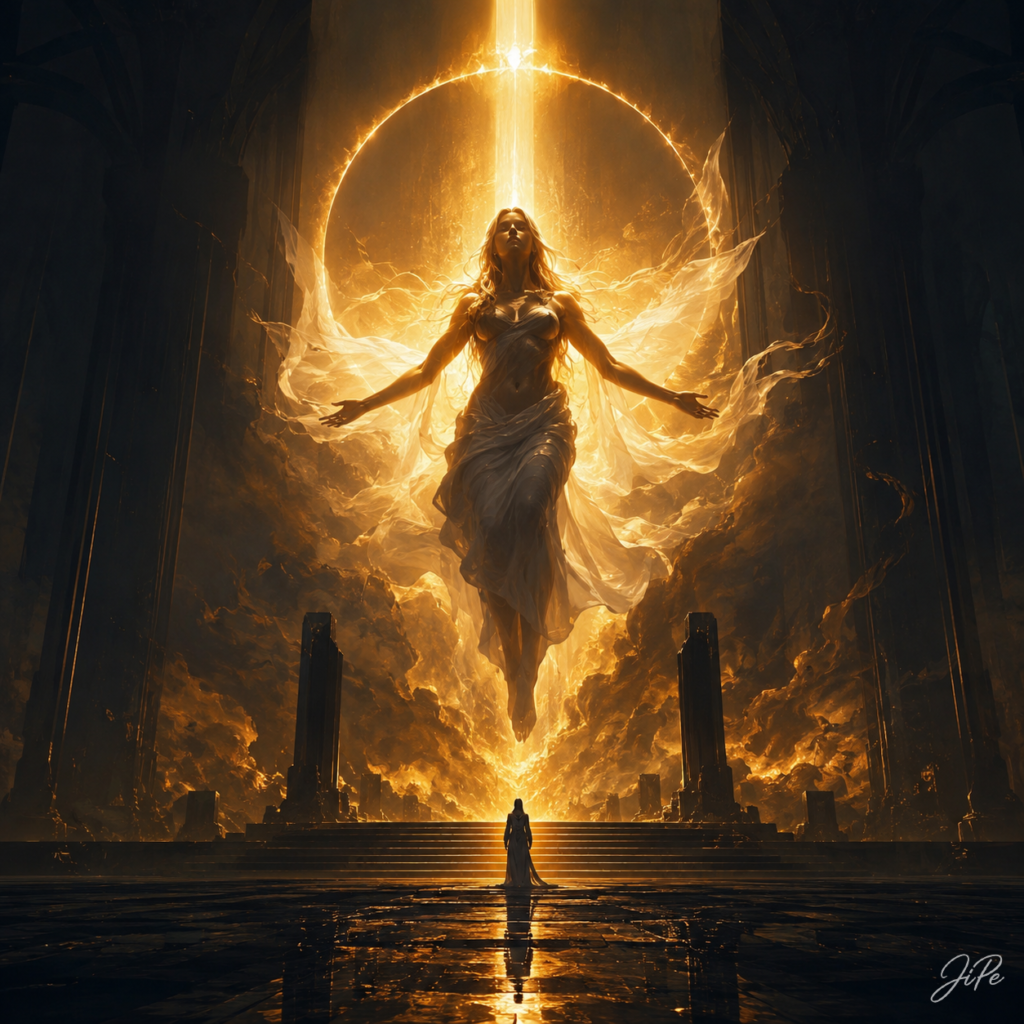
The Revelation of the Golden Goddess is a monumental meditation on transcendence, divine femininity, and the timeless moment when the invisible becomes manifest. Suspended between mythology and metaphysics, the work portrays neither a goddess in the traditional sense nor a literal supernatural apparition. Instead, JiPe presents revelation itself as a living force—a luminous encounter between the human soul and the eternal. The painting explores the threshold where faith, consciousness, memory, and light converge, inviting viewers into a space where spiritual experience transcends language and image.
At the heart of the composition, an ethereal female figure descends—or perhaps ascends—within an overwhelming column of radiant gold. Her body appears almost weightless, formed as much from light as from flesh, surrounded by flowing veils that dissolve into luminous energy. She is framed by a perfect circular halo that echoes ancient solar symbolism, while beneath her a solitary human figure stands at the foot of an immense staircase, dwarfed by both architecture and revelation.
This dramatic contrast of scale immediately establishes the emotional narrative of the work.
The encounter is not between two individuals.
It is between the finite and the infinite.
Between mortality and eternity.
Between the seeker and that which has always been waiting to be discovered.
The title, The Revelation of the Golden Goddess, deliberately resists a single interpretation. The ”Golden Goddess” is not intended as a specific deity drawn from one mythology or religious tradition. Rather, she functions as an archetype—a universal embodiment of wisdom, creation, compassion, beauty, transformation, and the life-giving power traditionally associated with the sacred feminine throughout human history.
She is simultaneously Isis and Sophia.
Athena and Saraswati.
The Divine Mother.
The Eternal Muse.
She belongs to every civilization precisely because she belongs to none.
Her identity is symbolic rather than historical.
In doing so, JiPe creates an image capable of speaking across cultures and belief systems, allowing every viewer to discover their own spiritual vocabulary within the work.
Light is unquestionably the central protagonist of the painting. Rather than merely illuminating the composition, it possesses agency. It pours downward from beyond the visible frame like a cosmic river, shaping form, dissolving matter, and redefining space itself. The goddess does not stand within the light.
She is inseparable from it.
Her garments appear woven from radiance, her silhouette dissolves into luminous currents, and even the surrounding atmosphere seems transformed by her presence. This treatment reflects one of JiPe’s recurring artistic philosophies: light is not simply physical illumination but a symbolic language capable of expressing truth, consciousness, grace, and spiritual awakening.
The circular halo behind the figure functions as both compositional anchor and symbolic centre. Throughout art history, the circle has represented eternity, unity, perfection, and the cyclical nature of existence. Here it operates on several levels simultaneously. It frames the goddess visually, reinforces the symmetry of the composition, and evokes celestial bodies such as the sun, eclipses, and cosmic portals.
Its geometry quietly suggests that revelation is never chaotic.
It possesses order.
Harmony.
Purpose.
The architectural environment surrounding the figures contributes profoundly to the painting’s psychological atmosphere. Towering columns disappear into darkness, recalling forgotten temples, sacred sanctuaries, and ancient halls of initiation. Their monumental scale emphasizes humanity’s perpetual desire to construct spaces capable of containing the divine, even while suggesting that true revelation ultimately exceeds every physical structure.
The temple becomes less a building than a state of consciousness.
It is the inner sanctuary where transformation occurs.
The solitary figure standing below provides one of the painting’s most emotionally compelling elements. Reduced almost to a silhouette, the individual becomes anonymous, allowing viewers to project themselves into the narrative. This figure is not portrayed in fear, worship, or submission alone. Instead, the posture communicates openness—a willingness to witness what cannot be possessed or controlled.
The encounter is profoundly personal.
Yet it also feels universal.
Every civilization has imagined moments when ordinary reality suddenly gives way to something immeasurably greater than itself.
This is one of those moments.
One of JiPe’s most sophisticated artistic achievements lies in his orchestration of scale. The goddess appears simultaneously colossal and intimate. She dominates the composition without becoming oppressive, while the human observer remains physically insignificant yet emotionally central. This delicate equilibrium transforms the painting from spectacle into contemplation.
The viewer does not simply observe revelation.
The viewer experiences its emotional gravity.
Materiality also plays an essential role. Although composed digitally, the image evokes the tactile richness of mixed-media painting. Layers of luminous texture resemble translucent veils, molten gold, and flowing pigment. The surrounding clouds appear sculpted rather than painted, while subtle weathered surfaces recall cracked frescoes and ancient gilded icons. These textures reinforce the sense that revelation is something simultaneously eternal and fragile—both ancient and continually renewed.
The colour palette remains intentionally restrained. Deep charcoal shadows establish vast architectural depth, while luminous gold dominates every focal point. Ivory highlights emerge within the flowing garments, creating extraordinary visual contrast without overwhelming the harmony of the composition. This limited palette allows the symbolic language of light to remain unmistakably clear.
Gold, throughout history, has signified far more than wealth.
It symbolizes incorruptibility.
Wisdom.
The divine.
The eternal.
By immersing the entire revelation within gold, JiPe aligns the work with centuries of sacred artistic tradition while reinterpreting it through a contemporary visual language.
Thematically, the painting explores revelation not as an external miracle but as an internal awakening. The goddess does not appear to conquer or command. She simply reveals what has always existed beyond ordinary perception. The human figure’s journey is therefore not one of acquisition but recognition.
Truth is not created.
It is remembered.
This philosophical perspective resonates strongly with mystical traditions across cultures, where enlightenment is often understood not as receiving something new but uncovering something timeless that has always lived within the soul.
Art historically, The Revelation of the Golden Goddess occupies a compelling intersection between visionary symbolism, contemporary mythological painting, sacred art, surreal realism, and monumental figurative composition. Echoes of Renaissance altarpieces coexist with modern cinematic scale, while sacred geometry quietly structures the composition without becoming decorative. JiPe’s characteristic synthesis of painterly atmosphere and hyper-realistic detail creates a visual language that feels both ancient and unmistakably contemporary.
Emotionally, the work balances awe with serenity. Unlike many depictions of divine revelation that emphasize judgment or overwhelming power, this painting radiates invitation. The goddess’s open arms communicate acceptance rather than dominance. Her expression remains calm, almost compassionate, suggesting that transcendence is not something to be feared but embraced.
The revelation offered here is not one of condemnation.
It is one of remembrance.
It reminds humanity of its forgotten relationship with light.
Ultimately, The Revelation of the Golden Goddess is less concerned with depicting a supernatural being than with visualizing one of the deepest human longings: the desire to encounter meaning beyond the visible world. It proposes that every culture, every myth, and every spiritual tradition is, at its heart, searching for the same luminous source—a presence that transcends names while remaining profoundly personal.
Standing before this work, viewers may initially be captivated by its monumental scale, radiant atmosphere, and cinematic beauty. Yet as the eye lingers, another experience gradually emerges. The painting begins to function less as an image and more as a mirror, reflecting the viewer’s own longing for transformation, purpose, and transcendence.
For perhaps revelation is not the moment when the heavens finally open before us.
Perhaps it is the moment when we become capable of seeing the light that has been shining all along.
And perhaps the Golden Goddess has never belonged to mythology alone.
Perhaps she has always lived within the deepest possibilities of the human spirit, waiting for the moment when we are finally ready to recognize her.