The Sea of Forgotten Souls

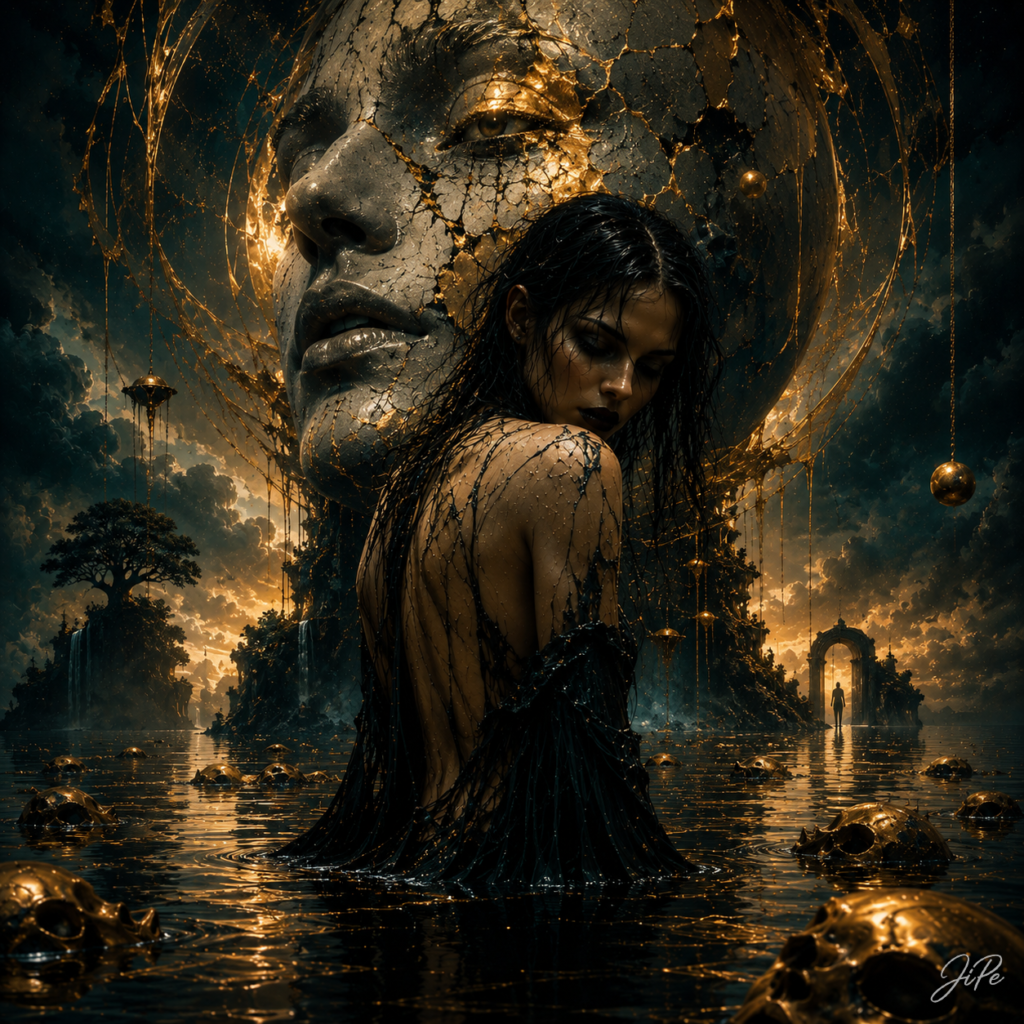
The Sea of Forgotten Souls is a profound meditation on memory, mortality, and the fragile boundary between remembrance and oblivion. Through a monumental symbolic composition, JiPe transforms water into the collective unconscious of humanity—a place where forgotten lives, abandoned histories, and silent grief continue to exist beneath the surface of time. Neither entirely dream nor reality, the painting occupies an ambiguous space where myth, psychology, and spirituality merge into a single visual narrative, inviting viewers to contemplate what becomes of the stories that history no longer remembers.
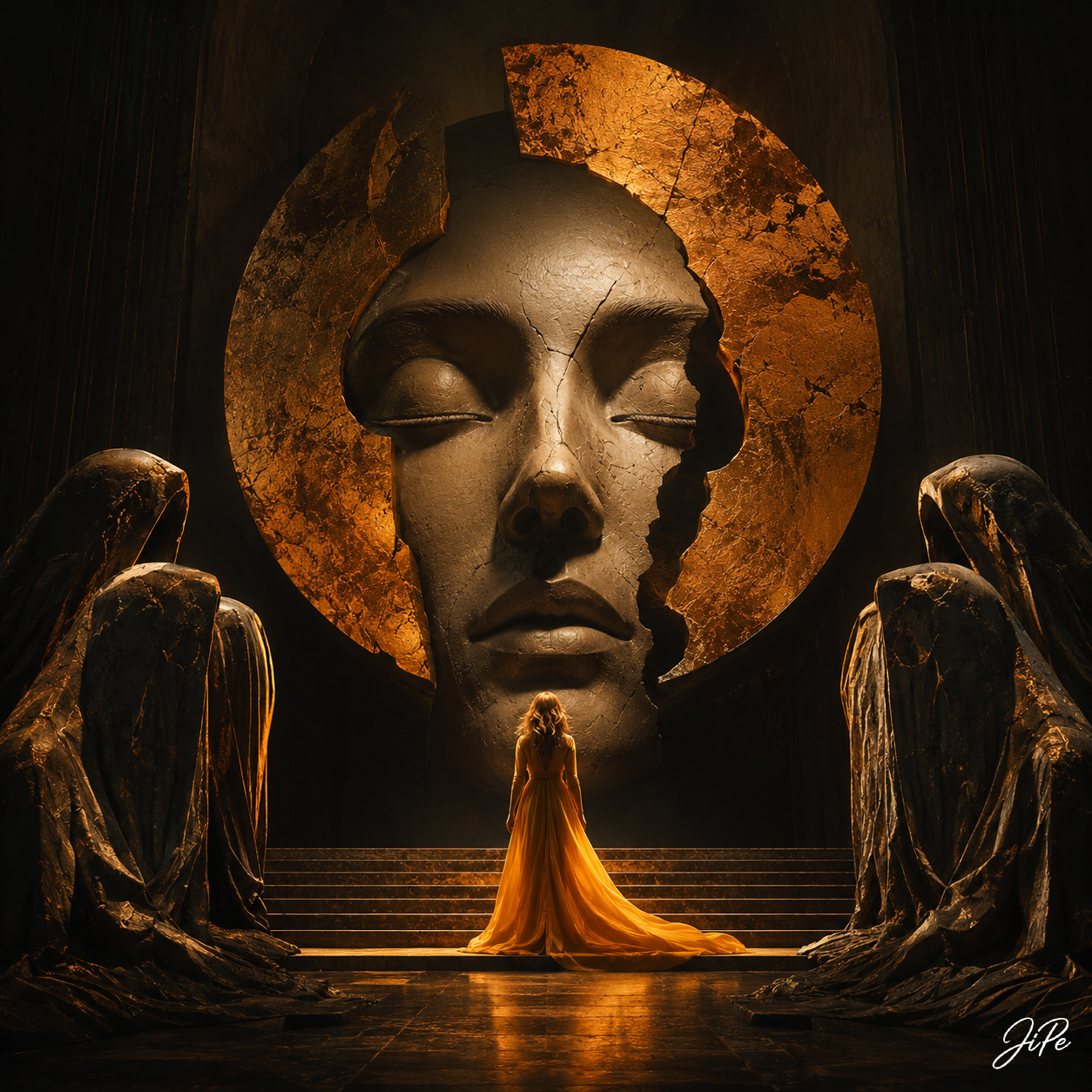
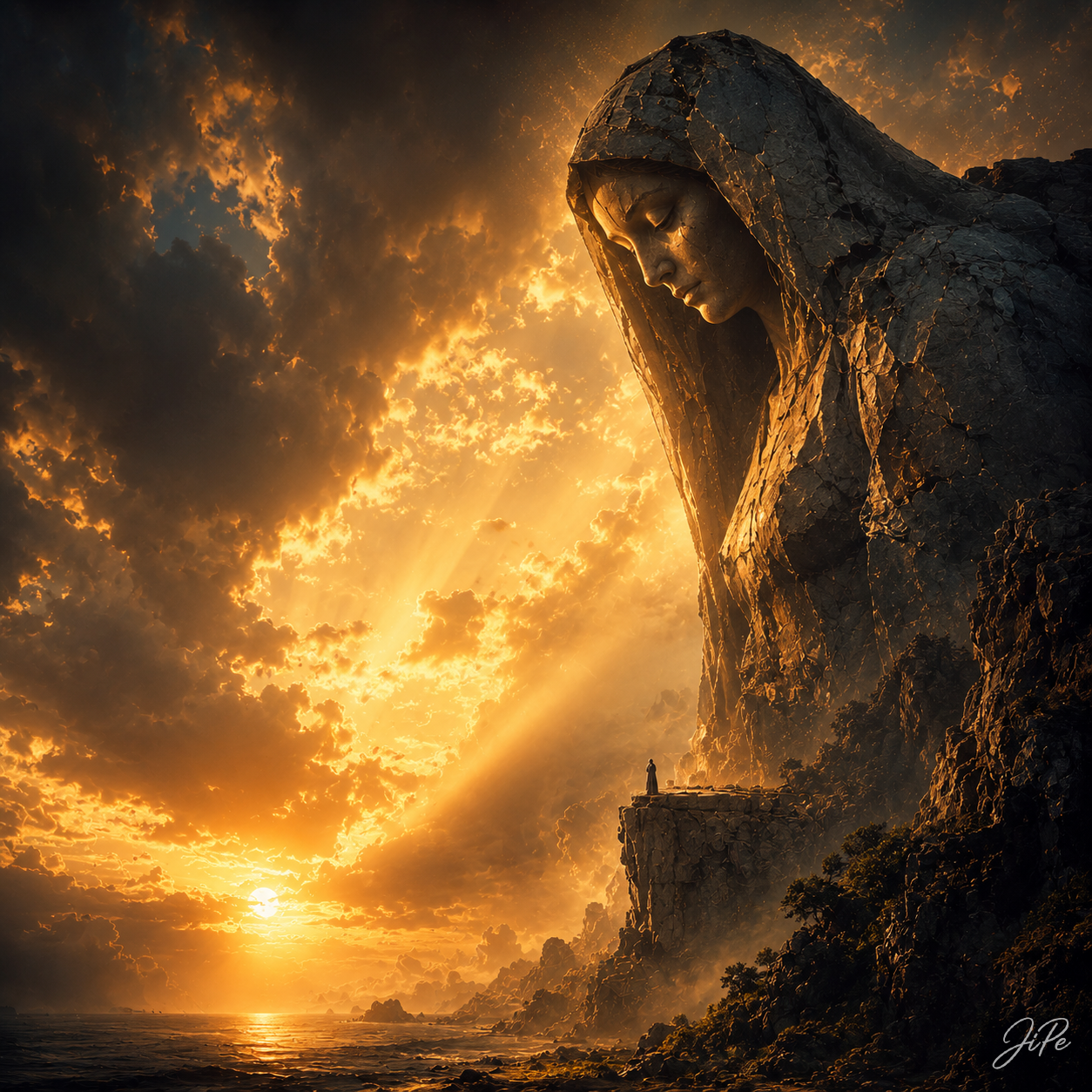
At the centre of the composition stands a solitary woman emerging from dark, reflective waters. Her body appears almost inseparable from the surrounding darkness, while her lowered gaze and quiet posture suggest introspection rather than despair. Behind her rises an immense fractured face, monumental in scale, its cracked stone surface illuminated by veins of radiant gold. The colossal visage dominates the horizon like the remains of an ancient forgotten deity, simultaneously watching over the scene and dissolving into it.
This relationship between the intimate and the monumental forms the emotional foundation of the work.
The woman represents the individual.
The giant face represents collective memory.
Together they become two dimensions of the same human experience.
The title, The Sea of Forgotten Souls, immediately establishes the symbolic landscape. This is not a literal sea populated by ghosts, but a metaphysical ocean where every forgotten life, every abandoned dream, every unnamed sacrifice, and every unspoken grief continues to exist beneath the visible world. The water becomes memory itself—fluid, reflective, immeasurable, and incapable of being fully possessed.
Throughout the composition, floating golden skulls drift silently across the water’s surface. Their presence is among the painting’s most striking symbolic elements. Rather than functioning as traditional memento mori intended to provoke fear, they serve as luminous relics of forgotten existence. Their gilded surfaces suggest that every life, no matter how obscure or forgotten by history, possesses immeasurable value.
Death has erased identity.
It has not erased significance.
The skulls become silent monuments to invisible humanity.
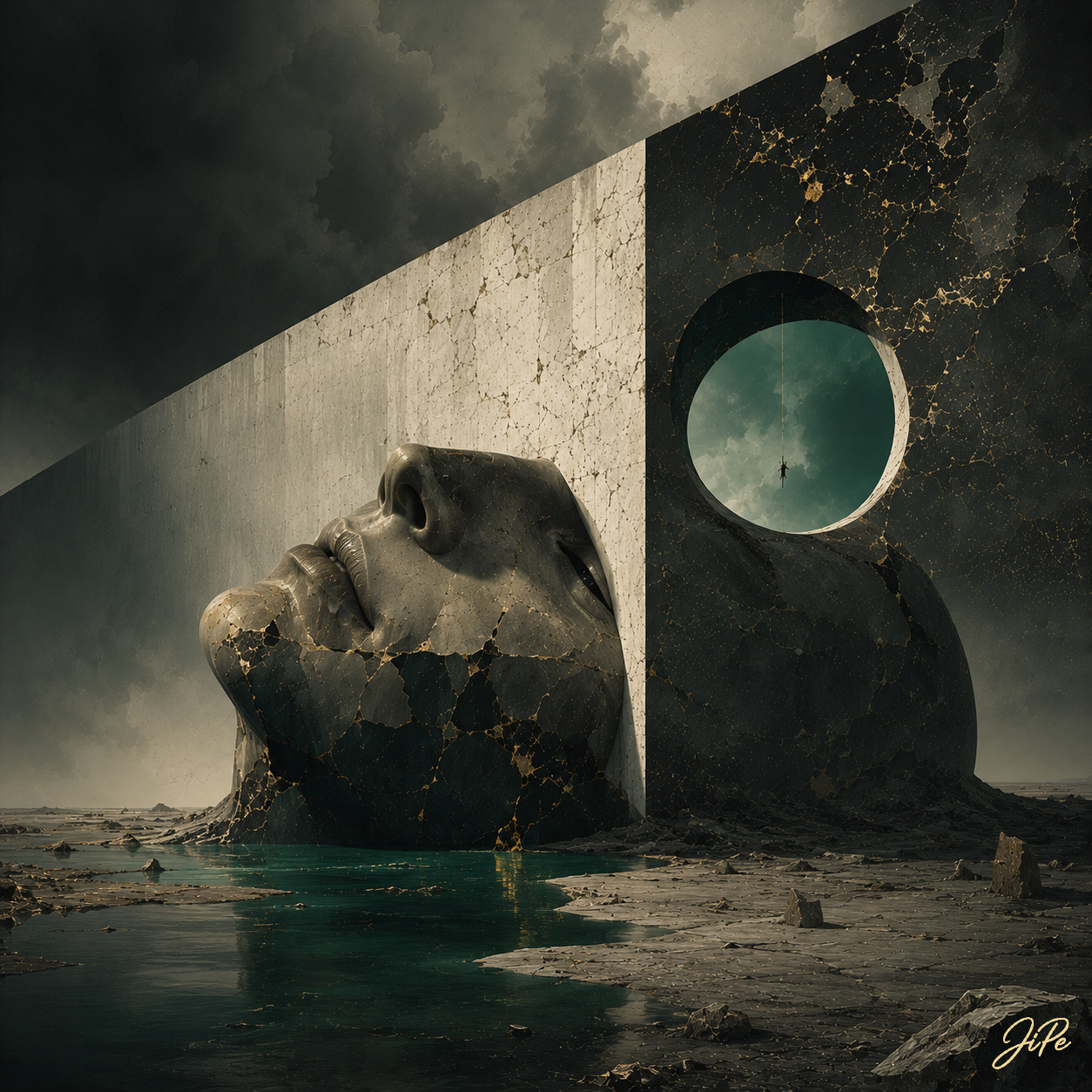
The monumental face rising behind the woman reinforces this meditation on memory. Weathered, fractured, and illuminated by delicate seams of gold, it recalls archaeological remains uncovered after countless centuries. Yet unlike ordinary ruins, this face appears alive within its fragmentation. It is not collapsing.
It is remembering.
Its cracks evoke the Japanese philosophy of kintsugi, where fractures are not concealed but transformed into places of beauty through gold. JiPe repeatedly employs this symbolic language throughout his artistic practice, suggesting that both civilizations and individuals become most profound where they have endured suffering.
Brokenness is not presented as failure.
It becomes evidence of survival.
Light plays an extraordinary symbolic role within the painting. Warm golden illumination emerges through storm-dark skies, reflecting across the water and activating the fractured monument behind the central figure. Rather than functioning as conventional sunlight, the illumination appears almost metaphysical—as if memory itself radiates from beyond ordinary perception.
This light neither rescues nor judges.
It reveals.
It uncovers what history has allowed to disappear.
The female figure occupies an especially complex symbolic position. She is not portrayed as victim, queen, priestess, or goddess. Instead, she exists as a universal witness. Her exposed back emphasizes vulnerability while simultaneously suggesting openness to memory itself. Her downward gaze communicates contemplation rather than surrender, inviting viewers to understand her less as a character within a narrative and more as an embodiment of humanity confronting its forgotten past.
She carries no visible burden.
Yet she appears surrounded by the weight of countless unseen lives.
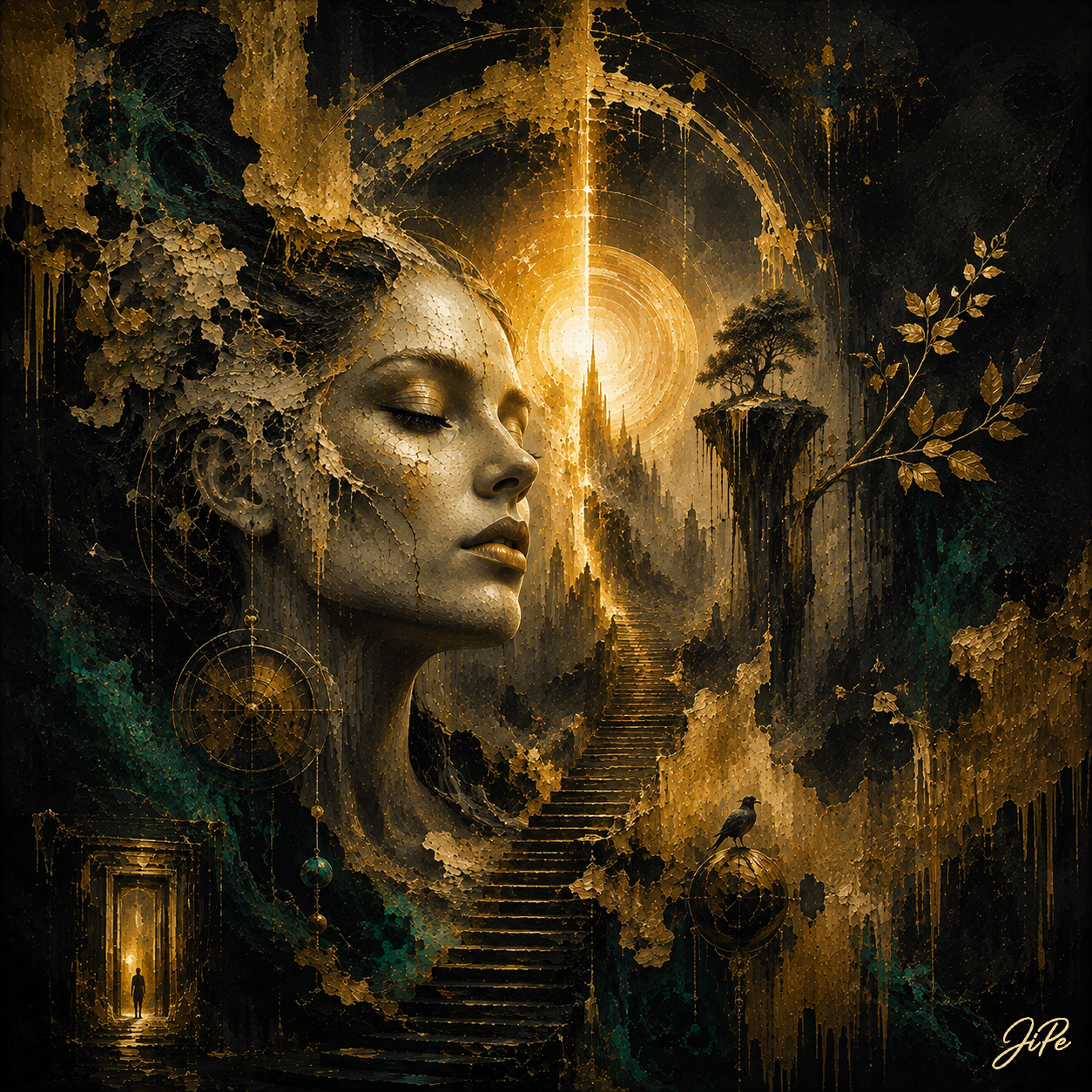
The landscape extending behind her deepens this symbolic framework. Small islands emerge from the water, supporting solitary trees, waterfalls, ancient architecture, and distant gateways illuminated by warm celestial light. These scattered fragments resemble memories drifting across consciousness—isolated yet mysteriously connected. Far in the distance, a lone human silhouette stands before a glowing portal, reinforcing one of the painting’s recurring themes: every soul ultimately stands alone before the unknown.
This secondary figure introduces another temporal layer.
Perhaps it is someone entering memory.
Perhaps someone leaving it.
Or perhaps someone discovering what has always existed beyond the visible horizon.
The composition itself demonstrates remarkable spatial sophistication. JiPe balances monumental verticality with expansive horizontal calm, allowing the immense face to dominate without overwhelming the central figure. The surrounding negative space enhances psychological depth, while carefully controlled reflections dissolve the distinction between physical reality and symbolic imagination.
The water functions simultaneously as mirror, threshold, and archive.
It reflects the present.
It conceals the past.
It suggests eternity.
Materiality contributes significantly to the painting’s emotional power. Although digitally created, the image evokes the tactile richness of layered oil painting and mixed-media surfaces. Cracked stone textures, weathered metallic gold, flowing reflections, and painterly clouds create a physical presence that recalls monumental frescoes eroded by centuries. The surfaces themselves seem to possess memory, as though time has become one of the painting’s invisible materials.
The restrained colour palette further strengthens the symbolic language. Deep charcoal, muted blue-black, antique gold, and luminous amber dominate the visual atmosphere. Occasional emerald undertones emerge subtly within the shadows, enriching the composition without disrupting its emotional unity. Gold remains the central symbolic colour throughout, representing remembrance, transcendence, and the enduring dignity of every human life.
From an art historical perspective, The Sea of Forgotten Souls occupies an intriguing intersection between contemporary visionary symbolism, surreal realism, monumental figurative painting, and mythopoetic narrative. Echoes of Symbolist painters, Romantic landscape traditions, and sacred iconography coexist with a distinctly modern cinematic sensibility. Yet the work avoids nostalgia by employing these historical references as visual vocabulary rather than imitation.
JiPe transforms familiar archetypes into something unmistakably contemporary.
Thematically, the painting explores one of humanity’s oldest existential questions: what becomes of those whom history forgets? The answer offered here is neither theological nor historical but profoundly poetic.
Nothing truly disappears.
Memory simply changes form.
Forgotten lives continue to exist—not necessarily within written history, but within the deeper architecture of existence itself.
The painting therefore challenges conventional understandings of remembrance. Public monuments celebrate famous individuals, while countless ordinary lives vanish from collective memory. JiPe quietly reverses this hierarchy. The anonymous become central. The invisible become monumental. The forgotten become eternal.
Emotionally, the work sustains a delicate equilibrium between melancholy and hope. The abundance of skulls initially evokes mortality, yet their transformation into luminous golden forms prevents despair from dominating the composition. Likewise, the immense fractured face appears wounded but not defeated. The central woman appears solitary but not abandoned.
Every element suggests continuity rather than extinction.
Perhaps forgetting is never absolute.
Perhaps memory survives in forms we cannot immediately recognize.
Ultimately, The Sea of Forgotten Souls is not a painting about death.
It is a painting about remembrance.
It asks whether a human life requires recognition to possess meaning, or whether existence itself leaves an indelible imprint upon the fabric of eternity. In this vision, every forgotten voice continues to resonate beneath the visible world, waiting for someone willing to listen beyond the noise of history.
Standing before this work, viewers may first be captivated by its monumental symbolism, dramatic atmosphere, and extraordinary visual craftsmanship. Yet with time, another realization quietly emerges. The painting ceases to depict forgotten souls as distant strangers.
Instead, it reminds us that every one of us is both the one who remembers…
and the one who hopes never to be forgotten.