Monumental Visionary Fine Art exploring mythology, consciousness, sacred light, and timeless visual storytelling.

Monumental Visionary Fine Art exploring mythology, consciousness, sacred light, and timeless visual storytelling.

Fantasy Paintings

The Keeper of Golden Wings

The Keeper of Golden Wings

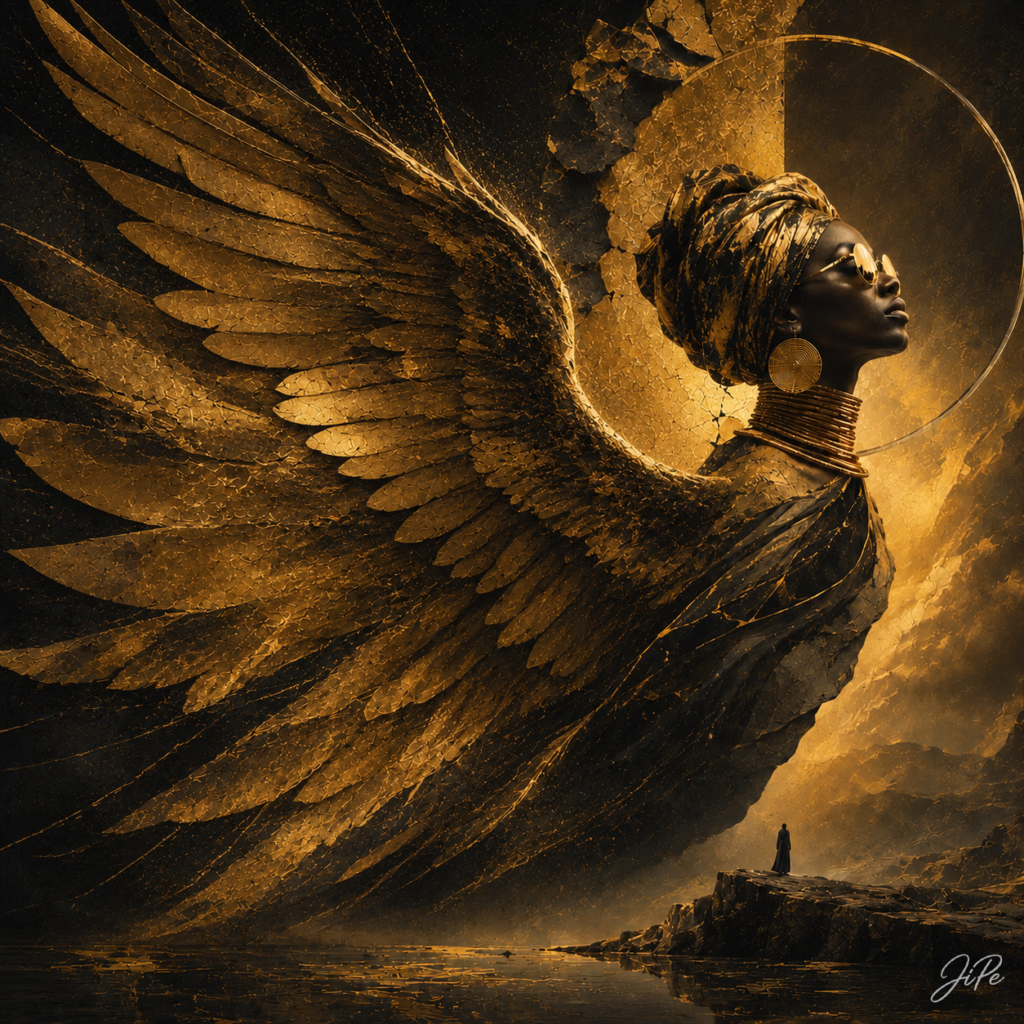
The Keeper of Golden Wings is a monumental meditation on guardianship, transcendence, and the enduring relationship between strength and grace. Blending contemporary visionary symbolism with monumental portraiture, mythological archetypes, and refined painterly realism, the work explores the idea that true guardianship is not rooted in power or conquest, but in wisdom, compassion, and the quiet responsibility of protecting what is sacred. Suspended between myth and philosophy, the painting presents an image that feels both timeless and profoundly contemporary, inviting viewers into a contemplative encounter with the unseen forces that shape the human spirit.

At the centre of the composition rises an immense winged figure whose presence dominates the surrounding landscape. Her body appears almost sculptural, emerging from darkness with quiet authority, while vast golden wings extend across the canvas like celestial architecture. Rather than depicting an angel in the traditional religious sense, JiPe creates an archetypal guardian—an embodiment of courage, dignity, memory, and spiritual protection. She belongs to no single mythology or belief system. Instead, she represents a universal presence that has appeared throughout human history under many different names and forms.

The title, The Keeper of Golden Wings, immediately establishes the painting’s symbolic framework. Wings have long represented freedom, transcendence, divine communication, and the capacity to move between worlds. Here, however, they are not simply instruments of flight. They become repositories of wisdom, each feather suggesting accumulated experience, sacrifice, resilience, and compassion. Gold transforms these wings into something beyond physical anatomy; they become manifestations of enlightenment itself, radiating an inner light that reflects not perfection but earned understanding.

The immense scale of the wings fundamentally shapes the viewer’s emotional experience. Stretching across nearly the entire composition, they create both shelter and awe. Their monumental presence dwarfs the solitary human figure standing below, yet rather than appearing threatening, they evoke protection. The traveller is not overwhelmed by power but embraced by it. In this subtle reversal, JiPe challenges conventional representations of greatness. True greatness does not dominate—it protects.

The guardian herself is portrayed in elegant profile, her gaze lifted beyond the visible horizon. Her closed lips and upward posture suggest profound inner stillness rather than outward action. She appears entirely self-contained, embodying the calm certainty that comes from complete alignment between purpose and being. Unlike heroic figures defined by dramatic movement or physical struggle, she communicates strength through absolute composure.

This composure becomes one of the painting’s most compelling psychological dimensions. In an age often characterised by urgency and conflict, The Keeper of Golden Wings proposes an alternative vision of power. Here, silence becomes strength. Stillness becomes authority. The work suggests that the highest forms of leadership emerge not through domination, but through presence, wisdom, and unwavering integrity.

The figure’s attire further reinforces this timeless symbolism. Wrapped in layered fabrics reminiscent of both ceremonial garments and contemporary abstraction, she appears suspended outside chronological history. Her elaborate head covering, elegant jewellery, and elongated neck rings draw subtle inspiration from diverse cultural traditions without belonging exclusively to any of them. JiPe intentionally avoids specific historical references, allowing the guardian to become a universal archetype that transcends geography, ethnicity, and time.

Behind the figure, a luminous circular form radiates like a celestial halo while simultaneously functioning as sacred geometry. Throughout JiPe’s artistic language, circles represent eternity, cosmic order, and the infinite continuity of existence. Here the circle frames the guardian’s head, transforming her into a symbolic bridge between earthly experience and higher consciousness. It is neither merely decorative nor explicitly religious; instead, it visualises the invisible harmony that underlies creation itself.

Light serves as the emotional architecture of the painting. Warm golden illumination emerges from behind the guardian, flowing outward through the wings and dissolving into surrounding darkness. Rather than functioning as natural sunlight, this radiance appears to originate from within the figure herself. Light becomes an expression of consciousness, compassion, and spiritual presence rather than physical illumination.

The dramatic chiaroscuro establishes one of the work’s defining visual tensions. Deep blacks and weathered charcoals coexist with radiant gold, producing a luminous atmosphere that feels simultaneously intimate and monumental. Darkness is never portrayed as negative. Instead, it functions as mystery—the vast unknown against which wisdom becomes visible. Gold does not conquer darkness; it simply reveals pathways through it.

Materiality plays an equally significant role. Rich impasto textures, cracked surfaces, distressed pigments, and subtle gold leaf effects create the impression of an ancient monument that has endured across countless centuries. The guardian appears weathered but never diminished. Time has marked her surface without erasing her presence. These visible fractures become symbolic of experience itself, suggesting that endurance and vulnerability coexist within every truly compassionate soul.

The solitary traveller positioned upon the rocky outcrop introduces the painting’s human dimension. Like many recurring figures throughout JiPe’s body of work, this anonymous individual functions as an archetype rather than a portrait. Standing before the immense guardian, the traveller represents humanity confronting something infinitely greater than itself—not with fear, but with quiet reverence.

The scale relationship between the figures carries profound philosophical meaning. Humanity appears physically insignificant, yet the traveller occupies a central compositional role. This subtle balance suggests that individual consciousness possesses equal importance within the larger cosmos. The guardian does not diminish human existence; she affirms its value by witnessing it.

The surrounding landscape further expands the painting’s symbolic vocabulary. Rocky terrain, reflective waters, and distant atmospheric horizons create a setting suspended between earthly geography and dreamlike metaphysical space. There is no identifiable location because the encounter takes place within an interior landscape as much as an external one. The environment becomes psychological, inviting viewers to interpret the scene as an encounter within their own consciousness.

The wings themselves remain the painting’s most remarkable achievement. Each feather appears individually articulated through layered painterly textures and luminous golden reflections. Their sweeping movement creates a visual rhythm that guides the viewer’s eye across the composition while simultaneously suggesting unseen currents of energy. Despite their immense scale, they possess extraordinary elegance, balancing monumental architecture with organic fluidity.

From an art historical perspective, The Keeper of Golden Wings synthesises influences from Symbolism, Romanticism, sacred portraiture, Renaissance monumentality, and contemporary visionary realism. Echoes of Byzantine iconography, Art Nouveau elegance, and mythological painting coexist within JiPe’s distinctly contemporary visual language, where cinematic composition merges seamlessly with textured mixed-media aesthetics and symbolic abstraction.

The work also reflects enduring archetypal traditions found throughout world mythology. Guardians, winged protectors, and celestial messengers appear across countless cultures—from Egyptian deities and Greek Nikai to Norse Valkyries, angelic beings, and spiritual protectors within Eastern traditions. JiPe deliberately refrains from depicting any one tradition directly. Instead, he distils their shared symbolic essence into a universal figure whose meaning remains open to personal interpretation.

Psychologically, the painting speaks to humanity’s deep longing for protection, guidance, and inner resilience. The guardian may be understood as an external spiritual presence, an ancestral memory, or the awakened higher self that exists within every individual. Her wings become symbols of qualities often neglected in contemporary life: patience, compassion, wisdom, courage, and silent perseverance.

Within JiPe’s broader artistic practice, The Keeper of Golden Wings continues his ongoing exploration of monumental symbolism, sacred geometry, transcendent light, and the relationship between human vulnerability and cosmic scale. Yet this work introduces a particularly refined expression of feminine strength. The guardian embodies neither aggression nor passivity, but an integrated form of power rooted entirely in awareness and grace.

The painting resonates especially strongly within today’s fragmented world. Surrounded by uncertainty and rapid change, viewers encounter an image that offers neither easy answers nor dramatic narratives. Instead, it presents a timeless reminder that genuine security arises not from external control but from inner equilibrium. The guardian does not promise rescue. She reminds us that courage already exists within those willing to seek it.

Perhaps the most extraordinary quality of The Keeper of Golden Wings is its profound silence. Despite the immense scale of the figure and the overwhelming presence of the wings, the painting never feels theatrical. Everything is suspended in perfect stillness, allowing contemplation to replace spectacle. The absence of visible action becomes its greatest emotional strength.

Ultimately, The Keeper of Golden Wings is a celebration of the invisible guardians that accompany every human journey. Whether understood as divine presence, conscience, memory, love, or awakened consciousness, the work reminds us that the greatest forms of protection rarely announce themselves. They remain quietly present, guiding without demanding attention, strengthening without seeking recognition.

Standing before this monumental vision, viewers are invited to recognise that the golden wings extend far beyond the boundaries of the canvas. They become metaphors for the unseen forces that lift humanity through moments of uncertainty, carry hope across generations, and remind us that true strength is measured not by the ability to conquer, but by the capacity to shelter, inspire, and illuminate the path of others. In this timeless encounter, JiPe transforms myth into meditation, revealing that every soul carries within it the possibility of becoming both traveller and guardian—both the one who seeks the light and the one who quietly keeps it alive.

Lämna ett svar