The Silence Before Creation’s First Word

The Silence Before Creation’s First Word is a contemplative vision of the moment that exists beyond history, beyond language, and beyond time itself. In this profound symbolic composition, JiPe does not attempt to depict the act of creation as an explosive beginning, but rather the infinite stillness that precedes every beginning—the sacred interval in which possibility exists before becoming reality. It is a painting about divine intention rather than divine action, about presence before movement, and about the immeasurable depth contained within silence itself.
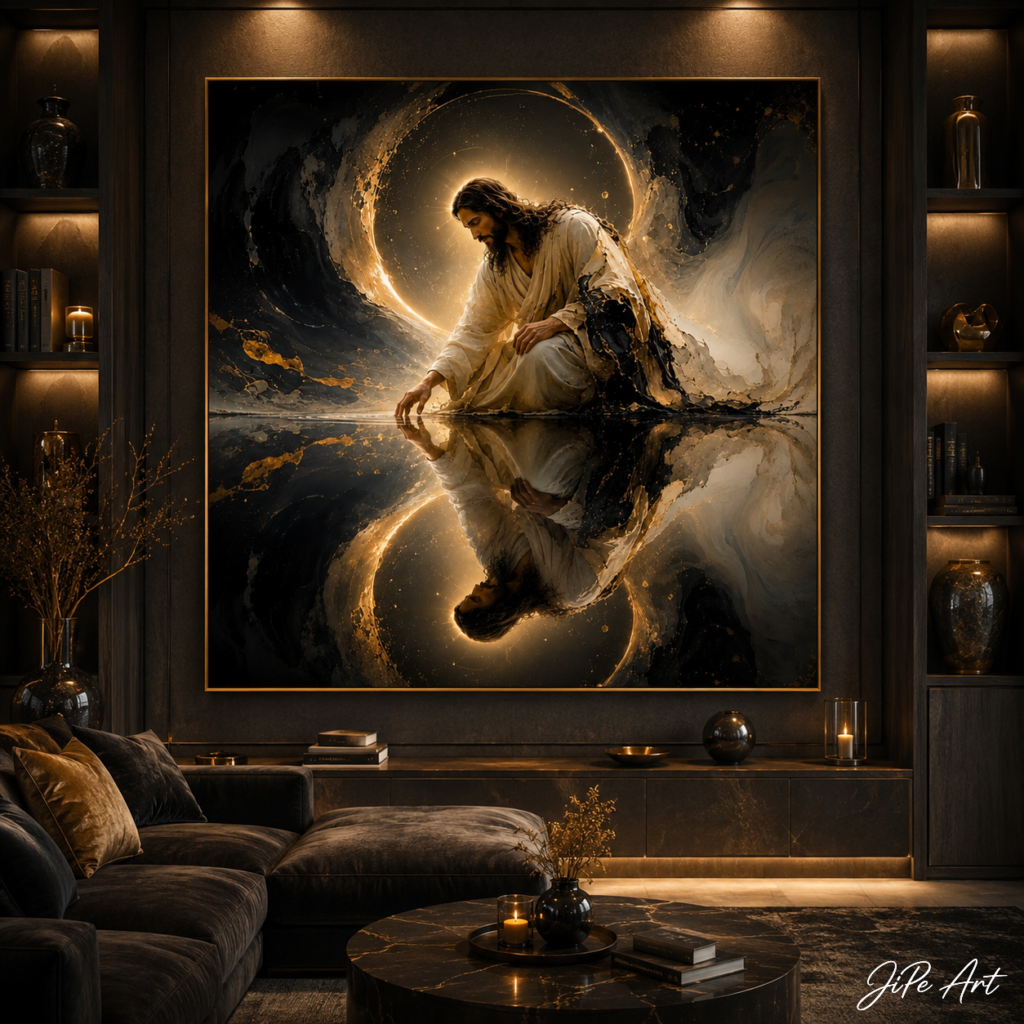
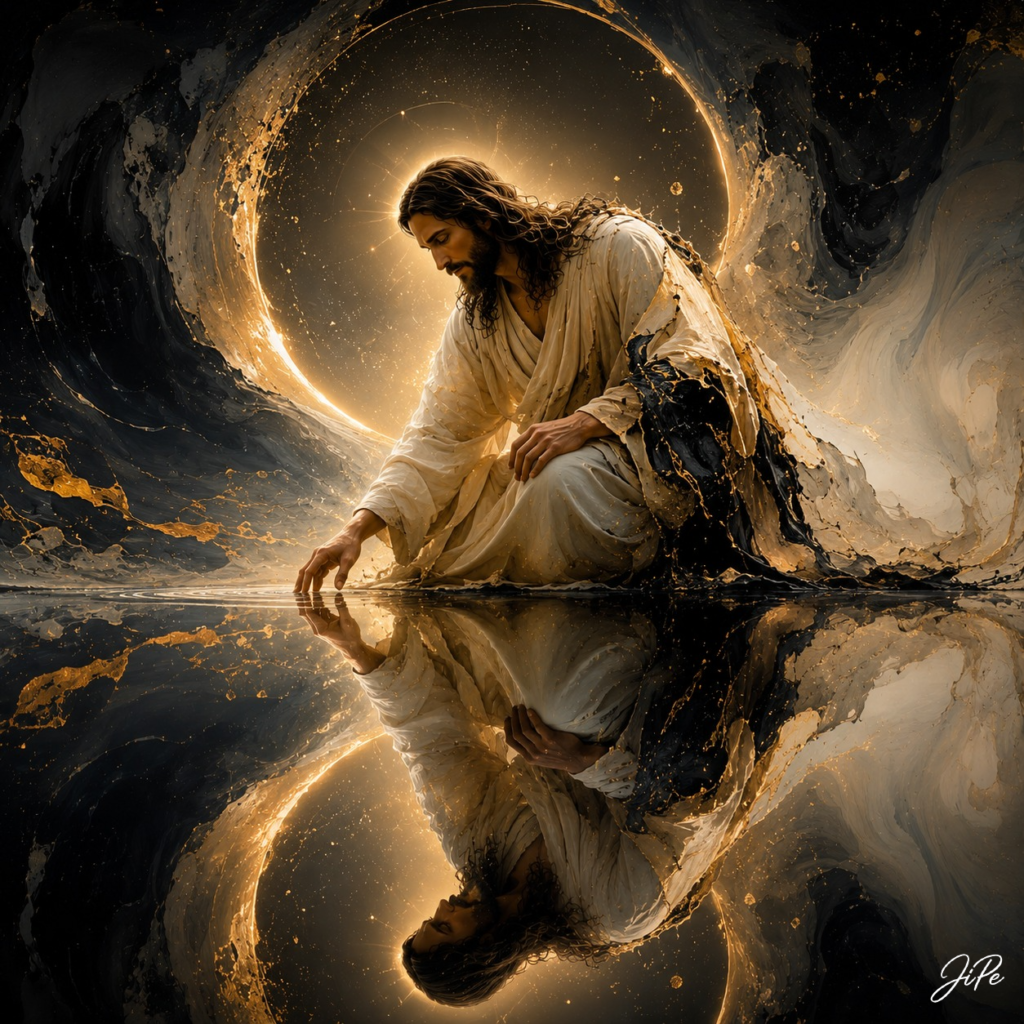
At the heart of the composition, a solitary figure clothed in flowing white robes kneels before an endless reflective surface. His hand gently touches the water, creating the slightest ripple upon an otherwise perfectly still world. Behind him, a radiant circle of golden light emerges from swirling abstract forms, enveloping the figure in an atmosphere that feels both cosmic and profoundly intimate. Beneath the surface, his reflection appears almost as tangible as his physical presence, dissolving the distinction between heaven and earth, spirit and matter, eternity and time.
Nothing dramatic occurs.
Nothing has yet been spoken.
And yet everything is already present.

The title, The Silence Before Creation’s First Word, immediately situates the viewer within one of humanity’s oldest philosophical and theological mysteries. Across countless spiritual traditions, creation begins not merely with action but with intention—with a moment of perfect stillness before sound enters existence. JiPe transforms this invisible threshold into visual form, suggesting that silence is not the absence of creation.
It is its foundation.
It is the space where every possibility already exists.
The kneeling figure naturally evokes Christ-like imagery through posture, garments, and compassionate presence, yet the work intentionally transcends literal religious illustration. Rather than depicting a historical event, JiPe presents an archetypal embodiment of divine consciousness. The figure becomes simultaneously Creator, Shepherd, Logos, Wisdom, and Eternal Presence—a universal symbol of the sacred relationship between infinite intelligence and the world waiting to emerge.
His gesture is remarkably restrained.
He does not command.
He does not conquer.
He simply reaches.
That quiet movement becomes the emotional centre of the entire composition.
The hand touching the water carries extraordinary symbolic significance. Throughout mythology, philosophy, and spiritual tradition, water frequently represents potentiality, the unconscious, memory, life, and the primordial state from which creation arises. Here, its perfectly reflective surface functions as more than a mirror.
It becomes the boundary between what already exists eternally…
and what has not yet entered time.
The gentle ripple generated by the fingertips suggests that creation itself begins almost imperceptibly. Great transformations are not always born from violence or spectacle. Sometimes they begin with the smallest movement—a thought, a word, a breath, a gesture.
The ripple becomes the first sentence of existence.
Light assumes its familiar yet ever-evolving role within JiPe’s symbolic language. The luminous golden halo surrounding the central figure recalls both solar imagery and sacred iconography while simultaneously functioning as an abstract portal beyond measurable space. It is neither sun nor moon.
It is origin.
The source from which illumination itself emerges.
Rather than flooding the composition, the light appears to breathe softly through the surrounding darkness, suggesting that revelation unfolds gradually rather than instantaneously.
The composition achieves extraordinary balance through reflection. The mirrored image beneath the water is not merely an optical effect but a philosophical statement. Reflection implies correspondence between visible and invisible realities. It recalls ancient mystical traditions in which earthly existence reflects a higher order beyond ordinary perception.
As above.
So below.
As within.
So without.
JiPe allows this ancient symbolic principle to structure the entire visual experience without ever making it explicit.
The surrounding environment dissolves into expressive abstract forms that resemble swirling clouds, liquid stone, cosmic dust, and painterly gestures simultaneously. Their ambiguity prevents the viewer from locating the scene within any recognizable geography. Instead, the painting exists within metaphysical space—a landscape before landscapes, a world before worlds.
Nothing has yet been named.
Everything waits to receive form.
Materiality contributes significantly to the work’s contemplative power. Although digitally created, the painting evokes richly layered oil paint, translucent glazes, and mixed-media textures. Sweeping brush-like movements coexist with cracked mineral surfaces and luminous gold leaf effects, creating a tactile quality that recalls both Renaissance devotional painting and contemporary visionary abstraction.
The textures themselves appear alive.
As though matter has not yet fully solidified.
As though creation remains in progress.
The restrained palette reinforces this atmosphere of sacred stillness. Ivory garments radiate softly against deep charcoal and muted black, while luminous gold defines every spiritual focal point. Subtle earth tones and delicate reflections prevent the composition from becoming theatrical, maintaining instead an atmosphere of quiet transcendence.
Gold here symbolizes far more than divinity.
It represents consciousness.
Truth.
The incorruptible essence from which all existence flows.
From an art historical perspective, The Silence Before Creation’s First Word occupies a unique intersection between visionary symbolism, sacred contemporary art, poetic realism, and metaphysical painting. Echoes of Byzantine iconography, Renaissance spirituality, Romantic atmosphere, and contemporary abstract expression coexist within a visual language that remains distinctly JiPe’s own. His synthesis of monumental symbolism with painterly intimacy transforms familiar religious imagery into something universally contemplative.
The painting’s greatest achievement lies perhaps in its refusal to illustrate doctrine. Instead of providing theological certainty, JiPe creates space for reflection. Christian viewers may recognize the eternal Logos before creation. Others may perceive the universal Creator, the cosmic architect, the awakened consciousness, or simply the profound mystery that precedes every beginning.
The painting welcomes interpretation.
It never demands one.
Psychologically, the work invites profound inward attention. Modern life is saturated with noise, speed, and constant activity. Here, however, stillness becomes the highest form of presence. The kneeling figure demonstrates that genuine creation does not emerge from haste but from perfect attentiveness.
Silence becomes active.
Stillness becomes creative.
Presence becomes transformative.
The water itself reinforces this psychological dimension. Reflection requires calmness. Disturbed water cannot faithfully mirror reality. Likewise, the human soul often discovers its deepest truths only after external noise has settled. JiPe quietly suggests that creation is not merely something performed by the divine.
It is also something continually unfolding within every human being willing to become still enough to receive it.
Ultimately, The Silence Before Creation’s First Word is a meditation on origins—not only the origin of the universe but the origin of every meaningful act, every work of art, every relationship, every prayer, every awakening. It reminds us that before every spoken word there exists listening. Before every creation there exists imagination. Before every transformation there exists surrender to silence.
Standing before this work, viewers may initially be captivated by its luminous beauty, masterful composition, and extraordinary atmosphere. Yet as the image gradually reveals its deeper rhythm, another realization quietly emerges.
Perhaps creation did not begin with sound alone.
Perhaps it first began with perfect stillness.
With a single hand reaching toward infinite possibility.
And with a silence so complete…
that it already contained every word the universe would ever speak.