Monumental Visionary Fine Art exploring mythology, consciousness, sacred light, and timeless visual storytelling.

Monumental Visionary Fine Art exploring mythology, consciousness, sacred light, and timeless visual storytelling.

Religious Paintings

The Infinite Passage

The Infinite Passage

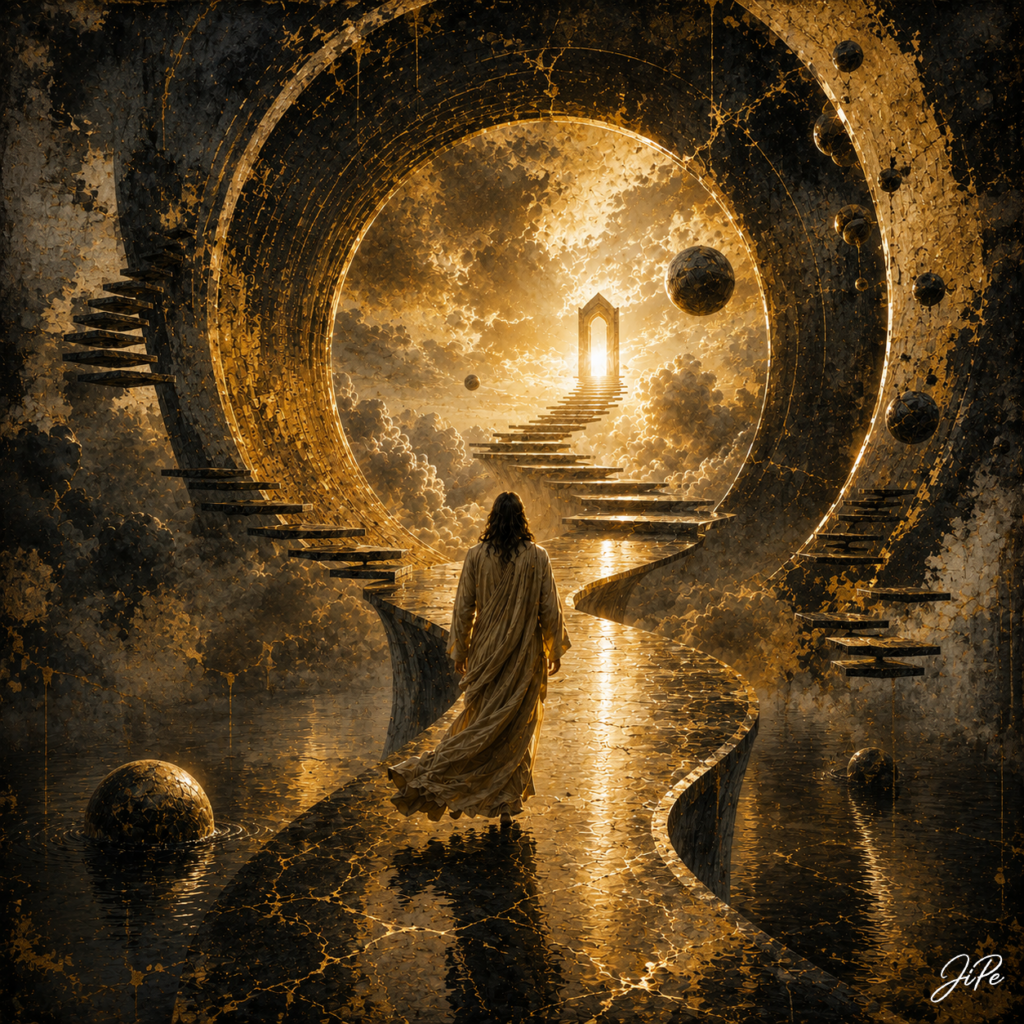
The Infinite Passage is a meditation on the eternal nature of the human journey—a symbolic exploration of consciousness, transformation, and the mysterious threshold that exists between the known and the unknowable. Rooted in the traditions of contemporary visionary art, symbolic painting, and metaphysical realism, the work invites viewers into a realm where architecture, light, and cosmic geometry become visual expressions of inner awakening rather than representations of physical reality. Rather than illustrating a destination, the painting contemplates the path itself, suggesting that existence is defined not by arrival, but by continuous movement toward deeper understanding.

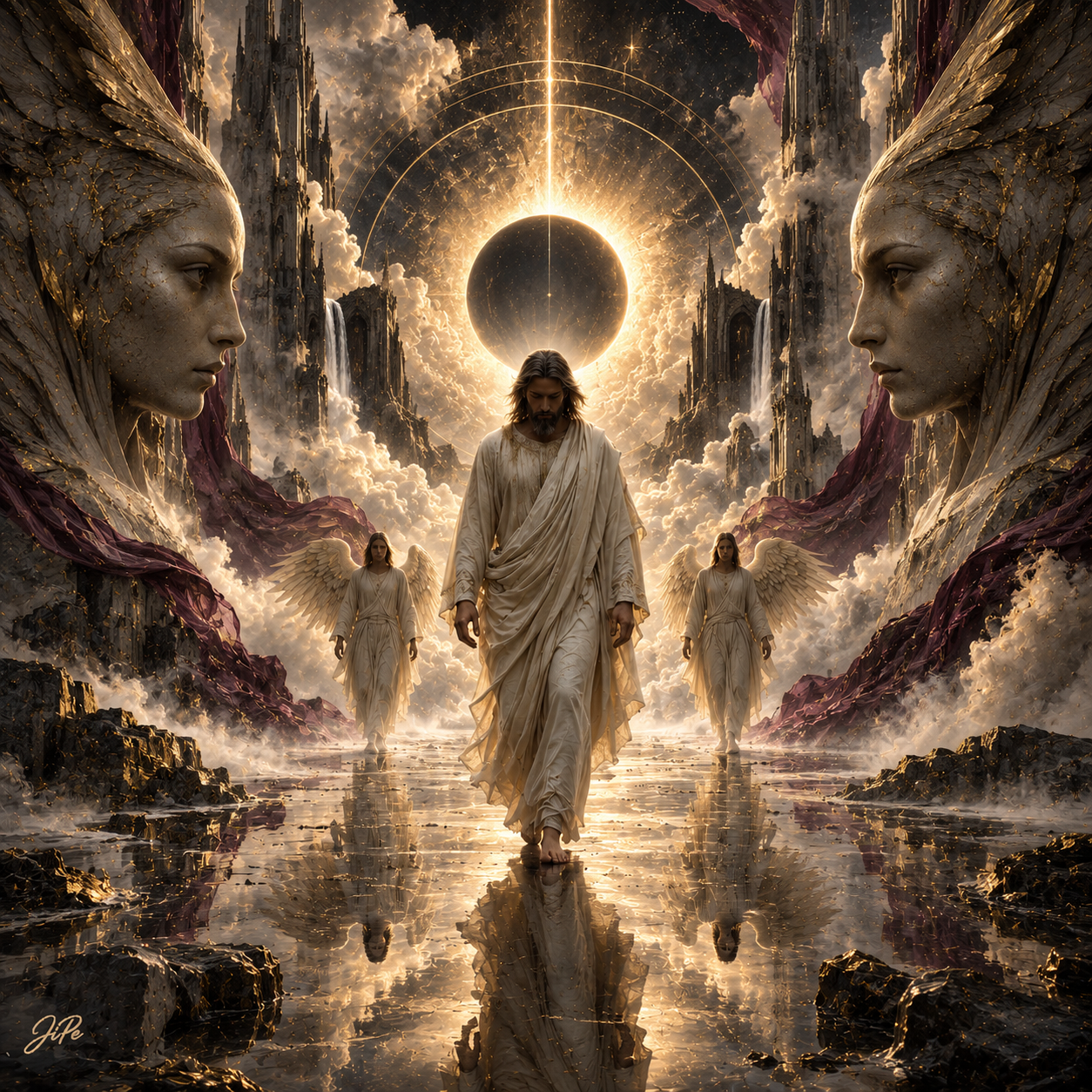
At the heart of the composition stands a solitary traveller, walking along a luminous pathway that rises through impossible space toward a radiant gateway suspended beyond the clouds. The figure remains anonymous, intentionally stripped of individual identity, allowing every viewer to project themselves into the narrative. This recurring archetype throughout JiPe’s work represents humanity itself—every individual who has ever questioned their place in the universe, sought meaning beyond material existence, or felt drawn toward something greater than the visible world.

The title, The Infinite Passage, establishes the painting as something more profound than a depiction of travel. The passage is not merely physical but existential. It represents the endless movement of consciousness through experience, memory, growth, loss, and renewal. Every step along the illuminated path becomes symbolic of personal evolution, reminding us that transformation is not achieved through singular moments of revelation but through countless quiet decisions made throughout a lifetime.

The composition is dominated by a vast circular architectural structure that frames the distant gateway. Throughout history, circles have symbolised eternity, unity, perfection, and the cyclical nature of existence. Here the monumental ring functions simultaneously as portal, celestial mechanism, sacred halo, and cosmic horizon. It encloses no walls, yet it defines an invisible threshold separating ordinary perception from transcendent awareness.

Its monumental scale immediately alters the viewer’s sense of proportion. Human presence becomes almost insignificant against the immense geometry of the universe, yet the traveller remains visually central. This tension between cosmic vastness and individual existence forms one of the painting’s most compelling philosophical dialogues. The work proposes that although humanity occupies only a tiny place within creation, every individual journey possesses immeasurable significance.

The pathway itself becomes one of the painting’s most powerful symbolic elements. It does not follow a straight trajectory but winds gracefully through space, suggesting that enlightenment is rarely achieved through direct progression. The curved road reflects the unpredictable nature of life, where uncertainty, detours, and unexpected transformations often reveal deeper truths than certainty ever could.

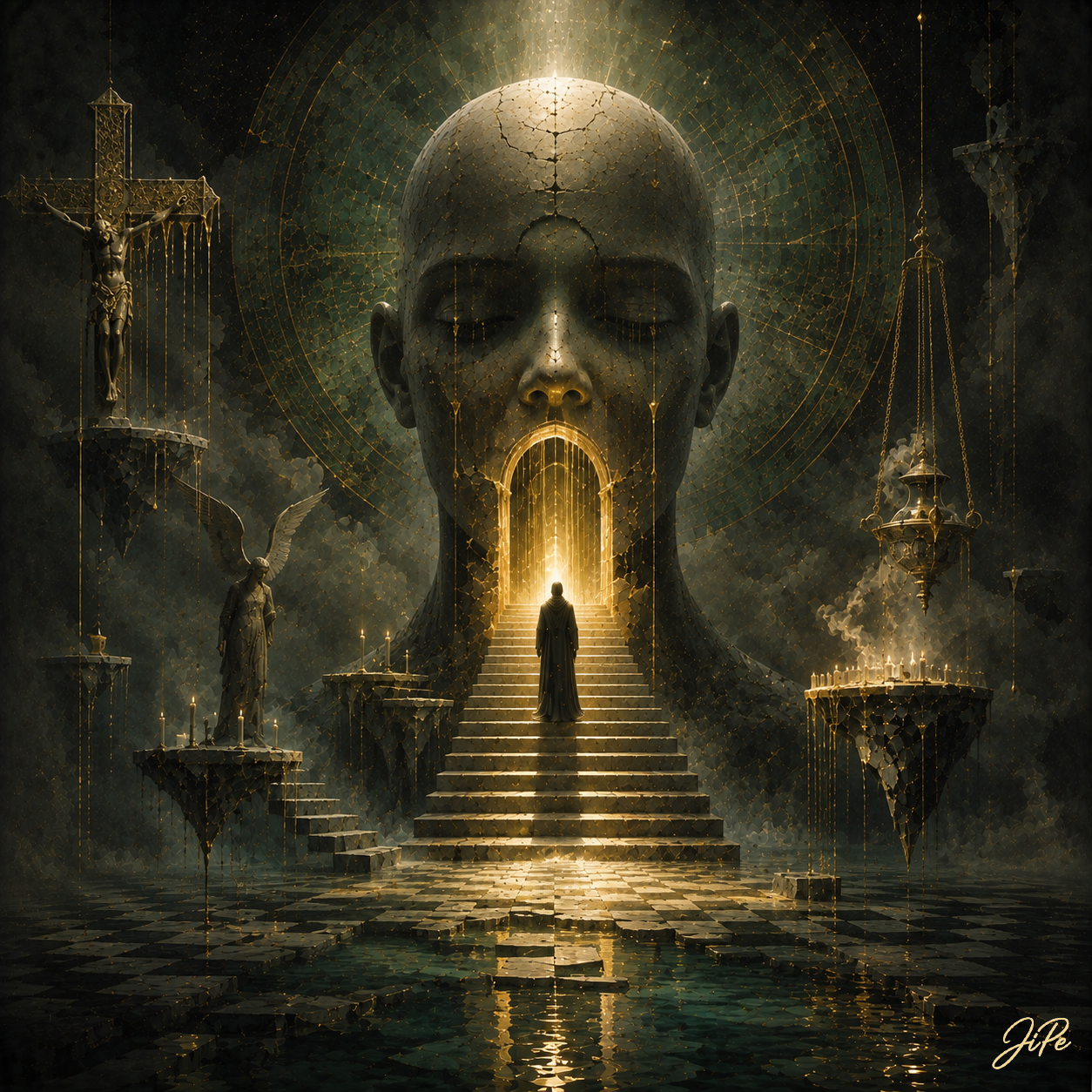
Floating staircases emerge throughout the composition, ascending and disappearing into unseen dimensions. Unlike traditional architectural forms, these fragmented steps refuse logical explanation. They appear suspended between construction and dissolution, functioning as metaphors for opportunities, choices, and alternate realities that accompany every stage of human existence. Some stairways lead upward while others seem to vanish into darkness, reminding viewers that every decision creates new possibilities while simultaneously closing others.

Surrounding the central pathway are floating celestial spheres that orbit the luminous portal like silent witnesses. These planetary forms evoke ideas of cosmic order, astronomical movement, and the interconnectedness of all existence. Their placement introduces a subtle rhythm into the composition, suggesting that the traveller’s journey unfolds within a universe governed by elegant but invisible harmonies.

Light functions as the painting’s primary narrative force. Rather than merely illuminating objects, it actively shapes the composition and guides emotional interpretation. A radiant golden brilliance pours through the distant gateway, flooding the surrounding clouds and reflecting across the pathway like liquid illumination. This light is not simply atmospheric—it becomes symbolic of consciousness, hope, wisdom, and transcendence.

The contrast between luminous gold and surrounding darkness establishes a visual dialogue that extends throughout the entire painting. Darkness is never portrayed as evil or threatening but as mystery itself—the fertile unknown from which insight emerges. Gold, by contrast, represents revelation rather than certainty. It is a living presence that continually invites movement forward without fully revealing what lies beyond the next threshold.

The restrained colour palette further reinforces this symbolic tension. Rich blacks, weathered charcoals, warm ochres, and radiant gold dominate the surface, creating an atmosphere that feels simultaneously ancient and timeless. The absence of unnecessary colour allows light itself to become the emotional language of the work. Every golden reflection upon the path appears to pulse with quiet energy, transforming the ground beneath the traveller into a bridge between earthly existence and metaphysical possibility.

Materiality also plays a significant conceptual role. Cracked surfaces, weathered textures, and layered painterly brushwork recall ancient frescoes, eroded monuments, and archaeological remains. The painting appears both newly created and impossibly old, existing outside chronological time. These richly textured surfaces remind viewers that every civilisation, every individual, and every idea carries visible traces of its own history.

Throughout the composition, fragments of sacred geometry subtly emerge within the circular architecture and surrounding space. These mathematical forms evoke the universal patterns found throughout nature, astronomy, and classical philosophy. Rather than serving decorative purposes, they suggest that beneath apparent chaos exists an underlying order that human consciousness continually seeks to understand.

The distant doorway becomes the painting’s emotional and philosophical focal point. Unlike conventional gates that separate one enclosed space from another, this portal opens directly into radiant light. It possesses neither visible walls nor physical destination. Instead, it represents possibility itself. The viewer is never shown what lies beyond because the unknown remains essential to the painting’s meaning. Mystery is preserved rather than resolved.

This deliberate ambiguity transforms the work into a deeply personal experience. Some viewers may recognise the gateway as a spiritual symbol of transcendence. Others may interpret it as enlightenment, memory, death, rebirth, creativity, or the future itself. The painting intentionally accommodates multiple readings without privileging any single interpretation. Its power lies precisely in its openness.

Art historically, The Infinite Passage synthesises influences from Symbolism, Romantic landscape painting, Renaissance concepts of sacred architecture, surreal spatial construction, and contemporary visionary realism. Echoes of Piranesi’s impossible architecture, Caspar David Friedrich’s contemplative solitude, and the metaphysical spaces of Giorgio de Chirico coexist within a distinctly contemporary visual language characterised by cinematic scale, layered mixed-media textures, and luminous gold illumination.

The painting also reflects recurring themes throughout JiPe’s artistic practice. The anonymous traveller, monumental portals, celestial geometry, and radiant pathways appear not as isolated motifs but as interconnected symbols within a broader visual philosophy exploring humanity’s search for meaning. Across the artist’s work, the journey consistently holds greater importance than arrival, while transformation emerges through quiet contemplation rather than dramatic spectacle.

Psychologically, The Infinite Passage speaks to the universal experience of becoming. Every individual encounters moments when familiar certainties dissolve and new directions remain invisible. The winding road symbolises these transitional periods, encouraging trust in movement even when outcomes cannot yet be understood. The traveller walks not because the destination is fully known, but because remaining still would mean abandoning the possibility of growth.

The painting carries particular resonance within contemporary society. In an era marked by rapid change, uncertainty, and constant distraction, The Infinite Passage offers a contrasting vision rooted in patience, reflection, and purposeful progression. It reminds viewers that genuine transformation cannot be hurried. Every meaningful journey unfolds through countless individual steps, each one contributing to an evolution that may only become visible in retrospect.

Perhaps the most remarkable achievement of the composition is its extraordinary sense of silence. Despite its immense scale and celestial grandeur, the painting radiates profound stillness. There is no conflict, no urgency, no visible struggle. The entire universe appears suspended in quiet anticipation, allowing viewers to experience not merely an image but a contemplative state of mind.

Ultimately, The Infinite Passage is not a painting about reaching heaven, escaping mortality, or solving the mysteries of existence. It is a celebration of the journey itself—the endless unfolding of awareness that accompanies every human life. It reminds us that every step toward wisdom also reveals new horizons, that every answer generates deeper questions, and that the greatest discoveries often occur while travelling between destinations rather than upon arrival.

Standing before this work, viewers are invited to recognise themselves within the solitary traveller. The luminous path extends beyond the boundaries of the canvas and into the imagination, becoming a metaphor for every choice, every transformation, and every unseen possibility that shapes a life. In this timeless vision, JiPe proposes that the passage is truly infinite because consciousness itself is infinite—forever moving, forever seeking, and forever illuminated by the distant light that continually calls us forward.

Lämna ett svar