
Monumental Visionary Fine Art exploring mythology, consciousness, sacred light, and timeless visual storytelling.

Monumental Visionary Fine Art exploring mythology, consciousness, sacred light, and timeless visual storytelling.

Nature Paintings

The Falling Light

The Falling Light
The Falling Light

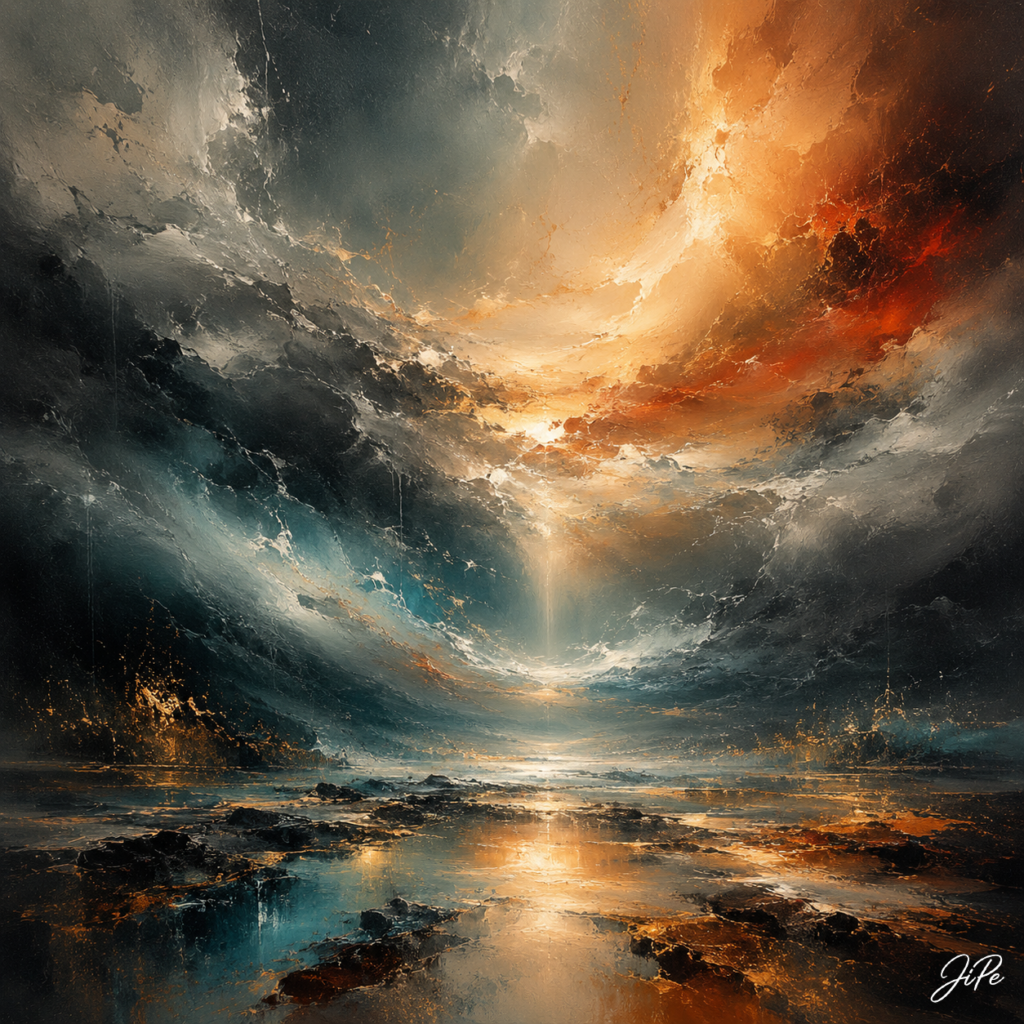
The Falling Light is a contemplative exploration of revelation, transformation, and the profound relationship between darkness and illumination. Rather than presenting light as a simple physical phenomenon, the painting transforms it into a symbolic force—an invisible presence descending through the fabric of the universe to touch the silent landscape below. Situated between abstract expression, visionary landscape painting, and contemporary symbolic realism, the work invites viewers into a realm where nature becomes metaphysical and atmosphere itself becomes the primary subject. It is less a depiction of a place than an emotional landscape, one in which light is experienced not merely as something seen, but as something deeply felt.

At first glance, the composition appears almost entirely devoted to sky. Vast, swirling masses of cloud dominate the canvas, their monumental movement suggesting both the immense scale of the cosmos and the intimate rhythms of human emotion. These clouds are not meteorological observations but painterly constructions that exist somewhere between abstraction and reality. Their sweeping forms create a sense of perpetual motion, as if the heavens themselves are slowly folding inward around a luminous centre.

Emerging from this immense celestial architecture is the painting’s defining element: a vertical column of radiant light descending from the opening in the clouds toward the reflective earth below. The beam is remarkably restrained. It neither explodes with dramatic force nor overwhelms the composition. Instead, it appears almost inevitable—a quiet descent that carries with it a profound sense of grace. The title, The Falling Light, suggests that illumination is not something humanity creates but something received, something that gently arrives from beyond conscious understanding.

The absence of human figures is particularly significant. Unlike many symbolic landscapes in which a solitary traveller serves as the viewer’s guide, here the landscape itself becomes the protagonist. This deliberate omission universalizes the experience. The viewer occupies the position of the silent observer, standing before an environment untouched by human intervention. The work therefore shifts attention away from narrative and toward pure contemplation, encouraging an emotional rather than literal reading of the image.

The horizon functions as an extraordinary point of equilibrium. It divides the celestial and terrestrial worlds while simultaneously uniting them through reflection. The still waters below mirror the luminous sky above, creating a visual symmetry that evokes philosophical ideas of correspondence between heaven and earth, spirit and matter, the infinite and the finite. Reflection becomes more than a compositional device; it becomes a metaphor for consciousness itself. What exists above is echoed below, suggesting that the external universe and the inner landscape may be inseparable.

Colour plays an essential symbolic role throughout the painting. Rich charcoal blues, cool greys, and muted turquoise tones establish a vast atmosphere of mystery, while brilliant amber, ochre, and luminous gold ignite the composition with extraordinary warmth. The juxtaposition of cool and warm colour temperatures is handled with exceptional sensitivity. Rather than competing, the two chromatic worlds seem to breathe together, reinforcing the central theme that darkness and light are complementary aspects of a single reality rather than opposing forces.

One of the painting’s most remarkable achievements lies in its treatment of light as substance. The luminous centre appears almost tangible, dissolving into translucent veils that gradually merge with surrounding clouds. Light possesses volume, density, and direction, transforming the atmosphere into something sculptural. It does not simply illuminate the scene—it becomes the architecture upon which the entire composition is built. Every cloud, reflection, and atmospheric transition exists because of its relationship to this descending illumination.

The expressive brushwork contributes enormously to the painting’s emotional resonance. Thick painterly textures, layered surfaces, and subtle impasto techniques create a dynamic material presence that recalls both traditional oil painting and contemporary mixed-media practices. The textured surface captures and reflects light in constantly changing ways, encouraging viewers to experience the work differently depending upon their physical position and surrounding environment. The painting therefore remains visually alive, continually revealing new nuances through its tactile complexity.

Despite its abstract tendencies, the composition maintains remarkable structural clarity. The sweeping arcs of cloud naturally direct the viewer’s gaze toward the central descent of light before leading it outward again across the reflective shoreline. This continuous visual movement creates a rhythm that mirrors the cyclical nature of breathing or meditation. There is no single focal point demanding immediate attention. Instead, the painting unfolds gradually, rewarding prolonged observation with increasing layers of symbolic meaning.

Art historically, The Falling Light establishes an elegant dialogue between several traditions. The sublime scale recalls the Romantic landscapes of artists such as J.M.W. Turner and Caspar David Friedrich, in which nature becomes a vehicle for spiritual contemplation. Simultaneously, its abstraction reflects twentieth-century explorations of atmospheric painting, while its symbolic treatment of light aligns it with visionary contemporary art that seeks to bridge emotional experience with metaphysical inquiry. Rather than belonging entirely to any single movement, the work synthesizes these traditions into a distinctive contemporary visual language.

The painting also explores one of art’s oldest symbolic subjects: light as revelation. Across cultures and throughout history, light has represented knowledge, transcendence, hope, divine presence, and awakening. Yet The Falling Light avoids literal religious interpretation. Its symbolism remains intentionally open, allowing viewers from different philosophical, spiritual, or cultural backgrounds to encounter the work through their own experiences. The descending illumination becomes a universal metaphor for insight itself—the unexpected moment when clarity emerges from uncertainty.

Equally important is the painting’s treatment of darkness. The surrounding storm clouds are never portrayed as threatening or destructive. Instead, they possess extraordinary beauty, their layered complexity enhancing rather than diminishing the brilliance of the central light. Darkness becomes a necessary condition for revelation, suggesting that moments of uncertainty often precede the deepest understanding. The work therefore rejects simplistic oppositions between light and shadow, presenting both as essential components of transformation.

The reflective shoreline anchors the composition within physical reality while simultaneously dissolving it into abstraction. Scattered rocks emerge from shallow water like fragments of memory, their surfaces catching delicate traces of gold and blue. These small details establish scale without distracting from the immense atmosphere above. They remind viewers that even the most expansive cosmic experiences remain grounded in tangible reality.

Emotionally, the painting is characterised by profound stillness. Despite the immense movement suggested by the clouds, the overall atmosphere remains deeply peaceful. There is no violence in the storm, no urgency in the descent of light, and no dramatic narrative demanding resolution. Instead, the work offers a rare visual experience of quiet transformation. It suggests that the most significant changes often occur silently, beyond spectacle, through gradual illumination rather than sudden revelation.

The title itself carries poetic ambiguity. The Falling Light may refer to sunlight descending through clouds, but it also evokes the idea of light willingly entering darkness—not to conquer it, but to inhabit it. This subtle inversion transforms the painting into a meditation on generosity, presence, and grace. Light does not remain distant within the heavens; it chooses to descend, bridging the apparent separation between the celestial and the earthly.

Within the broader context of contemporary symbolic art, the work stands as a compelling example of how landscape can transcend representation to become philosophical inquiry. The environment depicted here is less geographical than psychological. Mountains disappear, horizons dissolve, and atmosphere becomes emotion. Viewers are invited not simply to observe the scene but to inhabit its silence, allowing the painting’s luminous architecture to unfold gradually within their own imagination.

Ultimately, The Falling Light is a visual meditation on hope, presence, and the enduring possibility of illumination. Through its monumental atmosphere, refined painterly language, harmonious colour palette, and profound symbolic depth, the painting transforms an elemental phenomenon into an experience of quiet transcendence. It reminds us that light is not merely something that reveals the world around us—it is also something capable of revealing the unseen landscapes within us.

Standing before this work, one is left with the sense that illumination is never forced, never possessed, and never fully explained. It simply arrives, gently descending through the vastness of existence, touching both earth and consciousness with equal grace. In that silent descent lies the enduring power of The Falling Light—a reminder that even amidst uncertainty, there remains a luminous presence patiently finding its way toward us.

Lämna ett svar