
The Final Journey
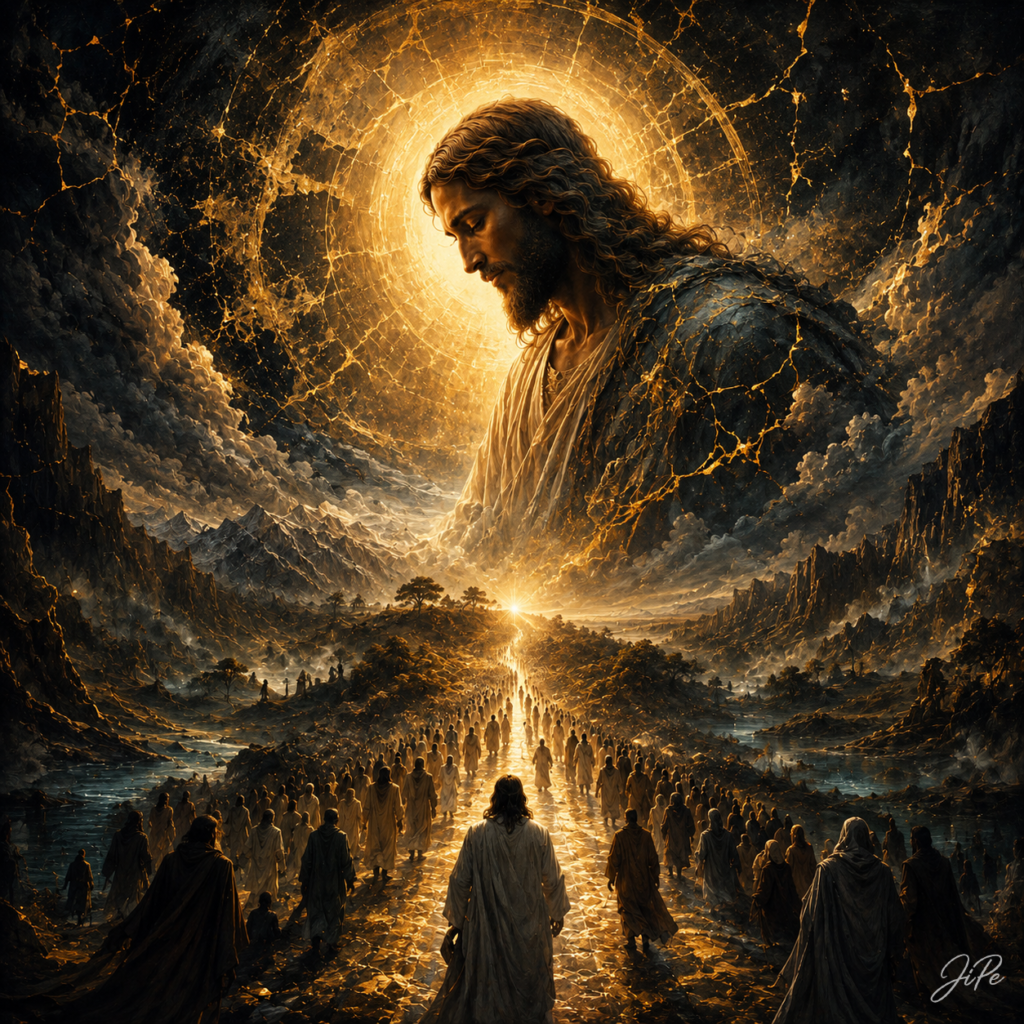
The Final Journey is a monumental meditation on transcendence, hope, and the timeless human longing to return to the source from which all life begins. Existing at the intersection of visionary symbolism, sacred narrative, and contemporary monumental realism, the painting transforms one of humanity’s oldest spiritual archetypes—the journey home—into an expansive visual experience that speaks simultaneously to faith, memory, mortality, and eternal renewal. Rather than illustrating a specific religious event, the work presents an archetypal pilgrimage, inviting viewers of every background to contemplate the universal passage from the temporal world toward a greater reality beyond human understanding.
At the heart of the composition rises the immense celestial figure whose bowed head dominates the heavens with extraordinary serenity. Suspended between clouds, light, and cosmic geometry, this monumental presence watches over the unfolding landscape without judgment or command. His downward gaze is filled with profound compassion, suggesting not authority through power, but authority through infinite understanding. The figure appears less as a distant ruler than as an eternal witness—one who accompanies every soul throughout its earthly journey.
The title, The Final Journey, immediately establishes the work as both destination and process. The word final does not imply an ending in the ordinary sense but rather the completion of a lifelong pilgrimage. It suggests fulfilment rather than loss, arrival rather than disappearance. The painting proposes that every human life is part of a greater movement toward light, wisdom, and reconciliation—a journey measured not by distance but by spiritual transformation.
The composition unfolds with remarkable narrative clarity while maintaining profound symbolic openness. In the foreground, countless figures advance together along a luminous pathway that stretches across the landscape toward an overwhelming point of radiant light. Individually they appear anonymous, yet collectively they become humanity itself. There are no distinctions of status, wealth, age, or identity. Every figure walks the same road, reminding viewers that beneath all earthly differences lies a shared destiny and a common search for meaning.
The central pathway functions as far more than a physical road. It becomes a visual axis connecting earth and heaven, humanity and eternity, the visible and the invisible. Constructed almost entirely from light, it recalls ancient symbolic traditions in which roads represent inner transformation rather than geographical travel. Every step taken along this glowing path appears simultaneously physical and spiritual, suggesting that true progress occurs within the soul as much as within the world.
Towering above this procession is an immense halo composed of luminous concentric circles and delicate networks of radiant fractures. These geometric forms evoke sacred architecture, celestial maps, and the symbolic perfection of the circle throughout art history. Their presence introduces a cosmic order underlying the entire composition, suggesting that existence itself follows patterns extending far beyond human perception. The halo is not merely decorative; it becomes the visual manifestation of eternity surrounding the compassionate figure at the centre of the heavens.
Light is unquestionably the painting’s primary language. Golden illumination flows through every element of the composition, uniting mountains, rivers, clouds, and humanity into a single harmonious vision. Yet this light never appears artificial or theatrical. Instead, it possesses remarkable emotional subtlety. It radiates quietly from the horizon before gradually expanding across the landscape, dissolving boundaries between physical matter and spiritual presence. Light here becomes synonymous with hope itself—not something imposed upon the world, but something emerging naturally from its deepest foundations.
The surrounding landscape reinforces the painting’s universal symbolism. Towering mountain ranges frame the valley with monumental dignity, while winding rivers and fertile plains suggest the continuity of life despite humanity’s continual movement through history. The mountains may be understood as symbols of permanence and endurance, standing in contrast to the transient procession below. Together they establish an environment where earthly existence unfolds beneath the silent witness of eternity.
One of the painting’s greatest strengths lies in its extraordinary sense of scale. The monumental celestial figure occupies the heavens while thousands of tiny human forms gradually disappear toward the radiant horizon. This dramatic contrast between the immense and the intimate evokes the sublime traditions of Romantic painting while simultaneously remaining deeply personal. Each individual figure matters precisely because of its smallness. Rather than diminishing humanity, the immense scale of the divine presence amplifies the significance of every single traveller.
The painterly treatment of texture contributes significantly to the work’s emotional power. Rich impasto surfaces, fractured gold leaf effects, weathered stone textures, and layered atmospheric brushwork create an image that feels simultaneously ancient and contemporary. The visible cracks spreading through the celestial geometry never suggest decay. Instead, they recall the philosophy of kintsugi, in which fractures become visible expressions of resilience and transformation. What has endured time becomes more beautiful precisely because it carries the marks of its history.
The restrained palette of charcoal, ivory, warm earth tones, and luminous gold establishes a visual harmony that enhances the contemplative atmosphere. Gold functions throughout the work as a symbolic material rather than simply a colour. Across civilizations, gold has represented incorruptibility, sacred presence, enlightenment, and eternal value. Within The Final Journey, its luminous qualities become the visual language of transcendence itself, guiding both the eye and the imagination toward the distant point of arrival.
The bowed posture of the celestial figure deserves particular attention. Unlike many traditional depictions of divine authority, the figure does not confront the viewer directly. Instead, the lowered head communicates humility, empathy, and intimate presence. This subtle gesture transforms the relationship between humanity and the divine from one of hierarchy into one of companionship. The figure appears to accompany the travellers rather than merely await them, reinforcing the painting’s underlying message of unconditional guidance.
Compositionally, the work demonstrates exceptional sophistication. Every major structural line converges toward the central light on the horizon. Rivers, mountain valleys, processions of people, atmospheric perspective, and even the celestial halo direct attention toward this luminous destination. Yet despite this powerful visual movement, the composition never feels rushed. Instead, it unfolds gradually, allowing the eye to travel through successive layers of narrative and symbolism before finally arriving at the radiant centre.
Art historically, The Final Journey engages with multiple traditions simultaneously. It echoes the sublime landscapes of Romanticism, the symbolic aspirations of nineteenth-century visionary art, the monumental sacred narratives of Renaissance painting, and the contemporary language of cinematic realism. Yet it ultimately establishes its own distinctive voice through its seamless fusion of painterly texture, symbolic geometry, and emotionally accessible visual storytelling.
The absence of overt doctrinal symbolism further strengthens the painting’s universal character. While many viewers may recognise references associated with Christian iconography, the work intentionally remains open enough to accommodate broader interpretations. It speaks to anyone who has contemplated mortality, hope, forgiveness, or the possibility of existence beyond visible reality. The journey portrayed here belongs not exclusively to one tradition but to humanity as a whole.
Philosophically, the painting explores the relationship between individuality and collective existence. Each traveller follows the same illuminated path, yet every figure remains distinct within the larger procession. This delicate balance reflects one of the central paradoxes of human life: every individual journey is unique, yet every human being ultimately participates in the same universal search for truth, belonging, and transcendence.
Emotionally, the atmosphere is characterised by extraordinary serenity. Despite the immense scale of the landscape and the countless figures moving toward the horizon, there is no sense of fear or urgency. The procession advances with quiet confidence, suggesting acceptance rather than uncertainty. Even the vast celestial figure radiates peace instead of overwhelming power. The result is a work that replaces anxiety surrounding mortality with profound reassurance, inviting contemplation instead of apprehension.
Ultimately, The Final Journey is not a painting about death but about fulfilment. It proposes that the conclusion of earthly existence is not an ending but the completion of a much greater narrative—a return to light after a lifetime of searching. Through its monumental composition, luminous atmosphere, symbolic richness, and deeply compassionate vision, the painting transforms one of humanity’s greatest mysteries into an image of extraordinary beauty and hope.
Standing before this work, viewers become participants in the silent procession themselves. The glowing path extends beyond the limits of the canvas, inviting each observer to imagine their own place within the endless movement toward illumination. In that moment, The Final Journey ceases to be merely a painting and becomes a timeless meditation on faith, humanity, and the enduring belief that every sincere step taken through life ultimately leads toward light.