Monumental Visionary Fine Art exploring mythology, consciousness, sacred light, and timeless visual storytelling.

Monumental Visionary Fine Art exploring mythology, consciousness, sacred light, and timeless visual storytelling.

Surreal Paintings

The Face Beyond Time

The Face Beyond Time

The Face Beyond Time is a monumental meditation on eternity, memory, and the silent dimensions that exist beyond the measurable flow of human existence. Existing at the intersection of visionary symbolism, surreal realism, and contemporary monumental art, the work transforms the human face into an architectural presence suspended between sculpture, landscape, and cosmic revelation. Rather than portraying a specific individual, the painting becomes an archetype of consciousness itself—a timeless witness standing beyond history, beyond chronology, and beyond the limitations of ordinary perception. It invites viewers to contemplate one of humanity’s oldest philosophical questions: what remains when time itself ceases to define existence?

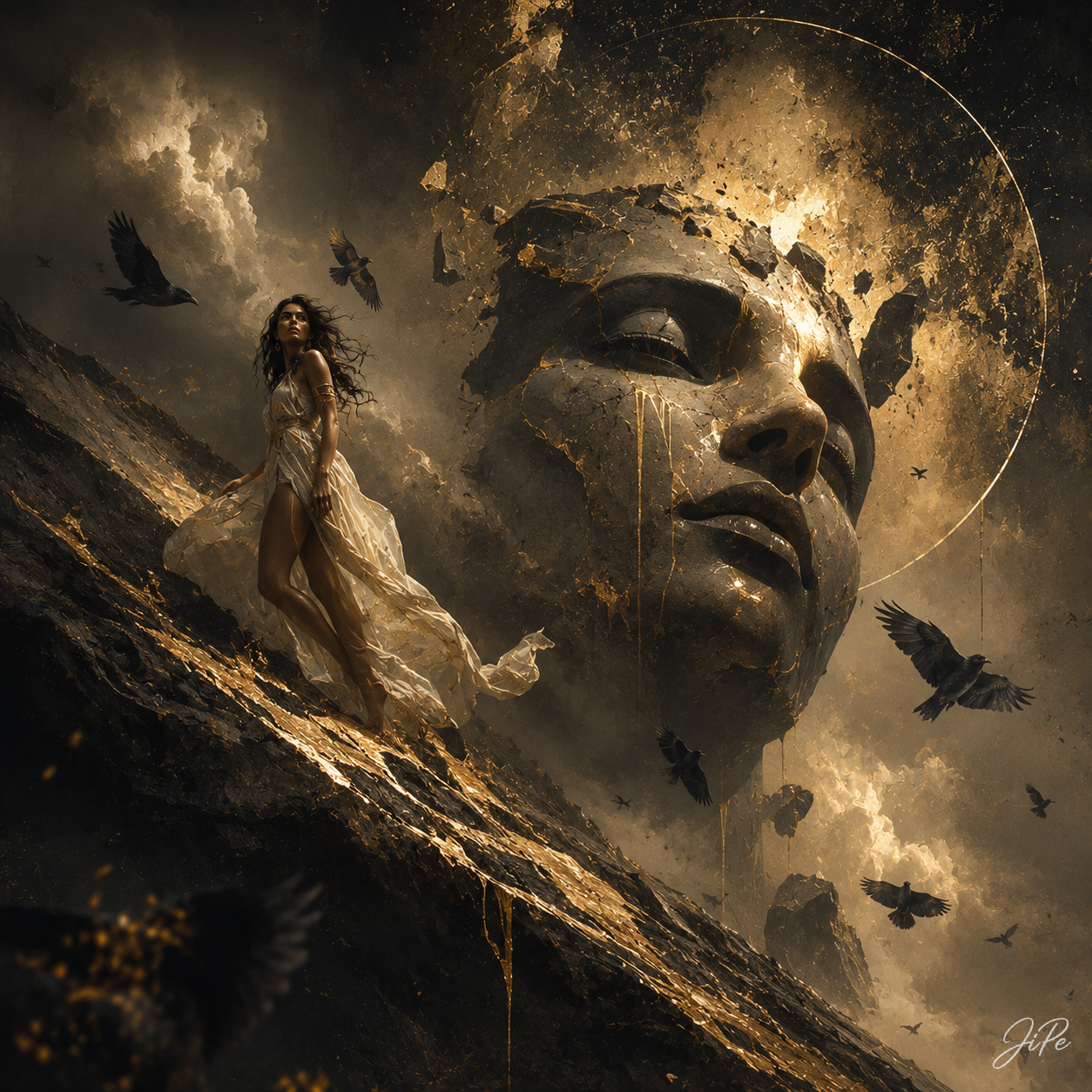
At the centre of the composition stands the immense profile of a weathered face emerging from a colossal vertical monolith. Its eyes are peacefully closed, suggesting contemplation rather than sleep, while delicate fractures spread across the stone-like surface like ancient geological maps recording countless ages. The face appears neither born nor constructed; instead, it seems to have slowly revealed itself from the very substance of the earth. It exists somewhere between monument and living presence, suggesting that wisdom is not created in a moment but accumulated across immeasurable spans of existence.

The title, The Face Beyond Time, immediately shifts the work beyond conventional narrative. This is not simply a portrait placed within an extraordinary landscape. It is an image that asks viewers to imagine consciousness existing outside chronological sequence. The monumental face becomes a symbolic embodiment of timeless awareness—a state in which past, present, and future dissolve into a single moment of complete stillness. Rather than illustrating eternity, the painting attempts to make eternity emotionally visible.

The composition achieves its extraordinary impact through the dialogue between two vastly different scales. Standing upon the rocky plateau is a solitary cloaked traveller whose small silhouette serves as the emotional anchor of the entire work. Although almost insignificant beside the colossal monument, this lone figure becomes the viewer’s representative within the scene. The traveller is not overwhelmed by the monument but drawn toward it, suggesting that the human search for meaning naturally leads beyond the measurable world toward questions that cannot be answered by time alone.

Separating the traveller from the monumental face is an extraordinary vertical beam of radiant golden light. This luminous division functions simultaneously as doorway, threshold, fracture, and axis. It appears to split reality itself into two dimensions while also connecting them. Architecturally it recalls the opening of an immense gate; spiritually it resembles revelation made visible. The light is not simply illumination—it becomes a symbolic passage between the temporal and the eternal, between finite existence and infinite awareness.

The work masterfully balances monumentality with intimacy. Although the face dominates nearly half the composition, its expression remains remarkably gentle. The lowered eyelids, relaxed lips, and subtle inclination of the head communicate profound serenity rather than authority. There is no sense of judgment or command. Instead, the figure appears absorbed in silent contemplation, inviting viewers to participate rather than merely observe. The monument becomes less an object of worship than a mirror reflecting humanity’s own hidden capacity for transcendence.

Light plays the defining role throughout the painting. The warm golden radiance emerging from the central divide contrasts beautifully with the expansive atmospheric landscape unfolding toward the distant horizon. On the left, the setting sun pours its final rays across the reflective earth, creating an immense visual dialogue between natural light and metaphysical illumination. The sun represents the familiar rhythm of earthly time—the daily cycle of dawn and dusk—while the vertical beam represents another form of light altogether: timeless, unwavering, and untouched by celestial movement. Their coexistence creates one of the painting’s most profound symbolic relationships.

The surrounding landscape reinforces this philosophical tension. The immense sky is filled with dramatic cloud formations whose illuminated edges suggest continual transformation. Clouds traditionally symbolize impermanence, movement, and the passage of time. Against this constantly changing atmosphere stands the immovable face, unchanged by weather, light, or season. The painting therefore establishes a visual opposition between transient phenomena and eternal presence, allowing viewers to experience both simultaneously within a single composition.

Materiality is equally significant. The colossal face possesses the appearance of weathered stone, its cracked surface recalling ancient sculpture, eroded cliffs, and archaeological relics. Yet the fractures shimmer with veins of luminous gold that seem to pulse quietly beneath the surface. These cracks never communicate destruction. Instead, they suggest accumulated experience—the visible record of endurance transformed into beauty. Like the philosophy of kintsugi, the work proposes that what survives time becomes more valuable precisely because it carries the marks of its journey.

The restrained colour palette contributes enormously to the painting’s emotional atmosphere. Rich charcoal blacks establish immense depth, while warm ochres and luminous gold dominate the visual field with extraordinary elegance. Gold functions here not merely as a colour but as symbolic language. Throughout art history, gold has represented transcendence, incorruptibility, sacred illumination, and eternal value. Within this work it becomes the visual expression of consciousness itself, emerging from darkness without violence or spectacle.

Compositionally, the painting demonstrates exceptional sophistication. The massive face occupies the right-hand side with commanding stability, while the expansive landscape opens toward the left in sweeping perspective. This asymmetrical balance creates both tension and harmony. The eye naturally travels from the distant sunset across the open plain toward the solitary traveller before finally arriving at the monumental face and the radiant vertical threshold. Every compositional decision reinforces the painting’s central theme: the journey from external reality toward inner revelation.

The deliberate use of negative space further strengthens this experience. Vast expanses of sky and landscape surround the principal figures, creating a profound sense of silence. Rather than filling every area with visual information, the composition allows emptiness to become meaningful. This restraint recalls traditions of contemplative painting in which space itself becomes a medium for meditation. The silence surrounding the monument becomes as important as the monument itself.

Art historically, The Face Beyond Time establishes a compelling dialogue between multiple traditions. The monumental scale recalls the sublime ambitions of Romantic landscape painting, while the symbolic architecture evokes the metaphysical aspirations of Symbolism. The sculptural qualities suggest classical antiquity, yet the fractured textures and luminous surfaces firmly position the work within contemporary visionary realism. The painting therefore exists simultaneously within historical continuity and contemporary innovation, creating a visual language that feels both ancient and remarkably modern.

Philosophically, the work explores one of humanity’s deepest aspirations: the desire to discover something enduring beneath the continual movement of life. Time governs every visible aspect of existence—growth, change, memory, and mortality. Yet throughout history, artists, philosophers, and spiritual traditions have imagined a dimension existing beyond chronological sequence. The monumental face does not provide answers to this mystery. Instead, it offers an image through which the mystery itself becomes emotionally accessible.

The solitary traveller plays a crucial symbolic role in this interpretation. Standing before the immense threshold, the figure represents humanity at the edge of understanding. There is no visible action, no dramatic gesture, and no narrative climax. Instead, the power of the image lies in anticipation. The traveller has arrived at a place where transformation becomes possible, but the decision to cross the threshold remains internal rather than physical. This quiet restraint grants the painting extraordinary psychological depth.

The emotional atmosphere is characterised by profound stillness. Despite the immense scale of the landscape and the dramatic luminosity of the sky, nothing feels chaotic. Every element contributes to an overwhelming sense of calm contemplation. The painting suggests that true revelation does not emerge through noise or movement but through attentive silence. The greatest discoveries often occur not in moments of action but in moments of complete presence.

Ultimately, The Face Beyond Time is an invitation to contemplate existence from a perspective untouched by ordinary chronology. Through its monumental symbolism, luminous atmosphere, refined composition, and philosophical depth, the work transforms the concept of eternity into a deeply human experience. It reminds viewers that beneath the continual movement of days, years, and generations lies another reality—one measured not by clocks or calendars but by awareness itself.

Standing before this immense face, the solitary traveller becomes every viewer who has ever paused to ask what exists beyond the visible horizon of time. The painting offers no final answers, only a profound visual meditation on permanence, transformation, and the silent presence that endures when every passing moment has faded. In that silence, The Face Beyond Time reveals that eternity may not be a distant destination but a dimension quietly waiting within the present moment itself.

Lämna ett svar