Monumental Visionary Fine Art exploring mythology, consciousness, sacred light, and timeless visual storytelling.

Monumental Visionary Fine Art exploring mythology, consciousness, sacred light, and timeless visual storytelling.

Figurative Paintings

The Crown Beyond Time

The Crown Beyond Time

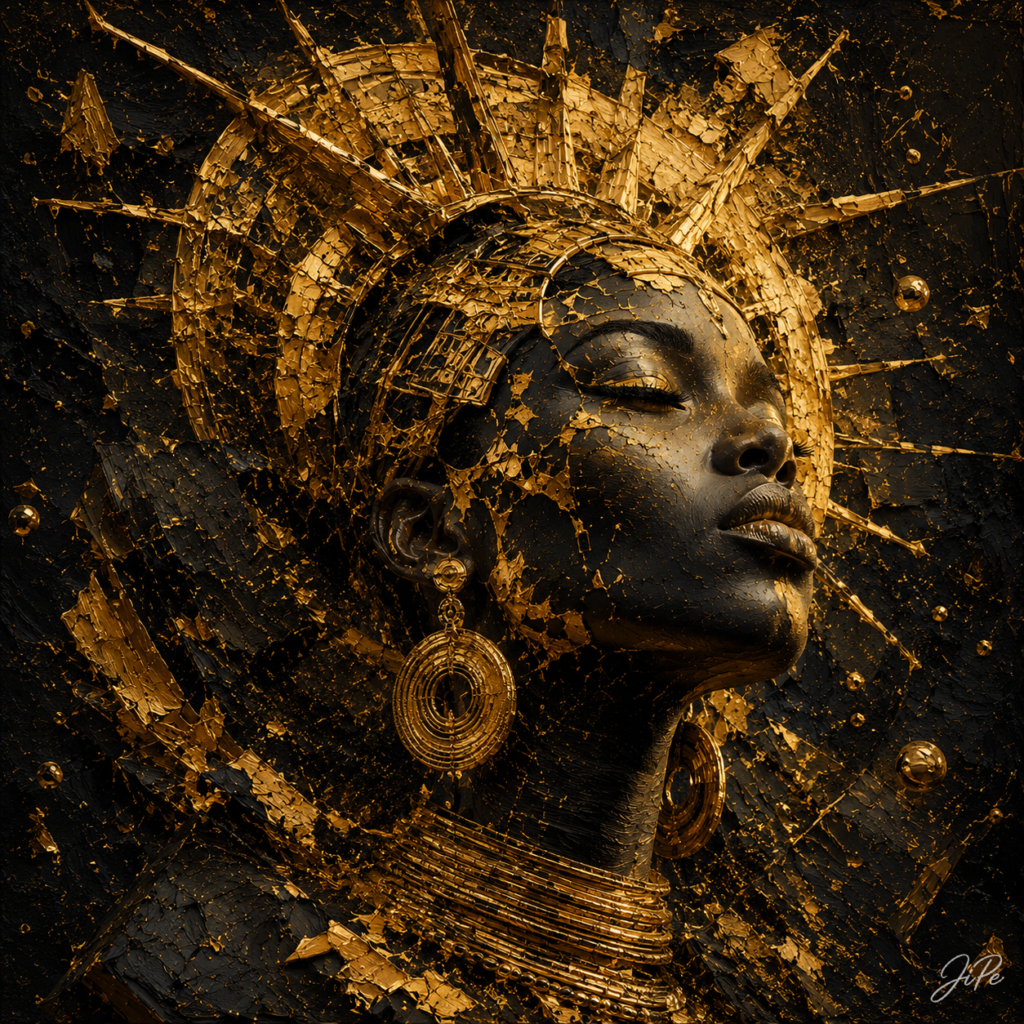
The Crown Beyond Time is a meditation on sovereignty beyond power, identity beyond history, and the enduring nature of the human spirit. Through an extraordinary fusion of symbolic portraiture, monumental abstraction, and luminous mixed-media aesthetics, the work explores the idea that true nobility is not inherited through bloodlines or bestowed by earthly kingdoms, but forged through wisdom, resilience, and inner awakening. The painting invites viewers into a timeless realm where the concepts of royalty, divinity, and consciousness converge, revealing a vision of authority that transcends both culture and chronology.

At the center of the composition emerges the serene profile of a woman whose eyes remain gently closed, suspended between contemplation and transcendence. Her expression is one of profound stillness, untouched by external conflict or temporal concerns. She does not present herself as a ruler over others, but as one who has attained mastery over herself. This distinction lies at the very heart of the work. The crown she wears is not a symbol of dominion—it is the visible manifestation of inner illumination, earned through experience, sacrifice, and spiritual evolution.

The magnificent golden headdress radiating behind her head functions simultaneously as crown, halo, celestial mechanism, and cosmic sun. Its intricate architecture extends outward like rays of light, dissolving the boundaries between ornament and universe. Throughout art history, circular halos have represented sanctity and divine presence; here, however, the halo expands into an elaborate cosmological structure, suggesting that enlightenment is not static but endlessly unfolding. The crown becomes less an object than a living field of consciousness, radiating outward into infinite space.

Gold occupies a central symbolic role throughout the composition. Rather than serving merely as decoration, it acts as a visual language of transcendence. Every fractured surface, every shimmering texture, and every luminous accent reinforces the philosophy that imperfection can become sacred when embraced rather than concealed. Inspired by the aesthetic spirit of kintsugi, the golden fissures transform visible fractures into sources of beauty and strength. They remind the viewer that wisdom is rarely born from perfection; instead, it emerges through endurance, healing, and the courage to carry one’s history openly.

The contrast between luminous gold and the figure’s deep obsidian skin creates one of the painting’s most striking visual dialogues. Darkness here is never associated with absence or fear. Instead, it functions as the fertile space from which light is born. The relationship between these opposing elements reflects one of the artist’s recurring themes: illumination gains its deepest meaning only when it emerges from shadow. The figure herself becomes the meeting point of these universal forces, embodying harmony rather than opposition.

The richly layered textures contribute significantly to the painting’s emotional resonance. Distressed surfaces, cracked pigments, sculptural impasto, and metallic fragments create the impression of an artifact simultaneously ancient and timeless. The portrait appears less painted than excavated, as though it has emerged from the accumulated memory of civilizations. This material complexity encourages prolonged observation, revealing new details with each encounter and reinforcing the notion that identity itself consists of countless accumulated layers.

The composition balances monumentality with intimacy in remarkable fashion. While the portrait dominates the pictorial space with almost sculptural grandeur, the closed eyes and relaxed expression create an atmosphere of inward reflection rather than spectacle. The viewer is not confronted by power but invited into contemplation. The absence of direct eye contact transforms the experience from portraiture into meditation, allowing the work to function as both image and mirror.

Symbolically, the earrings, necklaces, and circular ornaments further reinforce themes of continuity and eternal cycles. Their repeating forms echo the celestial geometry of the crown itself, creating visual rhythms that unite the human body with cosmic order. These adornments are not signs of material wealth but extensions of the painting’s larger symbolic vocabulary, suggesting that every aspect of existence participates in a greater pattern of interconnectedness.

From an art historical perspective, The Crown Beyond Time occupies a distinctive position at the intersection of contemporary symbolic realism, visionary portraiture, Afro-futurist aesthetics, sacred iconography, and mixed-media abstraction. It draws inspiration from the monumental stillness of classical portraiture while embracing the expressive freedom of contemporary fine art. The result is neither historical reconstruction nor fantasy illustration, but an entirely original symbolic language where portrait, sculpture, architecture, and celestial geometry merge into a unified visual experience.

Light remains the painting’s invisible protagonist. Rather than falling naturally upon the figure, it appears to emanate from within her presence and from the radiant crown surrounding her. This reversal transforms the portrait into a source rather than a recipient of illumination. The viewer senses that the figure is not merely reflecting light—she is generating it. In doing so, the work suggests that enlightenment is not bestowed from outside but awakened from within.

The title, The Crown Beyond Time, ultimately refers not to an object but to a state of being. It speaks of the enduring dignity that survives changing civilizations, shifting identities, and the passage of centuries. It proposes that the highest form of sovereignty lies in self-knowledge, compassion, and spiritual clarity rather than external authority. The crown therefore becomes a universal symbol, accessible to anyone willing to undertake the lifelong journey of transformation.

Ultimately, The Crown Beyond Time is a celebration of timeless consciousness. It reminds us that every human life contains the potential for transcendence, and that true greatness is measured not by power over others but by the depth of one’s inner awakening. Standing before this monumental portrait, the viewer is invited to reflect upon the invisible crown carried within every individual—a crown forged through resilience, illuminated by wisdom, and untouched by the passing of time.

Lämna ett svar