Monumental Visionary Fine Art exploring mythology, consciousness, sacred light, and timeless visual storytelling.

Monumental Visionary Fine Art exploring mythology, consciousness, sacred light, and timeless visual storytelling.

Viking and Norse Mythology Paintings

The Blood Oath

The Blood Oath
The Blood Oath

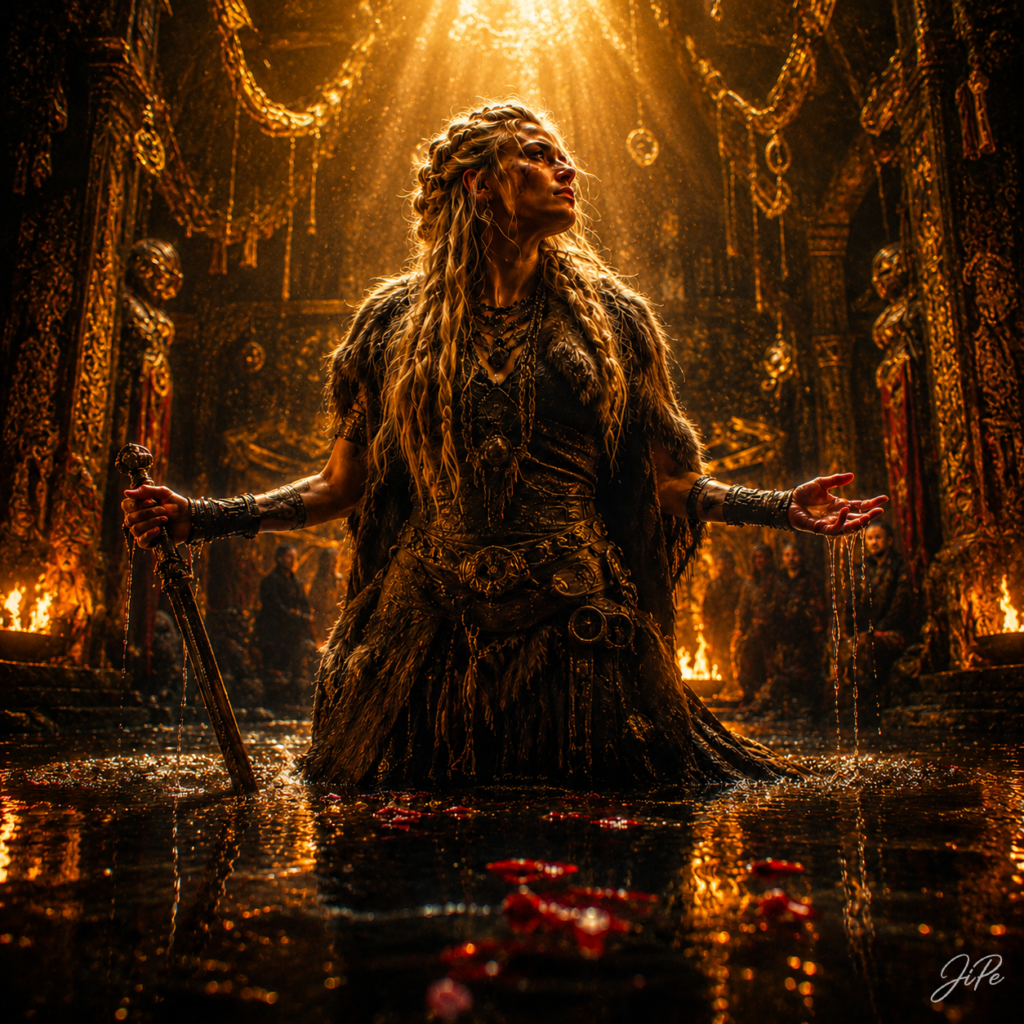
The Blood Oath is a monumental exploration of sacrifice, destiny, and the sacred weight of commitment. Rooted in the visual language of myth and ritual, the painting captures a timeless moment in which an oath transcends spoken words and becomes an irreversible act of transformation. Rather than illustrating a specific historical event, the work evokes the universal human experience of crossing a threshold from which there is no return. It is a meditation on honor, loyalty, and the profound cost of embracing one’s chosen path.

At the center of the composition stands a solitary warrior immersed in dark water, illuminated by a torrent of golden light descending from above. Her posture is both vulnerable and unwavering. She neither kneels in defeat nor stands in triumph; instead, she occupies the sacred space between surrender and empowerment. With one hand resting upon her sword and the other opened toward the heavens, she becomes both witness and participant in a ritual that reaches beyond the physical world. Her expression reflects neither fear nor certainty, but the quiet acceptance that accompanies every truly life-defining decision.

The title, The Blood Oath, carries symbolic significance far beyond the literal. Throughout human history, blood has represented life, ancestry, sacrifice, kinship, and covenant. In this painting, it becomes the invisible thread connecting the individual to forces greater than the self. The crimson petals floating across the water subtly reinforce this symbolism. They evoke both spilled blood and blossoming life, reminding the viewer that every profound sacrifice contains the possibility of renewal. The oath is therefore not merely an agreement but a transformation of identity—an acceptance that one’s future can no longer be separated from one’s values.

The sword serves as one of the painting’s central symbols. It is not depicted as an instrument of conquest but as an emblem of responsibility. Resting calmly within the warrior’s grasp, it signifies discernment, justice, and the burden of defending what cannot be measured by power alone. The weapon is secondary to the figure herself, emphasizing that true strength resides not in steel but in the moral conviction of the individual who carries it.

The surrounding hall resembles both an ancient temple and a royal sanctuary. Its monumental architecture, carved pillars, sacred ornaments, and flickering flames establish an atmosphere that exists beyond historical specificity. This is not a recognizable place but an archetypal space where myth, memory, and spiritual experience converge. The distant observers, partially concealed within shadow, reinforce the ceremonial nature of the scene. Their presence suggests that every oath is witnessed—not only by other people, but by history, ancestry, and the unseen forces that shape human destiny.

Light functions as the painting’s dominant symbolic language. Descending from the unseen heights of the composition, the radiant beam transforms the warrior into the focal point of a cosmic dialogue. Rather than merely illuminating the scene, the light becomes an active participant, representing revelation, divine recognition, and inner awakening. The dramatic contrast between luminous gold and profound darkness reflects one of the central themes within the artist’s body of work: that illumination acquires meaning only through its relationship with shadow.

The carefully restrained palette of deep blacks, weathered bronze, glowing amber, and radiant gold creates an atmosphere that feels simultaneously ancient and eternal. Gold leaf-inspired textures appear throughout the architecture, jewelry, water, and light, elevating the visual language beyond realism into symbolism. Gold becomes a metaphor for spiritual truth and incorruptible value, while the surrounding darkness represents uncertainty, mortality, and the unknown future into which the warrior willingly steps.

The reflective water surrounding the figure introduces another layer of meaning. Water has long symbolized purification, transition, and rebirth across cultures and mythologies. Here it functions as a liminal space between the life that has been left behind and the identity that has yet to emerge. Every ripple becomes a visual reminder that decisive moments radiate consequences far beyond the instant in which they occur. The viewer is invited to contemplate not only the ritual itself but the unseen transformation already unfolding beneath the surface.

From an art historical perspective, The Blood Oath occupies a compelling intersection between contemporary symbolic realism, visionary art, cinematic figurative painting, and myth-inspired visual storytelling. Monumental composition, painterly realism, dramatic chiaroscuro, and richly textured surfaces coexist with symbolic abstraction, allowing the work to communicate simultaneously through narrative, emotion, and archetype. Rather than reconstructing Viking mythology or medieval ritual literally, the painting creates an original symbolic universe where historical references become universal psychological metaphors.

The composition itself is constructed with remarkable balance. The central vertical axis established by the descending light creates a sense of sacred order, while the expansive horizontal gesture of the warrior’s arms opens the image outward, inviting viewers into the ceremony rather than allowing them to remain distant observers. Every architectural line, every reflection, and every beam of light ultimately guides the eye back to the solitary figure whose quiet resolve anchors the entire visual experience.

Ultimately, The Blood Oath is not a painting about war, violence, or conquest. It is about the invisible promises that define human existence. It speaks of the moments when conviction outweighs comfort, when identity is forged through choice rather than circumstance, and when sacrifice becomes the foundation of purpose. The work reminds us that the most significant oaths are rarely spoken aloud. They are carried in silence, honored through action, and remembered not because they were witnessed by many, but because they transformed the one who made them. In that profound stillness between light and shadow, The Blood Oath becomes a timeless reflection on courage, integrity, and the enduring power of commitment.

Lämna ett svar