
Monumental Visionary Fine Art exploring mythology, consciousness, sacred light, and timeless visual storytelling.

Monumental Visionary Fine Art exploring mythology, consciousness, sacred light, and timeless visual storytelling.

Fantasy Paintings

The Dance of Liquid Gold

The Dance of Liquid Gold

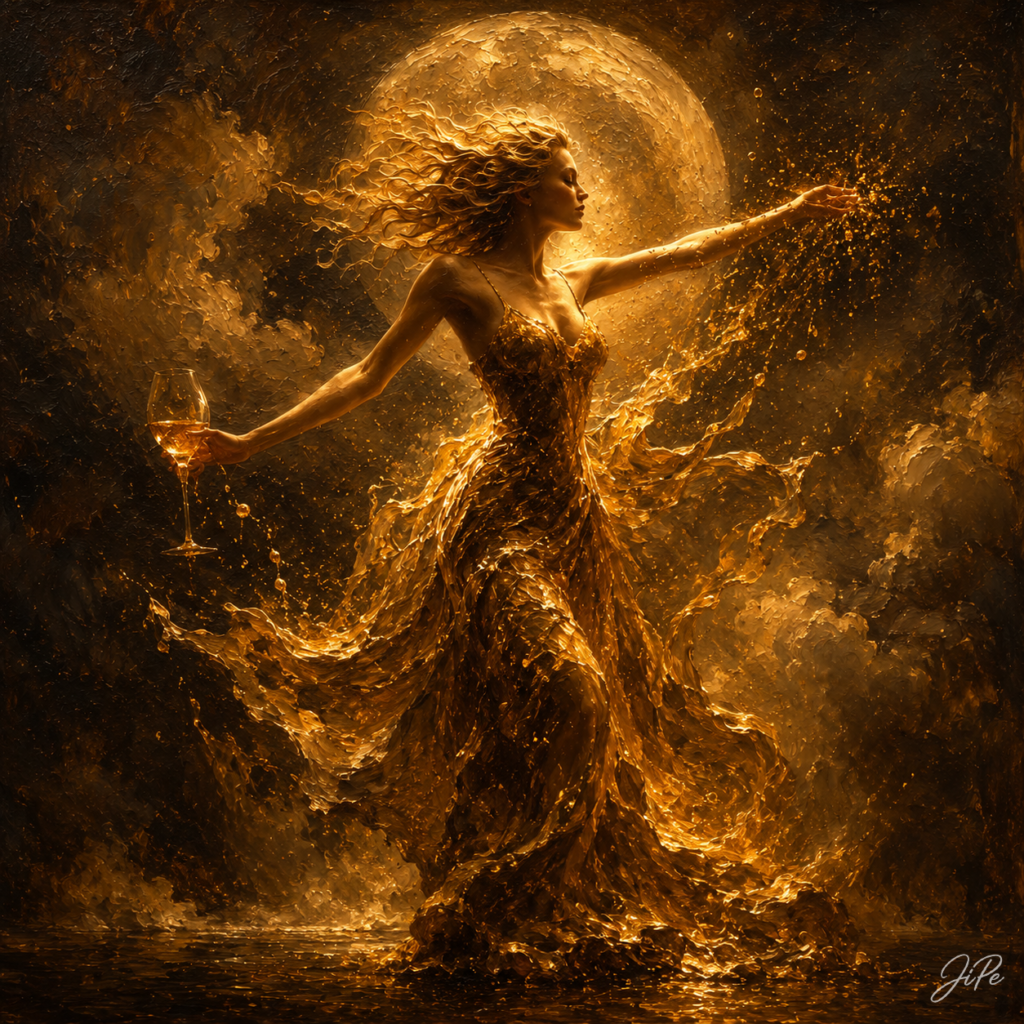
The Dance of Liquid Gold is a luminous celebration of transformation, abundance, and the fleeting beauty of the present moment. Suspended between dream and reality, the painting dissolves the boundaries between the human form and the elemental forces of light, suggesting that joy itself can become a sacred act of creation. Rather than depicting a literal dance, the work visualizes an emotional state—a moment in which movement, light, and spirit become inseparable, revealing the extraordinary hidden within the ordinary.

At the center of the composition stands a graceful female figure, captured in a gesture of effortless motion. Her body appears neither anchored to the earth nor detached from it, but suspended in perfect harmony between gravity and transcendence. Every extension of her arms suggests openness rather than possession, while the flowing movement of her body conveys freedom without chaos. She embodies the timeless archetype of vitality—the human soul fully immersed in the act of living.

Her gown appears to dissolve into cascades of molten gold, transforming fabric into liquid light. This remarkable metamorphosis forms the visual heart of the painting. The figure is not merely wearing gold; she is becoming one with it. The flowing streams enveloping her body symbolize the invisible energies that shape human experience: creativity, passion, memory, emotion, and inspiration. Gold ceases to function as material wealth and instead becomes a metaphor for life’s most precious qualities—those that cannot be owned, only experienced.

The wine glass held delicately within her left hand introduces a profound symbolic counterpoint. Throughout history, wine has represented celebration, communion, transformation, and the passage of time. Here, it serves not as a symbol of indulgence but of presence. The vessel becomes an invitation to savor existence itself, reminding the viewer that abundance is measured less by possession than by the capacity to appreciate each fleeting moment. The glass remains remarkably still despite the surrounding movement, suggesting that inner balance can exist even amidst life’s constant flow.

Behind the dancer rises a monumental golden moon whose radiant presence anchors the composition within a timeless celestial framework. The moon traditionally symbolizes intuition, cycles, femininity, and emotional depth. In this work, however, its luminous surface resembles both moon and sun, dissolving the distinction between night and day. It becomes a universal source of illumination, suggesting that true light originates not from external circumstances but from awakened consciousness. Positioned directly behind the figure, it transforms her silhouette into a living icon of renewal and creative energy.

Light is the dominant expressive force throughout the painting. Rather than illuminating the figure from outside, it appears to emerge through her movement. Every flowing ribbon of gold, every suspended droplet, and every radiant reflection reinforces the sensation that energy itself has become visible. The painting’s dramatic chiaroscuro heightens this effect, allowing brilliant luminosity to emerge from profound darkness. This recurring dialogue between shadow and light reflects one of the artist’s defining themes: beauty becomes most powerful when it arises from contrast.

The surrounding atmosphere dissolves into clouds of textured abstraction, where painterly brushwork and luminous particles create an environment that feels simultaneously atmospheric and cosmic. The background never competes with the central figure but instead expands her presence, allowing movement to continue beyond the physical boundaries of the body. Every swirling texture contributes to the sensation that the dancer is not moving through space—she is creating it.

Materiality plays a central role in the painting’s emotional impact. Thick impasto textures, fluid painterly gestures, luminous gold leaf-inspired surfaces, and richly layered pigments create a tactile quality that recalls both classical oil painting and contemporary mixed-media aesthetics. The surface itself appears alive, constantly shifting between solidity and fluidity. This ambiguity reinforces the painting’s central philosophical premise: nothing truly meaningful remains fixed; everything exists in a state of continuous becoming.

From an art historical perspective, The Dance of Liquid Gold occupies a compelling intersection between contemporary symbolic realism, visionary figurative painting, lyrical abstraction, and expressive mixed-media art. While the graceful pose recalls the elegance of classical dance and Renaissance allegory, the energetic painterly treatment introduces a distinctly contemporary visual language. Rather than illustrating mythology directly, the work constructs its own symbolic universe in which movement itself becomes sacred.

The composition is carefully orchestrated to create rhythmic visual harmony. The sweeping arc of the dancer’s body, the flowing diagonals of liquid gold, and the luminous circular form of the celestial body establish a dynamic balance between movement and stability. Every line directs the eye outward before gently returning it to the figure, creating a continuous visual cycle that echoes the painting’s themes of renewal and flow.

Beyond its visual beauty, the work speaks to a deeper philosophical idea: abundance is not something accumulated but something embodied. The liquid gold represents the invisible richness of a life lived authentically—with courage, gratitude, imagination, and emotional openness. The painting suggests that when one moves through the world in harmony with one’s true nature, every gesture becomes creative, every step becomes meaningful, and every ordinary moment possesses the potential to become extraordinary.

Ultimately, The Dance of Liquid Gold is an ode to the transformative power of joy. It reminds us that life’s greatest treasures cannot be measured in material wealth but in moments of genuine presence, creative freedom, and inner radiance. The dancer does not seek the light—she becomes its expression. Through her graceful movement, the painting invites viewers to rediscover the golden current that flows beneath everyday existence, encouraging them to embrace life not as something to be controlled, but as something to be danced with. In that luminous union between motion, light, and spirit, The Dance of Liquid Gold becomes a timeless celebration of human vitality and the endless beauty of becoming.

Lämna ett svar