Monumental Visionary Fine Art exploring mythology, consciousness, sacred light, and timeless visual storytelling.

Monumental Visionary Fine Art exploring mythology, consciousness, sacred light, and timeless visual storytelling.

Native American PaintingsSurreal Paintings

She Who Carries Worlds

She Who Carries Worlds

She Who Carries Worlds is a monumental exploration of memory, identity, ancestry, and the invisible landscapes that shape human existence. Existing at the intersection of symbolic realism, visionary portraiture, and contemporary mixed-media aesthetics, the work transcends conventional portraiture to become an allegory of consciousness itself. Rather than depicting a single individual, the painting presents an archetypal figure—one who embodies the accumulated weight of history, nature, mythology, and personal transformation. She is simultaneously woman, landscape, guardian, and universe.

The title serves as the conceptual foundation of the work. To ”carry worlds” is not simply to bear physical burdens, but to hold entire systems of memory, culture, imagination, and emotional inheritance within oneself. Every human being contains invisible geographies shaped by experience, ancestry, dreams, grief, resilience, and hope. This painting gives visual form to that hidden interior cosmos. It proposes that identity is never singular, but composed of countless worlds existing simultaneously beneath the surface of the visible self.

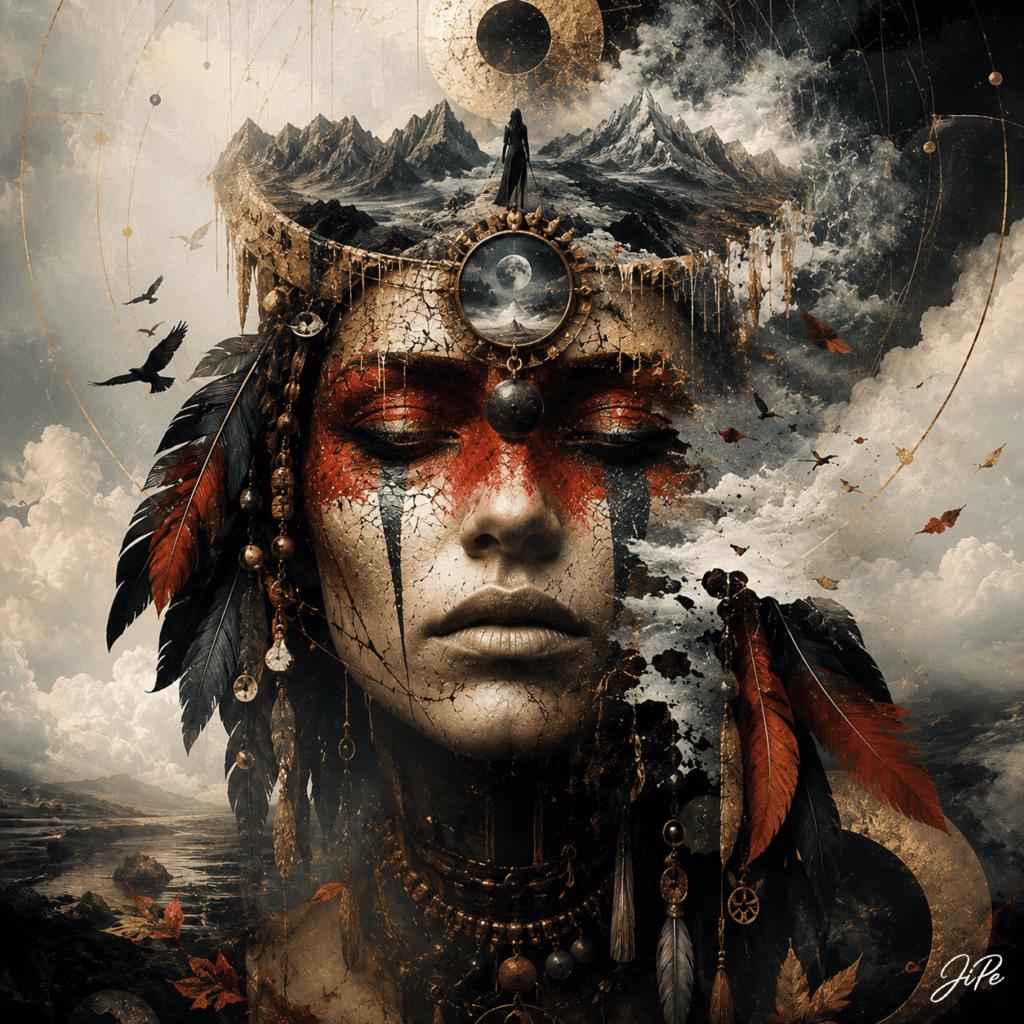
At the center of the composition is a serene female figure whose closed eyes immediately establish a profound atmosphere of contemplation. Her expression is neither passive nor withdrawn; instead, it suggests deep inward vision. She does not observe the external world because her attention is directed toward something infinitely larger—the inner universe she carries. Her calm presence anchors the entire composition, creating an emotional stillness that contrasts with the immense symbolic complexity surrounding her.

The face itself possesses the quiet dignity of a monumental sculpture weathered by time. Fine fractures spread across the surface of the skin like ancient ceramic repaired through centuries of survival. These delicate fissures are not symbols of weakness but of endurance. They remind the viewer that identity is shaped not by perfection, but by experience. Every fracture becomes a record of memory, every imperfection a testimony to transformation.

Across her eyes stretches a bold band of deep crimson pigment intersected by vertical black markings. These elements evoke ceremonial body painting found across numerous Indigenous traditions while remaining intentionally universal rather than tied to any single culture. The red functions as the color of life, sacrifice, ancestry, passion, and spiritual awakening. The black descending lines may be read as tears, rivers, ritual markings, or channels connecting the visible face to the invisible interior world. Their ambiguity allows the symbolism to remain open, inviting contemplation rather than prescribing meaning.

Perhaps the most extraordinary element of the composition rests upon the figure’s head. Rather than hair alone, an entire mountain landscape emerges from her crown, transforming the human form into living geography. Jagged peaks, winding valleys, and vast horizons unfold as though thought itself has become physical terrain. Standing upon this elevated world is a solitary figure gazing toward the eclipse suspended above. This tiny silhouette introduces an astonishing shift in scale. Humanity becomes both observer and inhabitant of consciousness itself.

The mountainous landscape symbolizes the accumulated terrain of experience. Mountains have long represented endurance, revelation, isolation, and spiritual ascent. Positioned upon the figure’s head, they become visual metaphors for the landscapes of memory and imagination that every individual carries throughout life. The lone traveler suggests that every journey toward understanding ultimately unfolds within ourselves.

Suspended at the center of this elevated landscape hangs a luminous medallion containing another world—a moonlit mountain scene enclosed within a circular frame. This nested image functions almost like memory preserved inside memory, a universe contained within another universe. It reinforces one of the painting’s central philosophical ideas: reality consists of infinite layers, each containing reflections of larger and smaller worlds simultaneously.

Throughout the composition, circles recur as dominant symbolic forms. The eclipse behind the mountains, the celestial medallion, planetary spheres, and subtle geometric diagrams all reinforce the concept of cyclical existence. Within the artist’s visual language, the circle represents eternity, wholeness, cosmic order, and continuous becoming. Unlike linear narratives, circles suggest that endings inevitably become beginnings and that identity remains perpetually in motion.

The eclipse occupying the upper background introduces another profound symbolic dimension. Historically, eclipses have represented moments of transformation, uncertainty, revelation, and the temporary suspension of ordinary perception. Here the eclipse becomes neither ominous nor catastrophic. Instead, it symbolizes those rare moments in life when familiar realities dissolve, allowing deeper truths to emerge.

Birds move throughout the sky, their flight establishing rhythm and symbolic freedom within the composition. Birds have historically represented transcendence, communication between worlds, intuition, and the movement of the soul. Their varied directions imply that no single path toward understanding exists. Some ascend into light, others disappear into shadow, reinforcing the painting’s acceptance of multiple journeys through existence.

The feathers adorning the central figure carry equally significant symbolic weight. Rather than functioning merely as decorative elements, they evoke memory, spiritual inheritance, and humanity’s enduring relationship with the natural world. They serve as visual bridges connecting earth and sky, physical existence and spiritual aspiration. Their careful placement alongside gold ornaments creates a dialogue between organic life and human craftsmanship, emphasizing the harmony between culture and nature.

Gold occupies an essential conceptual role throughout the work. Unlike precious metal employed simply for ornamentation, the fractured gold leaf textures suggest illumination emerging through imperfection. Gold traces the contours of memory, emphasizing sacred geometry, celestial structures, and emotional resonance. It functions simultaneously as light, time, and consciousness, binding together otherwise separate symbolic elements into one unified visual system.

The palette balances warm earth tones, luminous gold, soft ivory, charcoal blacks, and deep crimson accents with remarkable sophistication. Earth colors root the painting in human history and physical reality. Gold elevates the composition toward transcendence. Crimson introduces emotional intensity, while black establishes mystery and depth. Together these carefully controlled colors produce an atmosphere that feels simultaneously ancient and contemporary, intimate and monumental.

The artist’s painterly technique further reinforces these conceptual themes. Rich impasto textures, weathered surfaces, expressive brushwork, fractured gold leaf effects, and layered mixed-media aesthetics create the impression of an artifact shaped by centuries rather than a single moment of creation. The painting appears excavated from collective memory, carrying the visual patina of history while remaining unmistakably contemporary.

Compositionally, She Who Carries Worlds demonstrates exceptional architectural balance despite its extraordinary complexity. The frontal portrait establishes immediate psychological intimacy, while the towering mountain landscape expands the work into epic scale. Vertical movement draws the eye upward from the figure’s closed eyes toward the elevated landscape and celestial eclipse, while circular motifs repeatedly return the viewer to the center. This continuous movement reflects the painting’s central philosophical rhythm: ascent and return, expansion and reflection.

From an art historical perspective, the work exists within a rich dialogue between Symbolism, Surrealism, visionary art, sacred portraiture, and contemporary mixed-media painting. Echoes of Byzantine iconography appear in the halo-like celestial forms; Romantic landscape traditions emerge in the dramatic mountains; Symbolist philosophy informs the layered metaphors; and contemporary abstraction introduces gestural textures that resist purely narrative interpretation. Yet the painting ultimately establishes its own visual language—one in which portrait, landscape, cosmology, and mythology become inseparable.

Conceptually, the artwork reflects upon humanity’s relationship with inheritance. We inherit languages, stories, fears, dreams, landscapes, cultures, and memories long before we begin constructing our individual identities. These inherited worlds continue living within us whether consciously acknowledged or not. The central figure therefore becomes more than a portrait—she becomes an embodiment of collective memory itself, carrying generations within a single silent presence.

At a psychological level, She Who Carries Worlds also explores the remarkable capacity of the human imagination. The worlds resting upon the figure’s head suggest that every thought, every memory, and every dream possesses the power to become its own universe. Reality is not limited to physical geography; it is continuously expanded by consciousness itself.

Ultimately, She Who Carries Worlds is a meditation on the immeasurable depth contained within every human life. It proposes that beneath every face lies an unseen landscape of mountains climbed, storms endured, dreams preserved, histories inherited, and futures imagined. The painting reminds us that identity cannot be reduced to appearance alone. Each individual carries invisible worlds shaped by memory, resilience, culture, imagination, and hope.

Standing before this work, the viewer is invited into an encounter that is simultaneously personal and universal. The painting asks us to consider what landscapes exist within ourselves, what memories continue shaping our present, and what worlds we unknowingly carry each day. In that quiet act of reflection, She Who Carries Worlds reveals its deepest truth: that every human being is far larger than the visible body, containing entire universes that remain hidden until we learn to see beyond the surface.

Lämna ett svar