Monumental Visionary Fine Art exploring mythology, consciousness, sacred light, and timeless visual storytelling.

Monumental Visionary Fine Art exploring mythology, consciousness, sacred light, and timeless visual storytelling.

Surreal Paintings

The Hand of Creation

The Hand of Creation

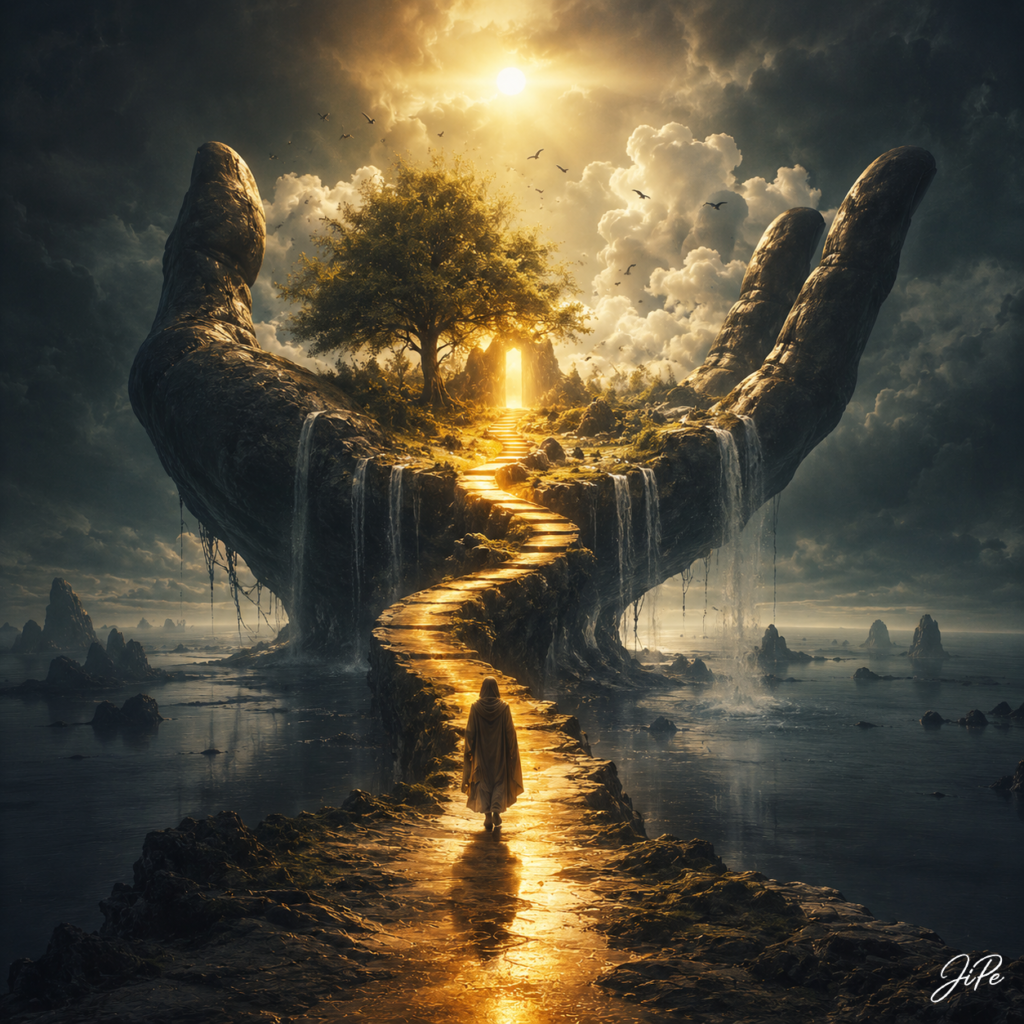
The Hand of Creation is a visionary meditation on origin, destiny, and the profound relationship between humanity and the creative force that sustains existence. Situated between contemporary symbolism, spiritual allegory, and surreal landscape painting, the work explores one of the oldest questions in human thought: What is the nature of creation, and what role does humanity play within it? Rather than presenting a literal religious narrative, the painting constructs a universal visual language in which landscape, architecture, and monumental form merge into a symbolic journey toward awakening. It invites viewers into a timeless space where creation is not understood as a singular historical event, but as an eternal process unfolding continuously within both the universe and the human soul.

At the centre of the composition rises an immense stone hand emerging from the waters like an ancient monument shaped by the beginning of time itself. Its colossal scale immediately transcends ordinary reality, transforming the hand into something far greater than human anatomy. It becomes an archetype—a universal symbol of protection, generosity, guidance, and creative power. Rather than grasping or controlling, the open palm gently supports an entire living world, suggesting that existence itself rests within an invisible act of care.

Resting upon this monumental hand is a flourishing island crowned by a solitary tree whose branches reach toward the heavens. At the heart of the island stands a radiant gateway from which golden light pours outward, illuminating the winding path below. This arrangement immediately recalls the symbolic language of sacred gardens found throughout world mythology. The tree evokes the Tree of Life, the World Tree, and countless traditions in which vegetation represents continuity, renewal, and the interconnectedness of all living things. Yet the painting deliberately avoids belonging to any single religious tradition, allowing these symbols to remain universal and deeply human.

The title, The Hand of Creation, functions on multiple levels simultaneously. The hand may be understood as the hand of a creator, the hand of nature, the hand of destiny, or even the creative potential residing within humanity itself. By refusing to define its origin, the artwork allows viewers from different philosophical, cultural, and spiritual backgrounds to discover their own interpretations. In doing so, the painting becomes less an illustration of belief than an invitation to contemplation.

The ascending path that winds from the foreground toward the illuminated portal serves as the emotional and conceptual spine of the composition. It begins in darkness at the viewer’s feet before gradually becoming saturated with golden light as it approaches the gateway. This transformation symbolises the human journey from uncertainty toward understanding, from separation toward unity, and from finite existence toward transcendence. The path is neither straight nor effortless. Its gentle curves suggest that enlightenment is achieved not through shortcuts but through perseverance, humility, and continuous movement.

The solitary traveller walking toward the light reinforces this interpretation. Unlike heroic figures commonly found in mythological painting, this individual possesses no identifiable features or attributes. Their anonymity transforms them into an everyman—a symbolic representation of all humanity. The viewer is encouraged to identify with this figure, recognising their own search for meaning within the landscape. Standing at the beginning of the illuminated path, the traveller becomes both witness and participant in creation itself.

The enormous difference in scale between the traveller and the monumental hand introduces one of the painting’s most compelling visual tensions. Humanity appears physically insignificant when measured against the vastness of creative power, yet the composition grants the traveller the central axis of movement and purpose. This relationship suggests that although individuals may be small within the cosmos, their choices and journeys possess profound spiritual significance.

Light operates throughout the painting as its primary symbolic language. A radiant sun breaks dramatically through immense cloud formations, casting golden beams that illuminate the tree, the portal, the hand, and the path simultaneously. Rather than merely describing atmospheric conditions, this light functions as a visual manifestation of consciousness itself. It connects heaven, earth, and humanity into one continuous field of illumination, suggesting that creation is sustained through the constant interaction between visible and invisible realities.

The luminous doorway beneath the tree becomes the painting’s central mystery. It appears less like architectural construction than an opening between dimensions—a threshold separating the familiar world from a higher state of awareness. Throughout art history, gates have symbolised transformation, initiation, and spiritual rebirth. Here the doorway does not simply represent arrival; it embodies possibility. The destination remains unknown, encouraging viewers to contemplate what lies beyond rather than providing definitive answers.

Water further enriches the symbolic complexity of the composition. The monumental hand rises from a calm sea whose still surface reflects both darkness and light. Throughout mythology and psychology, water frequently represents memory, potential, and the unconscious mind. The island therefore appears to emerge directly from the depths of collective existence, suggesting that creation itself originates from unseen foundations beneath conscious perception.

The waterfalls flowing gently from the edges of the hand reinforce this symbolism. They transform the hand from inert stone into something living and generative. Rather than remaining fixed, the sculpture appears to nourish the surrounding world continuously. These cascading streams imply that creation is not an isolated event completed in the distant past but an ongoing process of renewal that continually sustains life.

Materiality plays an equally important role in the painting’s conceptual framework. The immense hand possesses the weathered textures of ancient stone, marked by erosion, age, and geological permanence. Its surface carries the visual memory of countless centuries, suggesting that creative forces endure beyond the rise and fall of civilisations. The artist’s richly layered painterly textures evoke weathered frescoes, carved monuments, and contemporary mixed-media surfaces simultaneously, allowing the image to exist outside conventional historical periods.

Compositionally, the work demonstrates remarkable balance between monumentality and intimacy. The sweeping curves of the hand naturally guide the eye toward the central tree, while the illuminated pathway establishes a strong visual rhythm leading from the foreground into the heart of the composition. Every compositional element contributes to a sense of upward movement, reinforcing themes of aspiration, transformation, and spiritual ascent without sacrificing visual harmony.

The colour palette remains deliberately restrained yet emotionally powerful. Deep charcoal blues, muted earth tones, weathered stone greys, and radiant gold dominate the painting. Gold functions not simply as decoration but as a philosophical element. Throughout history it has symbolised purity, immortality, divine presence, and incorruptibility. Within The Hand of Creation, gold appears integrated into the landscape itself, dissolving the distinction between natural beauty and sacred illumination.

The painting also engages with the Romantic tradition of the sublime. Towering clouds, immense geological forms, dramatic atmospheric perspective, and overwhelming spatial scale evoke the emotional experience of confronting forces vastly greater than oneself. Yet unlike Romantic painters who often emphasised humanity’s insignificance before nature, this work proposes a more hopeful relationship. Humanity is not overwhelmed by creation but welcomed into it. The open hand becomes an image of invitation rather than domination.

Psychologically, the artwork may also be interpreted as a visual metaphor for the human mind. The hand represents creative potential, the island symbolises consciousness, the tree embodies growth, and the radiant doorway becomes the threshold between ordinary awareness and deeper understanding. In this reading, the traveller is engaged not in an external pilgrimage but in an inward journey toward self-discovery.

The presence of birds circling above the landscape introduces an additional symbolic dimension. Throughout countless artistic traditions, birds have represented freedom, transcendence, communication between earthly and celestial realms, and the soul’s capacity to rise beyond limitation. Their movement through the illuminated sky subtly reinforces the painting’s overarching theme of spiritual elevation without distracting from the quiet stillness that defines the composition.

From an art historical perspective, The Hand of Creation synthesises multiple traditions into a distinctly contemporary visual language. Echoes of Renaissance monumentality, Symbolist allegory, Romantic landscape painting, visionary realism, and contemporary fantasy coexist seamlessly within the composition. Yet these influences never become imitation. Instead, they contribute to a unique artistic voice that employs archetypal imagery to address timeless philosophical questions through a modern painterly sensibility.

Ultimately, The Hand of Creation is a profound meditation on origin, purpose, and the enduring relationship between humanity and the mysterious creative force from which all existence emerges. It suggests that creation is neither distant nor complete but continues to unfold within every moment of life, every act of compassion, every search for truth, and every step taken toward the light.

Standing before this work, viewers are invited to recognise themselves in the solitary traveller walking the illuminated path. The monumental hand does not compel the journey, nor does it dictate its destination. Instead, it quietly offers support, reminding us that every path toward wisdom begins with a single step, and that beyond the visible world there always remains another doorway waiting to be discovered.

Lämna ett svar