Arrow of Destiny

Arrow of Destiny is a powerful meditation on purpose, choice, and the invisible force that draws every life toward its defining moment. Situated between symbolic realism, contemporary abstraction, and visionary portraiture, the work explores the relationship between chaos and direction, questioning whether destiny is something that awaits us—or something we continuously create through courage, conviction, and intention.
Rather than illustrating a specific narrative, the painting presents an archetypal encounter between the individual and fate itself. It speaks a universal visual language built upon symbols that transcend culture and time. The viewer is invited not to witness an event, but to stand within a moment of profound psychological tension—where uncertainty, resilience, and purpose converge into a single decisive point.
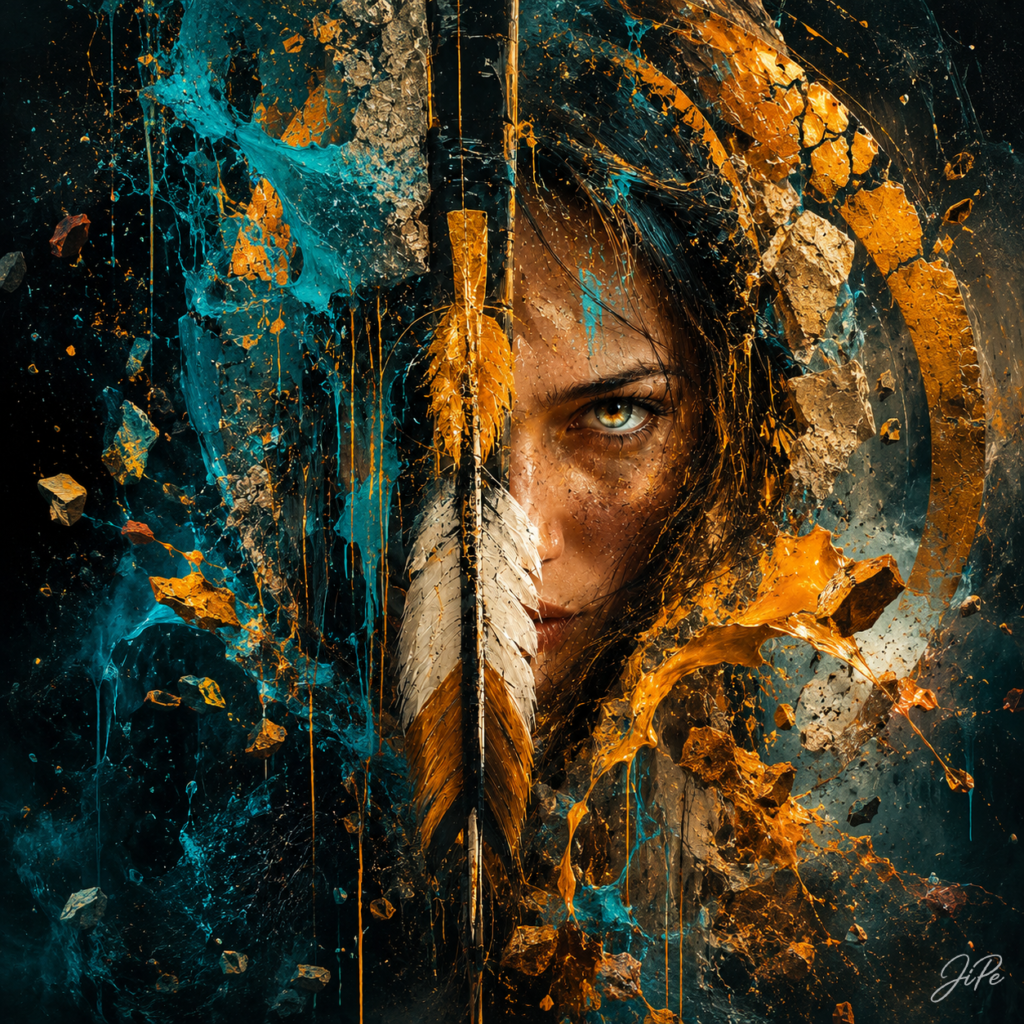
The title, Arrow of Destiny, immediately establishes the central metaphor. Throughout human history, the arrow has symbolized focus, movement, intention, and irreversible commitment. Once released, an arrow cannot return to the bow; it must complete the path for which it was set in motion. In this work, however, the arrow is not shown in flight. Instead, it stands perfectly still, dividing the composition into two opposing yet interconnected realities. It becomes the axis around which the entire painting revolves—a visual representation of destiny before action, of potential before fulfillment.
At the center of the composition emerges the intense gaze of a solitary figure. Only one eye is fully revealed, creating an immediate psychological connection with the viewer. This eye becomes the emotional nucleus of the work. It is not filled with fear, nor aggression, but with unwavering awareness. The figure appears to look beyond the visible world, as though perceiving possibilities that remain hidden from ordinary sight. The partially obscured face suggests that identity itself is never fully revealed. Every individual carries unseen histories, untold struggles, and inner landscapes that remain invisible beneath the surface.
The vertical arrow functions as far more than a weapon or object. It becomes a symbolic spine connecting earth and sky, matter and spirit, intention and action. Positioned directly through the center of the composition, it establishes perfect equilibrium while simultaneously creating tension between opposing visual forces. The arrow transforms into a philosophical line dividing what has already been lived from what has yet to become.
Surrounding the figure is an extraordinary eruption of fractured forms, flowing pigments, shattered stone, and luminous gold. These explosive elements suggest a universe in continuous transformation. Rather than depicting destruction, they visualize creation through disruption. Old structures dissolve while new realities emerge from their fragments. The painting proposes that genuine transformation rarely occurs gently. Instead, it often requires existing certainties to fracture before something greater can take shape.
The dramatic contrast between vibrant turquoise and radiant gold forms one of the painting’s most compelling symbolic dialogues. Gold has long represented illumination, wisdom, spiritual value, and enduring truth. Turquoise introduces ideas of intuition, renewal, emotional depth, and limitless possibility. Their collision creates extraordinary visual energy while expressing the delicate balance between knowledge and instinct, permanence and change, conscious intention and unconscious evolution.
Fragments of stone appear suspended throughout the composition as though gravity itself has temporarily ceased to exist. These floating elements evoke memories, beliefs, expectations, and identities breaking free from established structures. The viewer is reminded that personal growth often demands the willingness to let old certainties fall away. Every fragment becomes evidence not of collapse, but of becoming.
The feather attached to the arrow introduces an equally significant symbolic layer. Historically associated with freedom, guidance, truth, and communication between earthly and spiritual realms, the feather softens the otherwise rigid geometry of the arrow. Together they embody a profound duality: precision balanced by intuition, discipline accompanied by grace. The arrow may determine direction, but the feather allows the journey to remain stable through unpredictable winds.
Circular forms embedded within the background reinforce the artist’s recurring exploration of sacred geometry. These concentric structures suggest celestial bodies, eclipses, portals, and cycles of existence. Within the visual language of the painting, the circle symbolizes eternity, continuity, and the invisible order underlying apparent chaos. Positioned behind the figure, these luminous rings imply that individual destiny unfolds within far larger cosmic rhythms.
Light functions throughout the composition as an active force rather than passive illumination. Gold appears to emerge from fractures, particles, and movement itself, suggesting that enlightenment often arises precisely where life has been broken open. Rather than descending from above, the light seems generated through transformation. It is discovered, not bestowed.
Texture plays an essential role in communicating the painting’s emotional complexity. Thick painterly surfaces, fractured mixed-media effects, expressive splashes, weathered textures, and layered abstraction create a tactile experience that mirrors the psychological depth of the subject. The visible materiality of the artwork reminds viewers that transformation is never smooth. It leaves traces, scars, and accumulated layers that become part of identity rather than imperfections to conceal.
Compositionally, Arrow of Destiny demonstrates remarkable structural discipline despite its explosive visual energy. The central vertical axis anchors the painting with almost architectural precision, while surrounding abstract movements create dynamic asymmetry. The eye repeatedly returns to the figure’s gaze before being carried outward into expanding bursts of color and fractured form. This constant movement reflects the psychological process of decision itself—moments of inward reflection followed by outward action.
From an art historical perspective, the work exists within a dialogue between Symbolism, contemporary abstract expression, sacred portraiture, and visionary realism. It draws upon traditions in which physical objects function as metaphysical metaphors, while simultaneously embracing the freedom of contemporary mixed-media aesthetics. The result is a visual language that feels both timeless and unmistakably modern.
Conceptually, the painting addresses one of humanity’s oldest philosophical questions: Is destiny predetermined, or is it continuously shaped through individual choice? The work deliberately refuses to provide an answer. Instead, it suggests that destiny exists in the tension between these two possibilities. The arrow stands ready, but it has not yet been released. The future remains open, waiting for intention to become action.
At a psychological level, Arrow of Destiny explores the transformative moment preceding decisive change. Every life contains such thresholds—moments when uncertainty reaches its greatest intensity precisely because possibility has become limitless. The painting captures this fragile instant with extraordinary clarity. It portrays not victory or failure, but the profound stillness immediately before movement begins.
The absence of explicit narrative further strengthens the universality of the work. The figure represents no single culture, era, or individual. Instead, it becomes an archetype of every person standing before life’s defining choices. The arrow may symbolize vocation, truth, purpose, love, sacrifice, creativity, or personal awakening. Its meaning evolves according to the experiences each viewer brings into the encounter.
Ultimately, Arrow of Destiny is a meditation on intention. It reminds us that although life often appears fragmented and unpredictable, every meaningful journey begins with a single unwavering direction. The painting suggests that destiny is not merely something waiting in the distance, but something quietly taking shape within every decision, every act of courage, and every moment in which we choose to move forward despite uncertainty.
Standing before this work, the viewer encounters more than a portrait—they confront a mirror of their own potential. The silent gaze asks a question that cannot be answered by the painting alone: What path has your arrow been waiting to follow? It is within that deeply personal reflection that Arrow of Destiny reveals its enduring power, reminding us that our greatest transformations begin not when the future becomes certain, but when we choose to aim toward it.