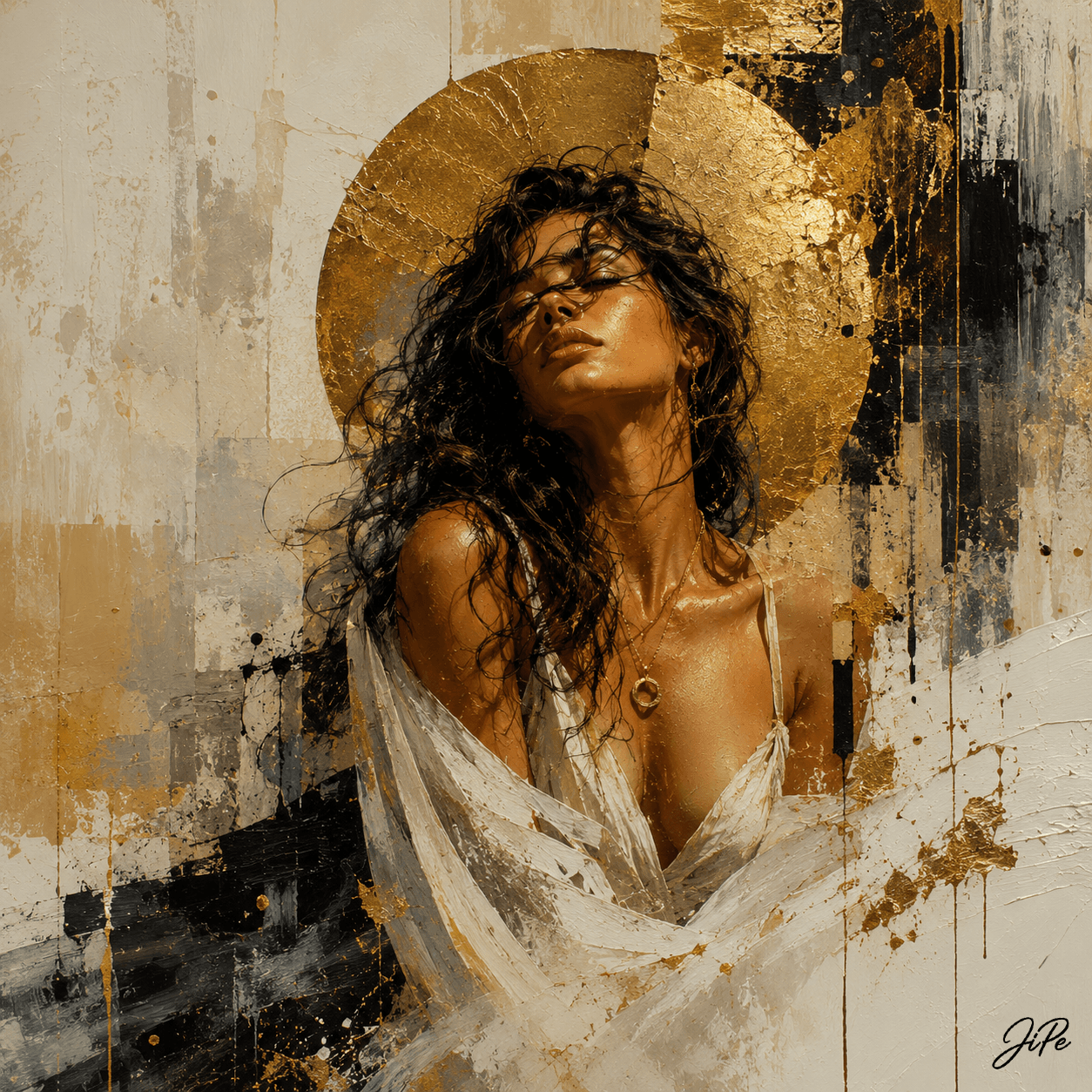
Elvis

Elvis is a contemporary tribute to one of the most iconic figures in the history of popular culture—a performer whose voice, charisma, and artistic presence reshaped twentieth-century music and forever altered the landscape of modern entertainment. Rather than serving as a documentary portrait, this work seeks to capture the emotional mythology surrounding Elvis Presley. It explores not only the legendary performer, but the enduring aura that transformed an individual into an everlasting cultural symbol whose influence continues to transcend generations.
At the center of the composition, Elvis is portrayed in a moment of profound introspection. His eyes remain gently lowered as he leans toward a vintage microphone, creating the impression that the music exists not as performance alone, but as personal confession. The quiet expression contrasts with the larger-than-life persona often associated with the ”King of Rock and Roll,” revealing a more contemplative figure whose artistic power originated as much from vulnerability as from confidence.
The microphone itself becomes one of the painting’s central symbolic elements. More than an instrument of amplification, it represents the bridge between artist and audience—the place where emotion is transformed into sound and personal experience becomes collective memory. Throughout music history, the microphone has stood as an icon of performance, but here it also suggests intimacy. It is less a stage prop than a silent companion, bearing witness to every lyric, every triumph, and every moment of doubt that shaped an extraordinary career.
The surrounding environment dissolves the boundaries between reality and imagination. Behind Elvis rises a dreamlike architectural landscape where illuminated cityscapes, cathedral-like silhouettes, glowing rivers, and celestial skies merge into a timeless symbolic setting. This is not a specific place but a visual mythology, suggesting that legendary artists eventually inhabit a realm beyond history—a landscape constructed from memory, admiration, and cultural imagination. The glowing ”ELVIS” sign reinforces this transformation, presenting the name not merely as identity but as an enduring emblem recognized throughout the world.
Light dominates the composition with extraordinary intensity. Brilliant golden illumination radiates from behind the figure, creating a luminous halo that elevates the portrait beyond biography into the language of symbolic portraiture. This radiant aura should not be interpreted simply as a religious reference, but as a metaphor for enduring influence, artistic brilliance, and the extraordinary ability of music to transcend time. The golden light appears to emerge simultaneously from the heavens and from the artist himself, suggesting that inspiration flows in both directions—from the individual to humanity, and from humanity back into the creative spirit.
The carefully balanced palette of deep midnight blue, charcoal black, luminous amber, and radiant gold reinforces the emotional atmosphere of the painting. The dark tones evoke reflection, nostalgia, and timeless elegance, while the warm golden highlights symbolize immortality, achievement, and creative illumination. Splashes of expressive gold across the surface introduce an almost musical rhythm, allowing the painting itself to appear alive with movement, much like the energy of a live performance suspended within a single moment.
The expressive brushwork and layered textures contribute significantly to the work’s emotional language. Rather than pursuing photographic realism, the painting embraces a contemporary mixed-media aesthetic where abstraction and realism coexist. Dynamic paint splashes, weathered textures, and luminous overlays create visual movement that echoes the rhythm of music itself. Every mark appears intentional, suggesting that memory is never perfectly preserved but constantly reshaped through emotion and collective imagination.
Compositionally, the work achieves remarkable balance between intimacy and monumentality. The close portrait establishes an immediate psychological connection with the viewer, while the expansive symbolic landscape extends the narrative beyond the individual into the realm of cultural mythology. The upward flow of architectural forms, celestial light, and circular halo-like structures guides the eye through the composition, creating a visual journey that mirrors the lasting ascent of Elvis from performer to legend.
Within the broader context of contemporary portraiture, Elvis occupies a compelling intersection between Fine Art, Expressionism, Pop Art, and Symbolism. Like Pop Art, it celebrates an internationally recognized cultural icon, yet it deliberately moves beyond celebrity portraiture. Instead of reproducing a familiar image, the painting seeks to reveal the emotional and symbolic significance that Elvis continues to hold within global culture. The expressive handling of paint aligns with modern figurative art, while the luminous atmosphere recalls the spiritual ambitions of Symbolist painting, where external appearance becomes a vehicle for exploring inner meaning.
For art historians, the work may be understood as part of the long tradition of elevating exceptional individuals into enduring archetypes. Throughout history, painters have portrayed kings, poets, composers, philosophers, and saints not merely as historical figures, but as embodiments of ideals that transcend their own lifetimes. In this painting, Elvis occupies a similar symbolic role. He becomes the archetype of artistic transformation—the individual whose creative voice reshaped an era while continuing to inspire new generations long after his lifetime.
The painting also reflects the profound relationship between music and visual art. Both disciplines possess the remarkable ability to evoke emotion without relying solely on language. Here, rhythm is translated into composition, melody into light, and memory into texture. The portrait becomes almost synesthetic, inviting viewers not only to see Elvis but to sense the emotional resonance of his music through visual form alone.
Ultimately, Elvis is a celebration of artistic legacy. It reminds us that truly transformative artists never disappear; they continue to exist within collective memory through the emotions they awaken, the stories they inspire, and the timeless works they leave behind. Standing before the glowing microphone, surrounded by radiant light and an imagined landscape shaped by music itself, Elvis becomes more than an icon of popular culture. He emerges as a universal symbol of passion, creativity, and the extraordinary ability of art to transcend time, transforming individual expression into something eternal.