Monumental Visionary Fine Art exploring mythology, consciousness, sacred light, and timeless visual storytelling.

Monumental Visionary Fine Art exploring mythology, consciousness, sacred light, and timeless visual storytelling.

Religious Paintings

Eternity’s Witness

Eternity's Witness
Eternity’s Witness

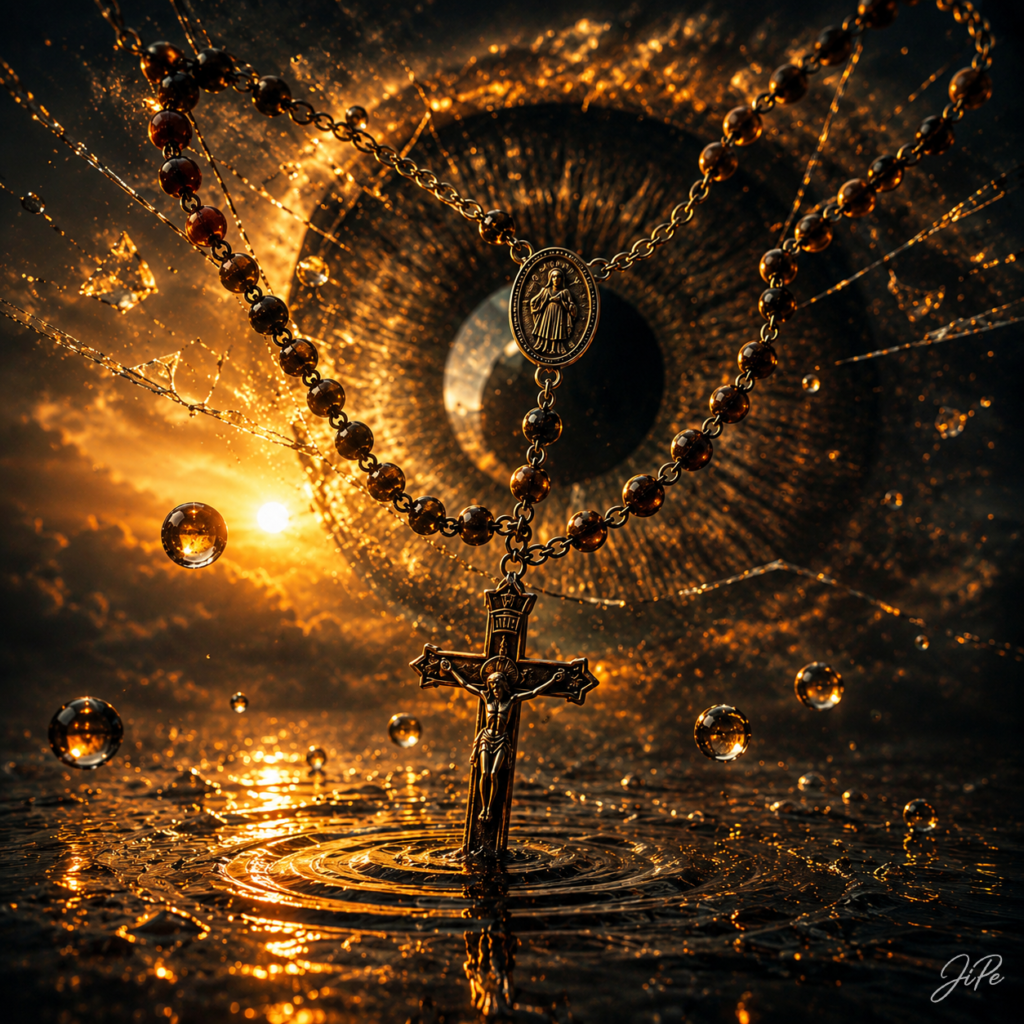
Eternity’s Witness is a profound meditation on faith, redemption, and the enduring relationship between the temporal and the eternal. Through the symbolic union of sacred objects, celestial light, and dreamlike atmosphere, the painting explores the idea that belief is not merely a historical tradition but a living presence that transcends time. Rather than illustrating a specific biblical narrative, the work invites viewers into a symbolic landscape where devotion, sacrifice, and hope converge, encouraging contemplation of the invisible dimensions that shape human existence.

At the heart of the composition hangs a finely crafted crucifix suspended above gently rippling water. Illuminated by an overwhelming golden radiance, the cross becomes the unmistakable focal point of the painting. It stands not simply as an object of religious devotion but as a universal symbol of sacrifice, forgiveness, and spiritual transformation. Rising from the reflective surface below, it appears to exist between heaven and earth, suspended in a moment where eternity touches the visible world.

Encircling the crucifix is a rosary whose delicate chain and polished beads create an elegant rhythm across the composition. The rosary functions as far more than a devotional object; it becomes a visual metaphor for continuity, prayer, and the countless generations who have sought comfort, strength, and meaning through faith. Each bead suggests an individual moment of reflection, while together they form an unbroken circle of remembrance and spiritual perseverance. The accompanying medallion quietly reinforces this symbolism, representing guidance, protection, and the intimate relationship between humanity and the sacred.

Behind these central elements emerges an immense circular form that dominates the background with quiet authority. Its monumental presence evokes the imagery of an eclipse, a celestial portal, or an infinite eye gazing beyond ordinary perception. This mysterious circle may be understood as the threshold between the material and the spiritual—a timeless symbol of eternity itself. Its immense scale contrasts dramatically with the delicate rosary suspended before it, reminding the viewer of humanity’s smallness within the vastness of creation while simultaneously affirming the profound significance of individual faith.

Light is the true protagonist of the painting. Brilliant golden rays penetrate the surrounding darkness with extraordinary intensity, dissolving rigid boundaries between physical space and spiritual experience. Rather than serving merely to illuminate the composition, the light becomes a visible manifestation of grace, revelation, and divine presence. It flows across the water, reflects within floating droplets, and transforms every metallic surface into a source of radiant energy. Darkness remains essential throughout the composition, not as an opposing force but as the silent space within which light acquires its deepest meaning.

The water beneath the crucifix introduces another significant symbolic dimension. Calm yet animated by subtle ripples, it reflects the surrounding light while suggesting purification, renewal, and spiritual rebirth. Across religious and artistic traditions, water has represented both physical life and inward transformation. Here, it becomes the meeting place between heaven and earth, where every ripple expands outward like the unseen consequences of faith, compassion, and hope. The circular patterns surrounding the base of the cross reinforce the idea that every act of belief extends far beyond the individual, touching lives across generations.

Suspended throughout the composition are luminous droplets that appear to float between gravity and light. These crystalline forms blur the distinction between water, stars, and celestial bodies, creating an atmosphere that feels simultaneously earthly and cosmic. They suggest prayers suspended in time, fragments of memory, or moments of grace preserved within eternity. Their quiet movement introduces a dreamlike quality that transforms the painting into a contemplative vision rather than a literal scene.

The restrained palette of deep charcoal, warm bronze, amber, and radiant gold establishes an atmosphere of profound reverence. Gold dominates the visual language, symbolizing divine wisdom, incorruptibility, and eternal life. Throughout the history of sacred art, gold has represented the presence of the divine beyond material reality, and in Eternity’s Witness it fulfills that same timeless function. Rather than simply coloring the scene, it becomes the emotional atmosphere itself, enveloping every object in a sense of sacred significance.

Compositionally, the painting demonstrates remarkable harmony through the interplay of vertical and circular forms. The crucifix anchors the composition with quiet stability, while the looping rosary introduces graceful movement across the picture plane. The monumental circular structure in the background provides visual balance and symbolic depth, drawing the viewer’s gaze toward an infinite center that remains deliberately unknowable. Every line, reflection, and ray of light contributes to a carefully orchestrated rhythm that encourages prolonged contemplation.

Within the broader context of contemporary visionary art, Eternity’s Witness engages with centuries of Christian iconography while presenting it through a distinctly modern visual language. The work draws inspiration from Symbolism, Baroque spirituality, and contemporary conceptual realism, combining meticulous detail with atmospheric abstraction. Rather than illustrating doctrine, it visualizes the emotional experience of faith itself, allowing traditional religious symbols to speak through universal themes of hope, remembrance, sacrifice, and transcendence.

For art historians, the painting may be interpreted as a contemporary continuation of the long tradition of devotional imagery, where sacred objects function as gateways to philosophical and spiritual reflection. Yet unlike many historical religious works that focus primarily on narrative, Eternity’s Witness emphasizes contemplation over storytelling. Its symbols remain open, inviting viewers from diverse backgrounds to engage with the work according to their own experiences, beliefs, and questions about existence.

The painting also reflects a timeless artistic fascination with the relationship between the finite and the infinite. The fragile rosary, the enduring cross, the reflective water, and the immeasurable celestial circle together create a visual meditation on humanity’s search for permanence within a world defined by change. The work suggests that eternity is not simply a distant destination but a reality that quietly reveals itself through moments of faith, compassion, memory, and inner stillness.

Ultimately, Eternity’s Witness is an invitation to pause before the mystery that has inspired artists, philosophers, and believers for centuries. It reminds us that some truths cannot be fully explained, only experienced. Through its radiant symbolism, contemplative atmosphere, and extraordinary interplay of light and shadow, the painting transforms familiar devotional imagery into a timeless reflection on hope, redemption, and the enduring presence of the eternal within the fragile beauty of human life.

Lämna ett svar