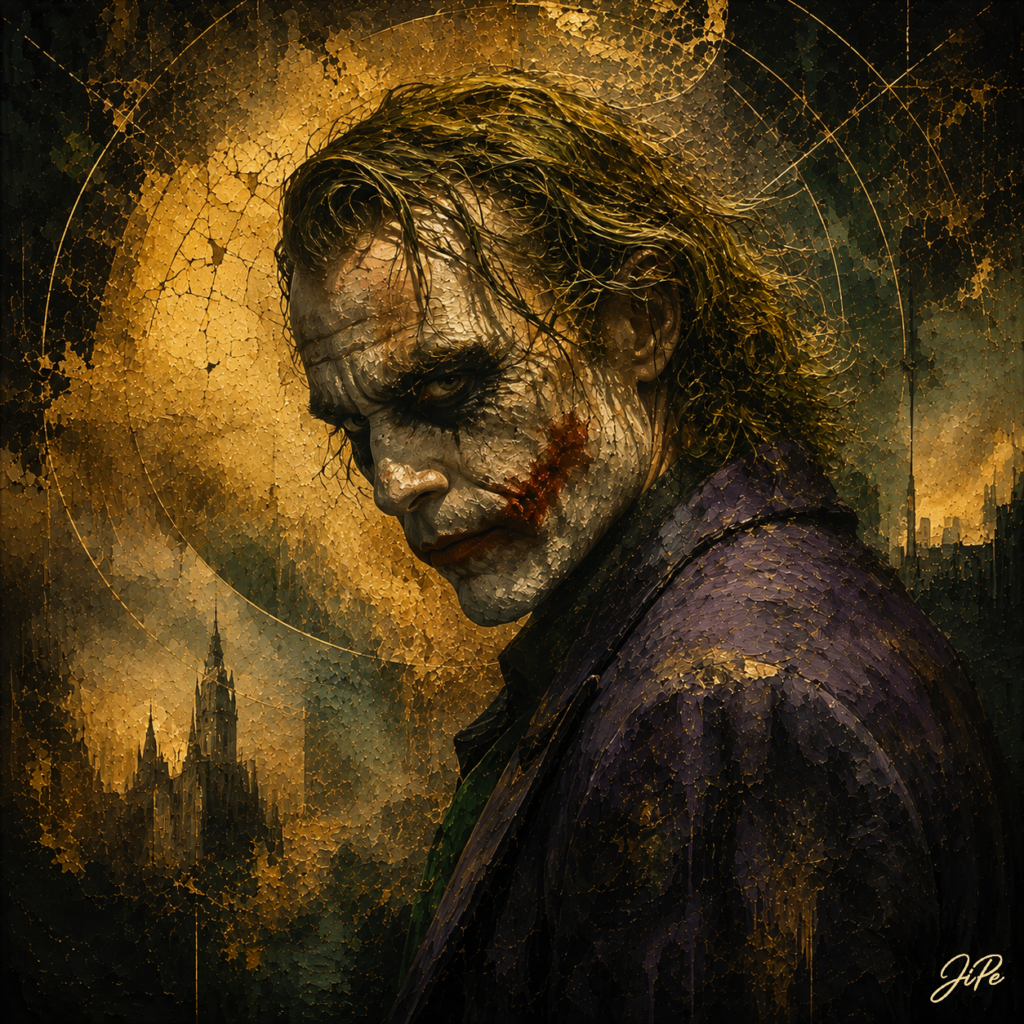
The Joker holds its subject in a moment of unnerving stillness, where menace is created less by action than by the possibility of what may follow. Heath Ledger’s portrayal in The Dark Knight became one of modern cinema’s most recognizable performances, earning him a posthumous Academy Award and leaving an enduring imprint on popular culture. The character’s fame has long since exceeded the boundaries of the film, while Ledger’s performance remains inseparable from its cultural memory.
Here, that familiarity is made strangely distant. The figure occupies the image with monumental gravity, yet seems psychologically unreachable. Light gathers behind him almost ceremonially, creating an uneasy tension between elevation and darkness. The city recedes into silence, as though the external world has become secondary to an interior logic we cannot enter.
The title, The Joker, names both a character and an idea: identity concealed within performance, order confronted by unpredictability, the human face transformed into a mask that reveals as much as it hides. Ledger’s fame adds another layer—the actor remains present within a role that has acquired an afterlife of its own.
What endures, then: the character, the performance, the man behind it—or the unsettling space where all three can no longer be entirely separated?