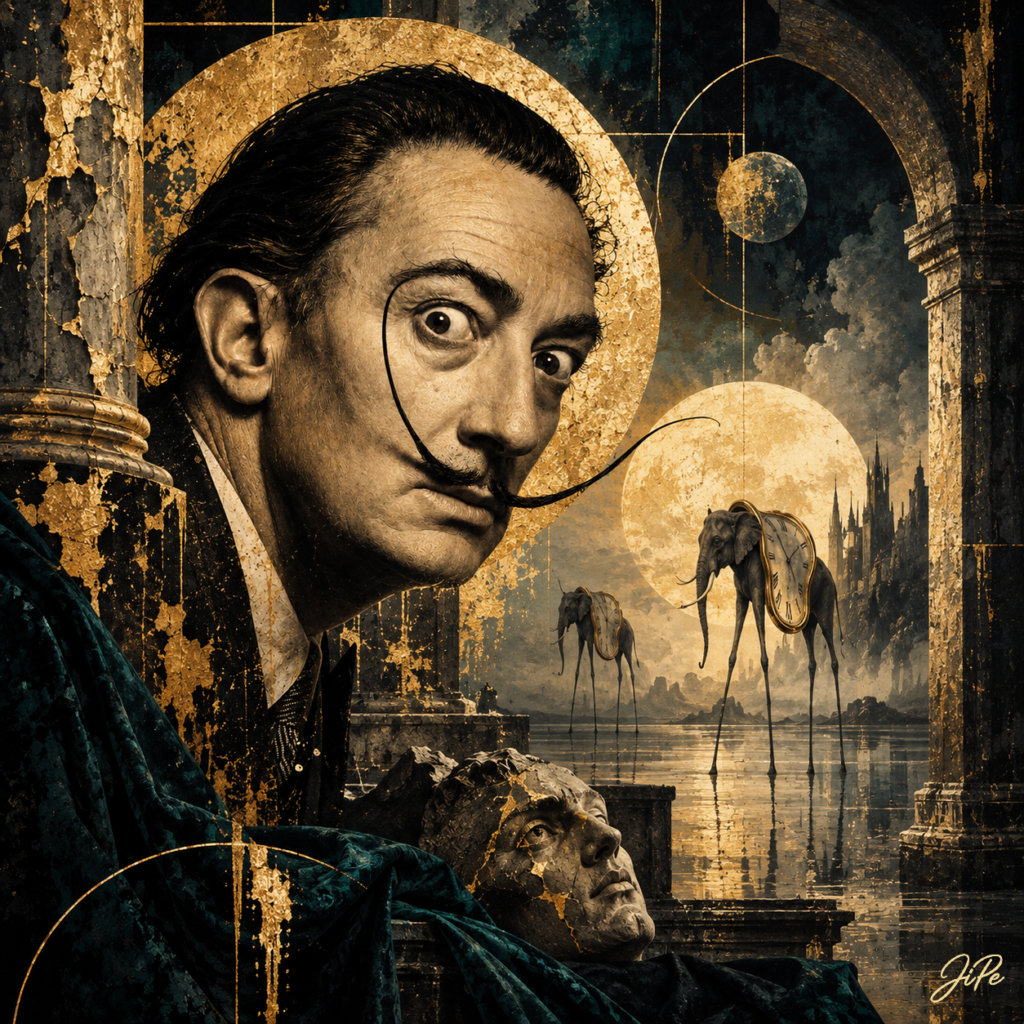
Salvador Dalí places the artist at the threshold between recognizable identity and a reality that refuses ordinary logic. Dalí became one of the twentieth century’s most internationally famous artists, cultivating a public presence so distinctive that his face, gestures, and celebrated moustache became cultural symbols in their own right. His fame extended beyond his paintings; the artist himself became part of the mythology surrounding his work.
Here, that unmistakable presence dominates without fully controlling the world around it. Scale shifts, time appears unstable, and distant forms inhabit a silence that feels suspended between dream and memory. Light assumes an almost metaphysical weight, illuminating certain passages while allowing others to remain unresolved. The familiar face is intensely present, yet the surrounding space continually undermines certainty.
In Salvador Dalí, the boundary between creator and creation becomes difficult to locate. The public persona, the private imagination, and the enduring images associated with his name seem to occupy the same psychological territory. Fame itself begins to resemble another transformation of reality.
Perhaps the final ambiguity lies there: did Dalí create a world through which we understand him, or did he gradually become another extraordinary figure inside the world he created?