Echoes of the Forgotten God

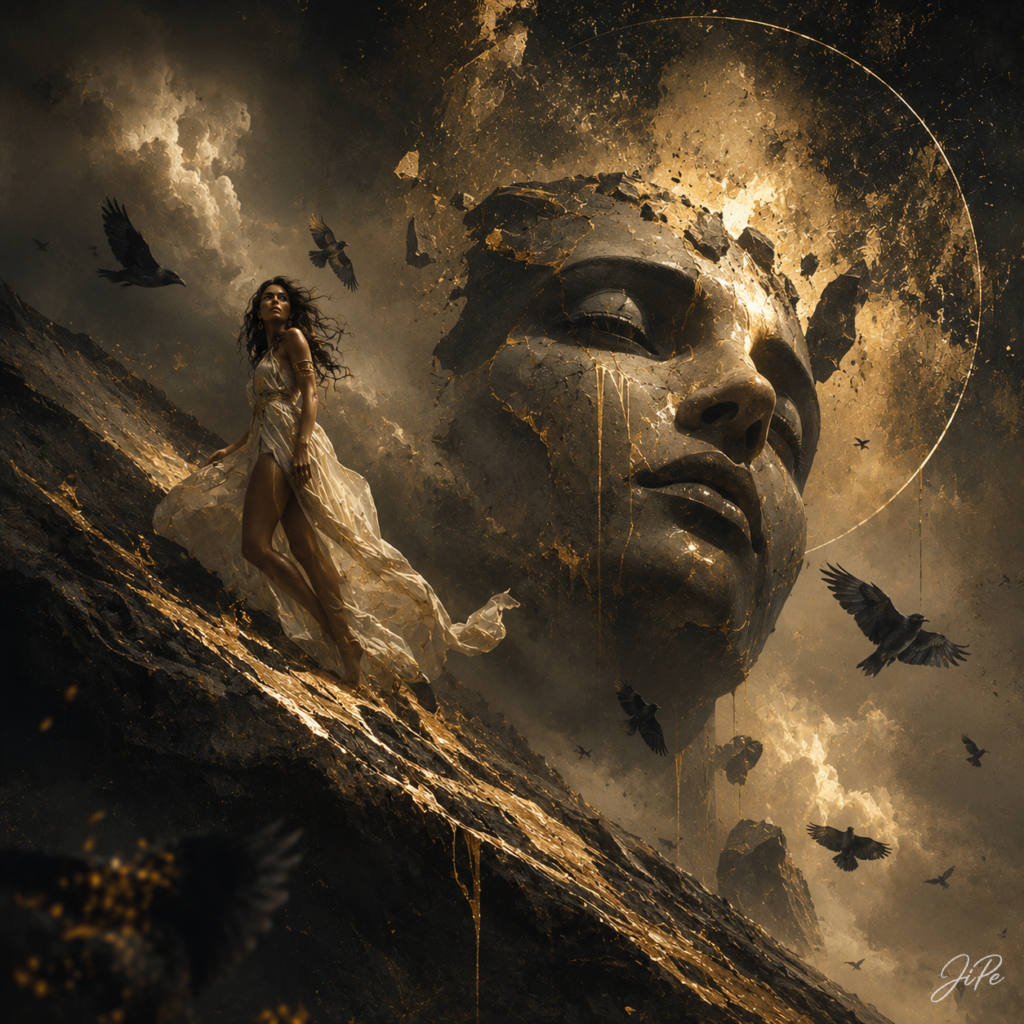
Echoes of the Forgotten God is a monumental meditation on memory, divinity, mortality, and the fragile relationship between humanity and the sacred. The work presents a mysterious female traveler moving across a steep, dark landscape while an immense fractured face rises behind her like the remains of a vanished deity. Ravens cross the turbulent sky, fragments of stone break away into space, and veins of gold illuminate cracks running through both the landscape and the colossal form. The entire scene appears suspended between destruction and revelation, as though the viewer has entered a world where an ancient god has disappeared but has never completely ceased to exist.
The title is fundamental to the work’s meaning. It does not describe the god himself, but his echoes. An echo is what remains after the original voice has fallen silent. It is evidence of a presence that can no longer be reached directly. In this sense, the painting is less concerned with divine appearance than with divine absence—with what happens when belief fades, temples disappear, names are forgotten, yet traces of something once considered eternal continue to survive.
The forgotten god is therefore both absent and overwhelmingly present.
His face dominates the sky.
The colossal face
The enormous sculptural head forms the visual and symbolic center of the composition. Its scale is deliberately impossible. It dwarfs the human figure, the birds, and the surrounding landscape, transforming the face from portrait into monument.
Yet this is not a monument preserved in triumph.
It is breaking apart.
Large sections of the forehead and skull have fractured into floating debris. Cracks spread across the surface. Golden lines penetrate the dark material, while streams resembling molten metal or sacred tears descend across the face.
The god appears caught between permanence and dissolution.
This contradiction is central to the painting. Gods are traditionally imagined as immortal, while stone monuments are created precisely to resist the passage of time. Here, both ideas are challenged. The divine image itself has become vulnerable to decay.
The supposedly eternal is disappearing.
And yet it has not disappeared.
That unresolved condition gives the work much of its emotional power.
The face as ruin
The colossal head can be interpreted as the remains of an ancient sculpture, but the painting deliberately makes its material identity uncertain.
Is it carved stone?
Is it a living deity becoming stone?
Is it a mountain shaped like a forgotten face?
Or is the entire vision occurring within the traveler’s consciousness?
The ambiguity allows the image to move between archaeology, mythology, and psychology.
The face becomes a ruin of belief.
Civilizations throughout history have created monumental images of their gods, rulers, ancestors, and sacred figures. These images often represented ideas intended to transcend individual human lives. Yet history repeatedly demonstrates that even the most powerful systems of belief can eventually become archaeological fragments.
Temples become ruins.
Sacred languages become undeciphered inscriptions.
Gods become mythology.
Ritual objects enter museums.
The painting compresses this enormous historical process into one extraordinary face.
The solitary woman
Against the immense scale of the forgotten deity stands a single woman.
Her placement is crucial. She occupies the left side of the composition, ascending or traversing a steep diagonal terrain while the colossal face fills the space behind her. Her pale, flowing garment contrasts dramatically with the black and gold landscape, immediately drawing the viewer’s attention.
She is physically small.
But she is not visually insignificant.
Her upright posture and upward gaze give her a sense of determination and awareness. She appears to have discovered something—or perhaps to have returned to something she already knew existed.
Unlike the god, whose eyes are closed, the woman is awake.
This creates one of the painting’s most significant symbolic oppositions.
The mortal sees while the god sleeps.
The human figure possesses temporary life but active consciousness.
The divine figure possesses monumental scale but remains silent.
This reversal complicates the traditional hierarchy between humanity and divinity.
The upward gaze
The woman does not look directly toward the colossal face. Instead, her attention appears directed upward and outward, toward something beyond the visible boundaries of the composition.
This creates an important sense that the forgotten god may not be the final destination of her journey.
She has encountered the remains of something enormous, but she continues to look beyond it.
Perhaps she is searching for the source behind the image.
Perhaps the god was only one interpretation of something greater.
Perhaps she recognizes that sacred forms can disappear while the human desire for transcendence remains.
Her gaze therefore transforms the work from an image of lost faith into an image of continued searching.
The god may be forgotten.
The search is not.
The closed eyes of the deity
The god’s closed eyes are among the most psychologically powerful elements in the composition.
An open gaze would create confrontation. The deity would appear conscious of the traveler and perhaps capable of judgment or intervention.
Instead, the eyes remain shut.
This silence introduces ambiguity.
Is the god dead?
Sleeping?
Dreaming?
Waiting?
Or has humanity simply lost the ability to awaken him?
The painting refuses to answer.
This uncertainty allows the closed eyes to function symbolically. They mark the boundary between presence and absence.
The face exists.
But communication has been lost.
The deity can still be seen but no longer speaks.
This is precisely the condition suggested by the word “forgotten.”
Golden tears
Thin streams of gold descend from the colossal face like tears.
These lines introduce an extraordinary emotional dimension to the otherwise monumental figure. A being large enough to resemble a landscape suddenly appears vulnerable.
The gold may suggest divine energy escaping from the fractured form.
But it can also be read as mourning.
Perhaps the god mourns his own disappearance.
Perhaps he mourns the civilization that once remembered him.
Perhaps the tears represent the final remnants of sacred power leaving the physical world.
Their golden color prevents them from being interpreted simply as sorrow. Gold traditionally carries associations with sacredness, incorruptibility, illumination, transcendence, and value.
The tears therefore become something more complex:
grief transformed into light.
Fracture as revelation
Golden fissures spread across the deity, landscape, and atmosphere.
This visual motif connects apparently separate parts of the composition into one underlying structure. The same energy that moves through the god also appears to exist within the world itself.
At first glance, the cracks suggest destruction.
On closer inspection, they reveal illumination.
Something beneath the surface is glowing.
This transforms fracture into a form of revelation.
An unbroken surface conceals its interior. A crack exposes what lies beneath.
Within Echoes of the Forgotten God, destruction therefore becomes paradoxically revelatory. The deity becomes most luminous precisely as the image begins to break apart.
The work suggests that disappearance may reveal meaning that permanence once concealed.
The halo
A thin circular form surrounds the colossal head, functioning simultaneously as halo, celestial orbit, sacred geometry, and compositional frame.
The circle immediately separates the figure from ordinary human identity.
Across centuries of religious and symbolic art, circular forms have represented eternity, unity, perfection, cosmic order, and divine presence. Here, however, the halo does not belong to a pristine sacred image.
It surrounds a god who is disintegrating.
This creates another powerful contradiction.
The symbol of eternity remains intact while the figure it sanctifies collapses.
The painting therefore asks whether sacred ideas can survive the forms created to represent them.
A statue can break.
A temple can disappear.
A name can be forgotten.
But can the underlying human experience of the sacred disappear as easily?
The halo suggests perhaps not.
Ravens and the persistence of memory
Dark birds move throughout the composition, their silhouettes cutting across the luminous atmosphere.
Whether understood specifically as ravens or more generally as symbolic black birds, they contribute strongly to the work’s atmosphere of prophecy, memory, death, and passage.
Ravens in particular carry rich mythological associations. They have frequently appeared as messengers, observers, companions of gods, and symbols of knowledge or memory.
Within this painting, their movement contrasts with the immobility of the colossal face.
The god remains silent.
The birds continue to travel.
This makes them potential carriers of what survives.
Perhaps the deity’s temples have disappeared and his worshippers are gone, but fragments of his story remain in motion.
The birds become living echoes.
The diagonal landscape
The steep diagonal running from the lower left toward the central area of the painting gives the composition unusual energy.
The woman does not stand on stable horizontal ground. She moves across an inclined world.
This physical instability reinforces the philosophical instability of the scene.
Nothing is secure.
The god is breaking.
The landscape is fractured.
Stone floats through the atmosphere.
The sky is turbulent.
Even gravity seems uncertain.
The woman must maintain balance while moving through this unstable environment.
Her physical journey therefore becomes a metaphor for the human attempt to navigate a world in which inherited certainties have begun to collapse.
Light emerging from darkness
The painting is dominated by black, charcoal, bronze, and muted earth tones, but extraordinary golden illumination breaks through the darkness.
This light appears strongest behind the colossal face, where the fragmentation of the deity allows the sky itself to burn through.
Again, destruction and illumination become inseparable.
The god’s disintegration creates an opening for light.
This is one of the most significant visual propositions in the work.
The disappearance of an old structure does not necessarily result only in emptiness.
It may create space for something previously hidden.
This interpretation allows Echoes of the Forgotten God to move beyond melancholy toward transformation.
A landscape of the sublime
From an art-historical perspective, the work strongly engages with the tradition of the sublime.
The sublime emerges when the viewer confronts something so vast, powerful, mysterious, or overwhelming that ordinary categories of understanding become inadequate. Romantic artists often used mountains, storms, oceans, ruins, and tiny human figures to create this sensation.
Echoes of the Forgotten God adapts this tradition to a contemporary mythological environment.
The overwhelming force is not merely nature.
It is memory.
The woman confronts a presence that is physically gigantic but historically absent.
The true scale of the deity lies not only in the size of the face but in the unknown span of time separating the traveler from the civilization that once understood it.
The painting therefore combines spatial and temporal sublimity.
The god is enormous.
But the forgotten past behind him is even larger.
Symbolism and visionary art
The work also belongs naturally within the territory of contemporary Symbolism and visionary art.
Its elements operate simultaneously as physical objects and metaphors.
The woman is both traveler and consciousness.
The god is both sculpture and forgotten belief.
The ravens are both birds and memory.
The cracks are both destruction and revelation.
The gold is both material and transcendence.
The halo is both geometry and eternity.
The landscape is both terrain and psychological state.
This multiplicity prevents the painting from becoming a simple illustration.
Its meaning remains open because each visual element can support several interpretations at once.
When belief becomes archaeology
One of the most compelling readings of Echoes of the Forgotten God concerns the transformation of belief into history.
Every civilization tends to experience its own sacred systems as immediate and meaningful. Gods are worshipped as living presences. Temples function as active centers of ritual. Symbols are understood by communities that share their meaning.
Centuries later, the same objects may be encountered very differently.
The temple becomes an archaeological site.
The sacred image becomes an artifact.
The ritual becomes a subject of academic reconstruction.
The god becomes mythology.
The painting visualizes this transition.
The traveler appears to have arrived after belief has become ruin.
She can see the face.
But can she understand what it once meant?
This gap between seeing and understanding is central to the work.
The forgotten name
Significantly, the title does not tell us the god’s name.
This absence is powerful.
To name a deity would connect the image to an established mythology and provide the viewer with a ready-made narrative.
Instead, the god remains unnamed.
His identity has disappeared.
Only the image survives.
This makes the figure universal.
He could represent every forgotten deity, every vanished belief system, every civilization whose sacred world once seemed permanent.
The absence of a name also places the viewer in the same position as the traveler.
We encounter the remains without possessing the original explanation.
We must interpret fragments.
The fragility of immortality
The painting contains an important paradox regarding immortality.
The god is physically monumental but culturally fragile.
The woman is physically vulnerable but consciously present.
The deity may once have been considered eternal, yet he has been forgotten.
The mortal traveler will eventually disappear, yet in this moment she is the one capable of remembering.
This reversal suggests that immortality may depend less on divine nature than on human memory.
A god remembered for thousands of years remains culturally alive.
A god completely forgotten effectively disappears.
The work therefore asks an unsettling question:
Do gods survive because they are immortal—or because someone continues to remember them?
Memory as resurrection
If forgetting causes disappearance, remembering becomes a form of resurrection.
The traveler’s presence may therefore possess greater significance than first appears.
Simply by encountering the forgotten face, she restores it to consciousness.
She sees what had been unseen.
And through her, the viewer sees it as well.
The painting itself performs the same act.
Art creates an image of the forgotten god and therefore makes him present again.
He may not return as an object of worship.
But he returns as a question.
As an image.
As an idea.
As an echo.
This is one of art’s oldest powers: to make absent things present.
The god as psychological archetype
The colossal figure can also be interpreted not historically but psychologically.
Perhaps the forgotten god represents an aspect of the human self that has been suppressed, abandoned, or lost.
The woman may therefore be traveling not through an ancient landscape but through an interior one.
The giant face becomes buried memory.
The ravens become returning thoughts.
The fractures become emotional wounds.
The golden light becomes awareness.
The journey becomes an encounter with something once central to identity but later forgotten.
Under this interpretation, the title becomes deeply personal.
Everyone carries forgotten gods.
Old ambitions.
Childhood selves.
Lost beliefs.
People once loved.
Dreams abandoned.
Fears buried.
Versions of ourselves that no longer govern our lives but remain somewhere beneath the surface.
Occasionally, something awakens their echo.
The difference between silence and absence
The painting repeatedly challenges the assumption that silence means nonexistence.
The deity does not speak.
But his face remains.
His eyes do not open.
But gold still moves through his fractures.
His civilization may have vanished.
But symbols of sacredness remain around him.
This creates an important philosophical distinction.
Something can cease to speak without ceasing to influence.
The past operates in precisely this way.
Much of what shapes the present comes from people, cultures, and events that can no longer explain themselves.
We live among echoes.
Language itself is inherited.
Traditions are inherited.
Architecture is inherited.
Myths are inherited.
Even ideas we believe to be modern often carry fragments of far older structures.
The forgotten god becomes a metaphor for these invisible inheritances.
Destruction as transformation
The upper part of the colossal head appears to explode outward into fragments.
Yet the movement does not feel purely catastrophic.
Light pours through the opening.
The fragments become part of the atmosphere.
The physical form is breaking down, but its energy appears to disperse into the surrounding world.
This suggests transformation rather than simple annihilation.
Perhaps nothing disappears entirely.
It changes form.
A religion becomes mythology.
A temple becomes a ruin.
A god becomes an archetype.
A ritual becomes tradition.
A historical memory becomes art.
The original form dies.
Its influence continues elsewhere.
The traveler and the god
The relationship between the woman and the colossal face ultimately gives the painting its deepest emotional dimension.
They are opposites in almost every respect.
She is small.
He is enormous.
She moves.
He remains still.
Her eyes are open.
His are closed.
She belongs to the present moment.
He belongs to an immeasurable past.
She is mortal.
He was presumably considered eternal.
Yet it is she who now carries the possibility of continuation.
If she remembers him, something survives.
This creates an extraordinary reversal of power.
The god once may have governed the lives of mortals.
Now his existence depends upon a mortal witness.
The echo as final symbol
The title’s word “echo” ultimately provides the key to the entire composition.
An echo cannot exist without an original sound.
But it also cannot preserve that sound perfectly.
It returns altered.
Weaker.
Delayed.
Transformed by distance and environment.
This is exactly how cultural memory works.
The past never returns unchanged.
Every generation receives fragments and interprets them through new experiences.
Myths evolve.
Symbols acquire new meanings.
History is rewritten as new evidence appears.
The forgotten god cannot return exactly as he once existed.
He can only return as an echo.
And perhaps that is enough.
A meditation on what survives
Ultimately, Echoes of the Forgotten God is a work about the persistence of meaning after the disappearance of certainty.
Its visual world is filled with loss: the deity is fractured, the landscape unstable, the sky turbulent, and the original civilization nowhere to be seen.
Yet the work is equally filled with continuation.
The woman walks.
The birds fly.
Gold remains luminous.
The halo survives.
The fragments still carry the shape of what they once belonged to.
Memory persists.
The painting therefore refuses to treat forgetting as complete annihilation.
Something always seems to remain.
Perhaps only a fragment.
Perhaps a symbol.
Perhaps a story whose original meaning has changed.
Perhaps a feeling no one can fully explain.
Perhaps only an echo.
The woman continues across the dark slope while the immense forgotten face dissolves behind her. Ravens move through the turbulent sky. Golden fractures illuminate ancient surfaces. The god remains silent, his closed eyes preserving a mystery that neither the traveler nor the viewer can fully recover.
We do not know his name.
We do not know who worshipped him.
We do not know why he was forgotten.
But for the duration of the encounter, he exists again.
And therein lies the work’s most profound idea:
Perhaps the opposite of death is not immortality, but remembrance. In Echoes of the Forgotten God, the divine survives not because stone can resist time, but because even after the name has vanished and the monument has begun to fall, something continues to resonate in those who encounter what remains.