
The First Crossing
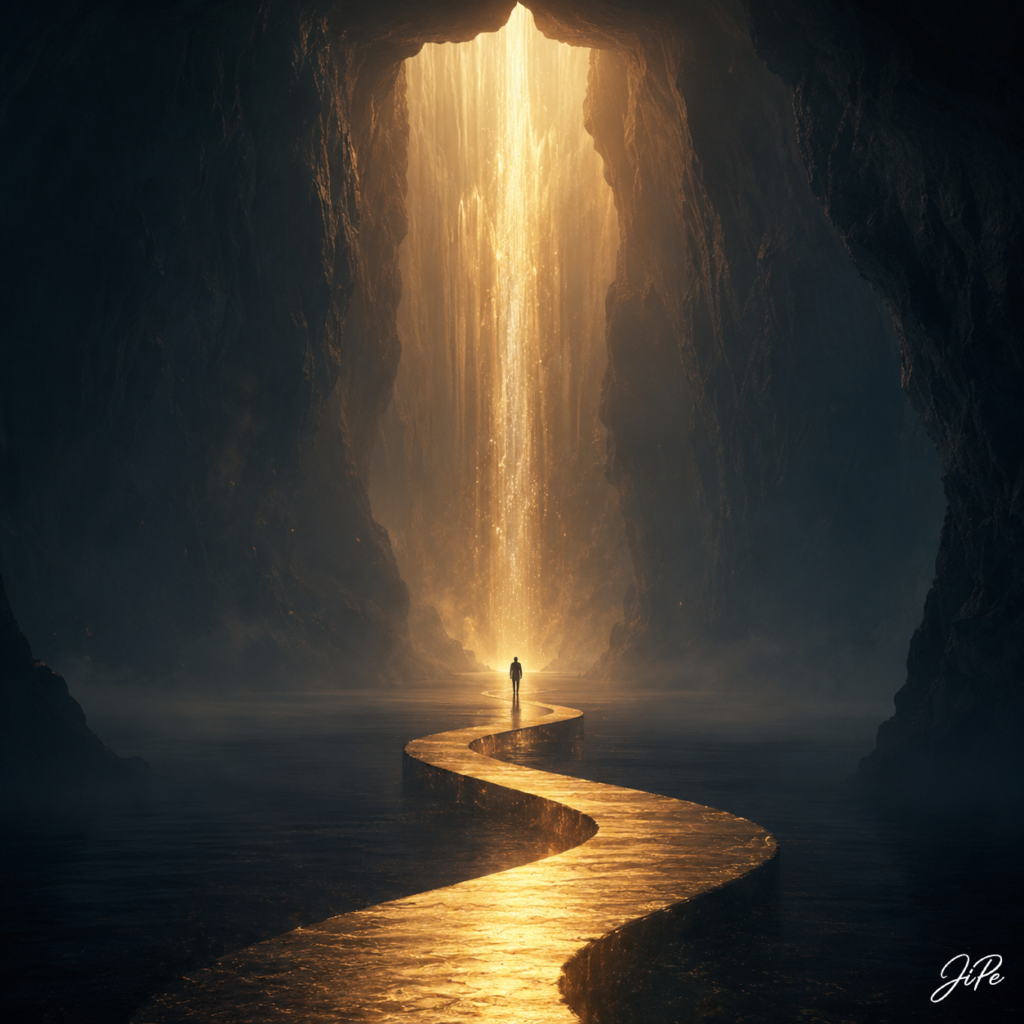
The First Crossing is a profound meditation on transition, faith, and the mysterious threshold between the known and the unknown. Rooted in the visual traditions of contemporary symbolic realism, minimalist monumentalism, and visionary art, the work transforms a seemingly simple journey into a universal allegory of human existence. Through its restrained composition, monumental scale, and luminous treatment of light, the painting explores one of humanity’s oldest experiences: the moment when we choose to step beyond certainty and into transformation.
Unlike narrative paintings that seek to describe a specific event, The First Crossing deliberately resists literal interpretation. Instead, it presents a symbolic landscape where every element functions as metaphor. The solitary figure, the winding golden pathway, the immense cavern, and the descending column of celestial light combine to create a visual language that speaks equally to spiritual awakening, psychological growth, philosophical inquiry, and personal renewal. The painting does not provide answers—it creates a space in which contemplation becomes the viewer’s own journey.
At the centre of the composition stands a lone human figure, almost insignificant in physical scale when compared to the overwhelming dimensions of the surrounding cavern. Yet this apparent fragility becomes the source of the work’s emotional power. Throughout history, artists have used the solitary figure to express humanity’s relationship with the infinite. Here, that tradition is elevated into something deeply contemporary. The figure represents neither hero nor pilgrim alone, but every individual who has ever stood before a life-changing decision, an unseen future, or an encounter with something greater than themselves.
The title, The First Crossing, introduces the painting’s central philosophical idea. A crossing is never simply the act of moving from one place to another. It signifies transformation. It marks the irreversible moment when one leaves behind an old reality while stepping toward another that cannot yet be fully understood. The word ”first” intensifies this symbolism, suggesting an origin, an initiation, or the beginning of a lifelong spiritual passage. Every meaningful transformation begins with a first step, and this painting captures that exact moment with extraordinary restraint.
Perhaps the most striking feature of the composition is the winding golden path that leads through the darkness toward the radiant source of light. The path refuses the simplicity of a straight line. Instead, it curves gently across the still waters, suggesting that genuine progress is rarely direct. Human growth unfolds through uncertainty, patience, and gradual discovery. The elegant serpentine movement also creates an exceptional compositional rhythm, guiding the viewer’s eye naturally through the image while reinforcing the symbolic nature of the journey itself.
The path appears almost suspended between material and immaterial existence. Its luminous surface reflects the descending light while floating above dark waters that seem immeasurably deep. Water has long symbolised the unconscious, memory, purification, and the unknown. Here it functions as the invisible realm beneath conscious experience—the vast emotional and spiritual depths over which every individual must travel. The illuminated path becomes a metaphor for inner conviction: fragile in appearance, yet strong enough to carry those willing to trust it.
Dominating the composition is the immense vertical cascade of golden light descending from the opening high above the cavern. This extraordinary beam functions simultaneously as waterfall, divine illumination, architectural axis, and metaphysical connection between heaven and earth. It is not merely a source of visibility; it is the organising principle of the entire composition. Every visual element is oriented toward this radiant centre, making light itself the true subject of the painting.
Unlike dramatic religious imagery in which divine light overwhelms the observer, the illumination in The First Crossing possesses remarkable gentleness. It falls silently, almost tenderly, into the darkness below. The effect is profoundly contemplative. Rather than commanding attention through spectacle, the light invites quiet reflection. It suggests revelation without force and presence without domination. This restraint gives the work an emotional maturity that rewards prolonged observation.
The cavern surrounding the figure becomes another powerful symbolic element. Vast walls of dark stone rise beyond visibility, enclosing the scene while simultaneously suggesting immeasurable depth. The cave has appeared throughout mythology, religion, and philosophy as both sanctuary and place of initiation. From Plato’s allegory of perception to sacred hermitages and prehistoric sanctuaries, caves represent the interior landscape of human consciousness. In this painting, the cavern becomes the mind itself—a place where darkness is not the absence of meaning but the space from which illumination emerges.
Scale plays a crucial role in shaping the viewer’s experience. The monumental dimensions of the environment dramatically diminish the human figure, yet this reduction never communicates hopelessness. On the contrary, the painting proposes that true significance arises precisely from recognising one’s place within something infinitely greater. The individual becomes meaningful not despite their smallness but because of their willingness to continue walking.
The composition demonstrates remarkable balance between minimalism and monumentality. Every unnecessary visual element has been removed, allowing the essential symbolic forms to resonate with extraordinary clarity. The vast negative spaces surrounding the illuminated pathway create an atmosphere of silence rarely achieved in contemporary figurative painting. This disciplined simplicity allows the emotional weight of the image to emerge gradually rather than through immediate visual complexity.
Colour is handled with exceptional sophistication. Deep charcoal blues, muted blacks, and cool atmospheric greys dominate the cavern, while luminous golds, warm ambers, and delicate ivory highlights define the path and descending light. This restrained palette establishes an elegant dialogue between concealment and revelation, darkness and hope, mystery and understanding. The golden illumination never feels decorative; it appears intrinsic to the spiritual architecture of the work itself.
Materially, the painting demonstrates a refined sensitivity to surface and atmosphere. Subtle painterly textures enrich the stone walls, while the reflective pathway captures shifting nuances of light with remarkable realism. Soft atmospheric haze dissolves sharp boundaries, allowing forms to emerge gradually from darkness. This combination of tactile texture and ethereal atmosphere creates a visual experience that feels simultaneously monumental and intimate.
Art historically, The First Crossing enters into dialogue with multiple traditions. The spiritual minimalism recalls the contemplative architecture of sacred spaces, while the dramatic treatment of light evokes the emotional power of Baroque painting. At the same time, its symbolic restraint aligns it with twentieth-century metaphysical art and contemporary visionary realism. Yet the painting avoids direct quotation of historical styles. Instead, it synthesises these influences into a distinct visual language characterised by clarity, elegance, and timeless symbolism.
The work also explores the psychological dimensions of transition. Every individual eventually encounters moments when familiar structures dissolve and certainty disappears. Careers change, relationships evolve, identities shift, beliefs mature. During these passages, one often walks without fully understanding the destination. The First Crossing visualises precisely this condition. The destination remains partially concealed, yet the path itself remains illuminated. The painting therefore suggests that meaning is discovered not by seeing the entire journey in advance, but by trusting the next visible step.
From a theological perspective, the descending light may be understood as divine grace, revelation, or spiritual calling. From a philosophical perspective, it may represent truth itself. Psychologically, it becomes the emergence of higher consciousness. Artistically, it functions as pure visual rhythm. The strength of the painting lies precisely in its openness. It refuses to confine itself to a single interpretive framework, allowing viewers from diverse cultural, philosophical, and spiritual backgrounds to encounter their own reflections within its symbolic architecture.
The extraordinary silence that permeates the work is perhaps its greatest achievement. Nothing distracts from the essential encounter between the solitary traveller and the radiant unknown. There are no dramatic gestures, no narrative conflict, and no visible obstacles beyond the immensity of the journey itself. This profound stillness transforms the painting into an experience rather than simply an image. Standing before it becomes an act of contemplation.
Ultimately, The First Crossing is a painting about courage—not the courage found in conquest or certainty, but the quieter courage required to continue walking when the destination remains hidden. It reminds us that every life contains thresholds that cannot be crossed collectively. Some journeys must be undertaken alone, guided only by faith, hope, curiosity, or an inner conviction that light exists beyond the darkness.
In its monumental simplicity, luminous symbolism, and masterful orchestration of space and light, The First Crossing transcends narrative illustration to become a timeless meditation on human transformation. It invites viewers to recognise that every meaningful beginning starts with a single crossing, and that the path toward illumination is rarely revealed all at once. Instead, it unfolds gradually beneath our feet, one luminous step at a time, leading us toward a horizon that becomes visible only because we choose to move forward.