Monumental Visionary Fine Art exploring mythology, consciousness, sacred light, and timeless visual storytelling.

Monumental Visionary Fine Art exploring mythology, consciousness, sacred light, and timeless visual storytelling.

Surreal Paintings

The Breath Before Creation

The Breath Before Creation

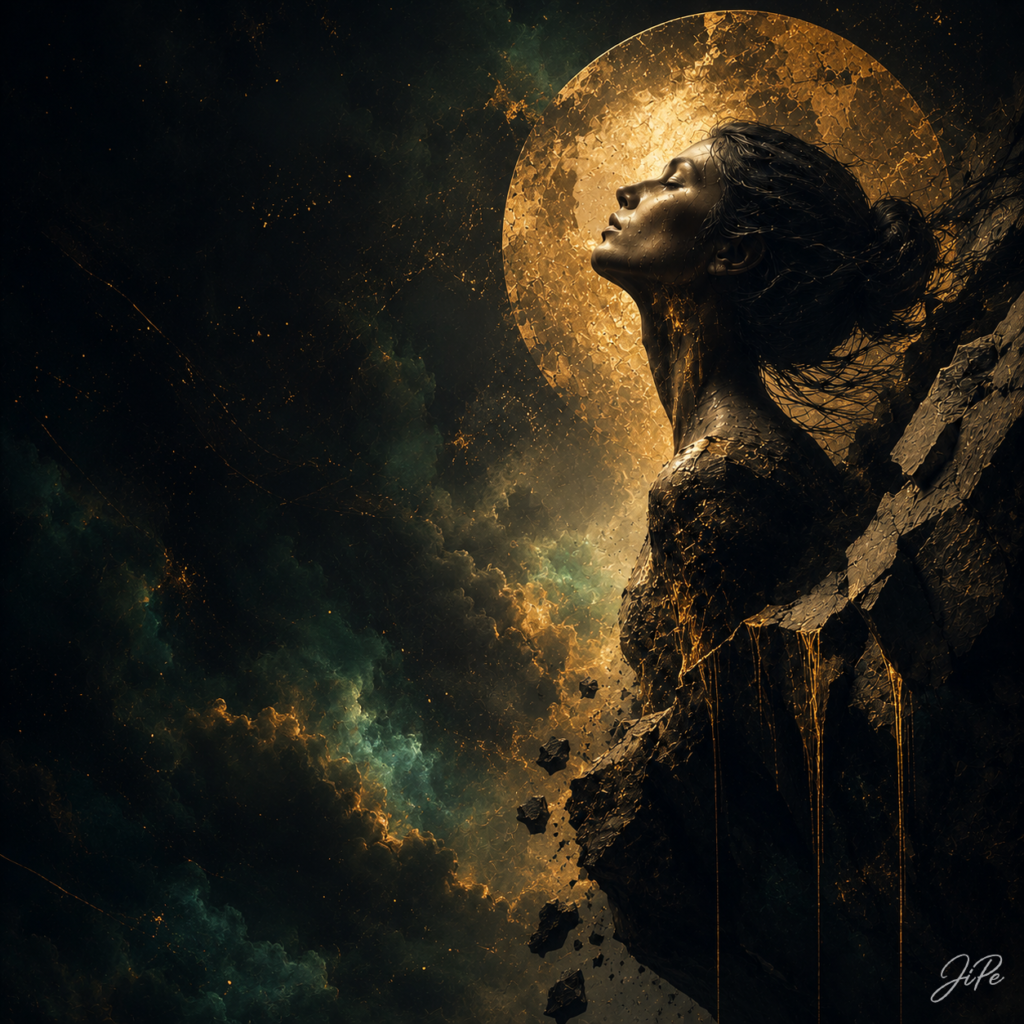
Every civilisation has imagined a moment before the beginning—a silent interval before light separated from darkness, before time acquired direction, before existence unfolded into form. The Breath Before Creation inhabits this profound and mysterious threshold. It is not a depiction of the creation of the world itself, but of the infinite stillness that precedes every act of creation. It portrays the invisible pause in which possibility exists without form, where becoming has not yet chosen its shape, and where eternity quietly gathers its first breath.

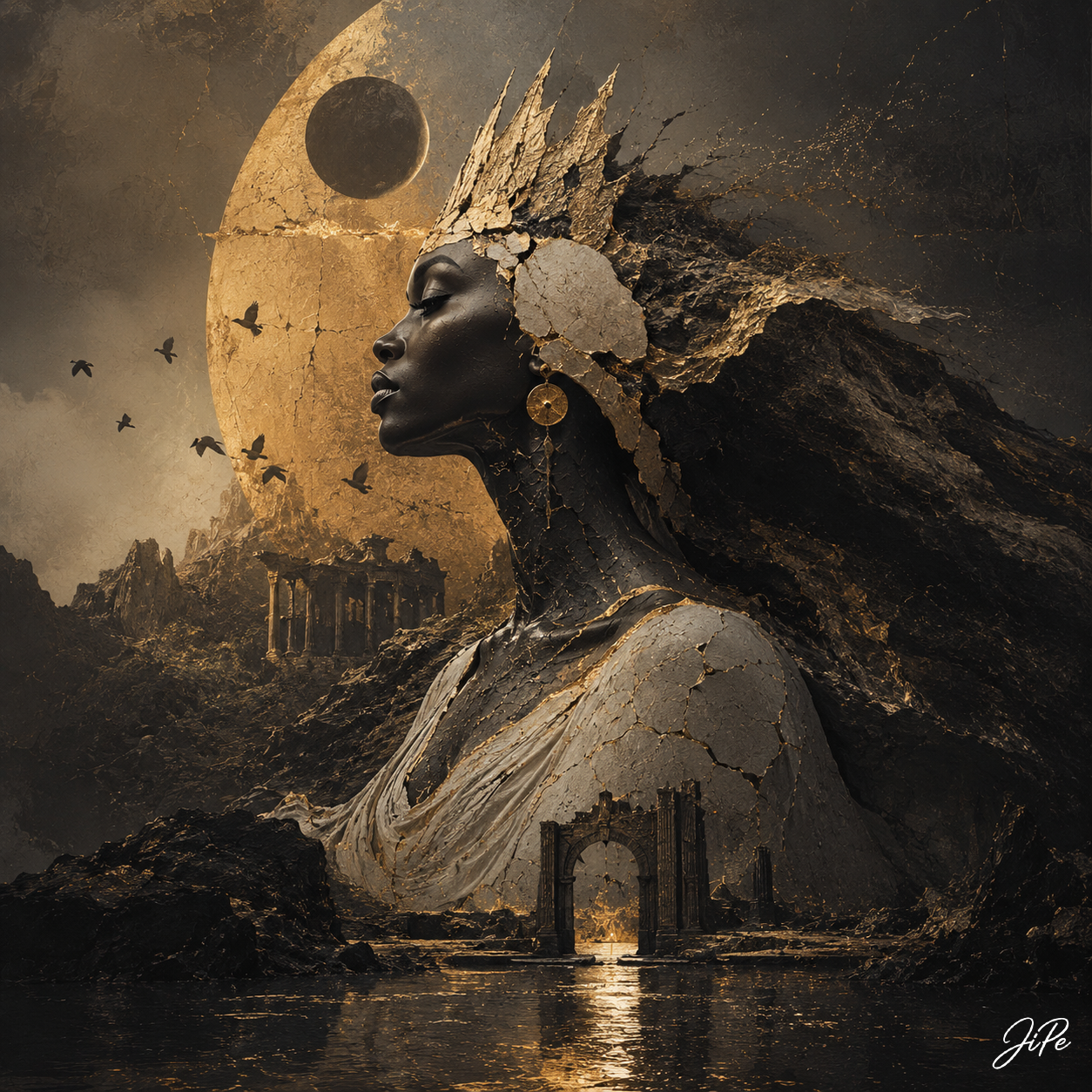
At the centre of the composition emerges a monumental female figure whose body appears to dissolve seamlessly into fractured stone. She is neither entirely human nor entirely geological, but something suspended between consciousness and the primordial substance of the universe itself. Her closed eyes and uplifted face suggest complete immersion in an unseen presence. She does not appear to await revelation; rather, she embodies the moment before revelation becomes reality.

The title introduces one of the work’s most compelling philosophical ideas. Breath is among the oldest symbols of life, spirit, and creation across countless cultures and religious traditions. Before words are spoken, before movement begins, before form emerges, there is breath. It is invisible yet transformative. In this painting, breath becomes the silent force that precedes existence itself—a metaphor for infinite potential held within perfect stillness.

Behind the figure radiates a monumental golden disc whose luminous surface recalls the visual language of sacred iconography while simultaneously evoking celestial bodies, eclipses, and cosmic gateways. The circle functions as far more than a compositional anchor. Throughout history, circular forms have symbolised eternity, unity, perfection, and the cyclical nature of existence. Here it becomes the visual manifestation of the eternal source from which all creation originates—a light that exists beyond time rather than within it.

Unlike many representations of divine illumination, however, this light is remarkably restrained. It does not overwhelm the figure but gently surrounds her, allowing darkness to retain equal significance within the composition. The artist consistently refuses to present darkness as the opposite of creation. Instead, darkness becomes its necessary companion. Just as seeds germinate beneath the earth and stars are born within cosmic voids, creation itself requires silence before it can become visible.

This delicate equilibrium between light and shadow defines the emotional atmosphere of the work. Vast areas of deep charcoal and midnight tones surround the luminous centre, creating an extraordinary sense of spatial depth. The darkness does not feel empty but alive—filled with subtle textures, distant clouds, and barely perceptible currents of colour. Hints of deep emerald and oxidised turquoise quietly emerge within the surrounding atmosphere, introducing a subtle chromatic complexity that enriches the otherwise restrained palette while reinforcing the painting’s cosmic character.

The artist’s characteristic use of fractured surfaces introduces another powerful symbolic layer. The woman’s body appears partially carved from weathered stone whose countless fissures shimmer with golden light. These fractures recall the philosophy of kintsugi, where brokenness is not concealed but honoured through precious restoration. Here, however, the symbolism extends even further. The cracks suggest that creation itself is born not from perfection but from openness—from the willingness to allow light to enter what has been broken, transformed, and renewed.

Materiality plays a central role in the painting’s emotional impact. Thick painterly textures, eroded surfaces, expressive brushwork, and subtle gold leaf effects create the impression of an ancient monument simultaneously emerging from and returning to the earth. The work possesses the tactile authority of weathered sculpture while retaining the atmospheric fluidity of contemporary mixed-media painting. This tension between permanence and dissolution reflects the central philosophical theme: that all existence continuously moves between formation and transformation.

Perhaps the painting’s greatest visual achievement lies in its extraordinary use of negative space. Large areas of quiet darkness surround the monumental figure, allowing silence itself to become an active compositional element. In an age often characterised by visual excess, the artist demonstrates remarkable restraint. Every empty region deepens the viewer’s awareness of the luminous centre, encouraging contemplation rather than spectacle. The composition breathes with the same quiet rhythm suggested by its title.

Psychologically, the figure may be interpreted as the embodiment of latent consciousness—the moment before inspiration, before healing, before courage, before the first irreversible decision that alters the course of a life. She represents not action but readiness. The closed eyes suggest that true vision often begins inwardly, long before the external world reflects that transformation. In this sense, the painting becomes an image of creative awakening as much as cosmic origin.

From an art historical perspective, The Breath Before Creation resonates with the contemplative ambitions of Symbolism while embracing the atmospheric grandeur of Romantic landscape painting and the tactile richness of contemporary mixed-media practice. Echoes of sacred iconography, monumental sculpture, and visionary abstraction coexist without becoming literal references. The result is a visual language that feels simultaneously ancient and unmistakably contemporary, rooted less in historical quotation than in universal archetypes.

The restrained colour palette of black, charcoal, weathered stone, luminous gold, and subtle emerald undertones contributes to the painting’s timeless presence. Gold continues to function as the artist’s primary symbolic language—not merely representing divinity but consciousness itself. It becomes the visible manifestation of invisible truth, illuminating neither objects nor landscapes alone, but the profound mystery from which all existence emerges.

The work intentionally resists definitive interpretation. Some viewers may recognise spiritual creation, others psychological rebirth, artistic inspiration, or the quiet resilience that precedes personal transformation. Still others may experience the figure as an embodiment of nature itself, silently preparing another cycle of life. The painting offers no single narrative because its subject exists prior to narrative itself. It speaks instead through atmosphere, intuition, and symbolic resonance.

Ultimately, The Breath Before Creation is a meditation on the sacred power of stillness. It reminds us that every meaningful act begins in silence long before it becomes visible. Every work of art, every civilisation, every relationship, every transformation first exists as unseen possibility carried within the quiet depths of imagination and spirit.

Standing before this work, the viewer is invited to inhabit that extraordinary threshold where nothing has yet happened, and yet everything already exists in potential. It is the moment before the first word, before the first heartbeat, before the first dawn—a timeless breath suspended between eternity and becoming. In that immeasurable silence, The Breath Before Creation reveals perhaps its deepest truth: creation does not begin with movement, but with the quiet courage to embrace infinite possibility before it takes form.

Lämna ett svar