Where Shadows Bloom

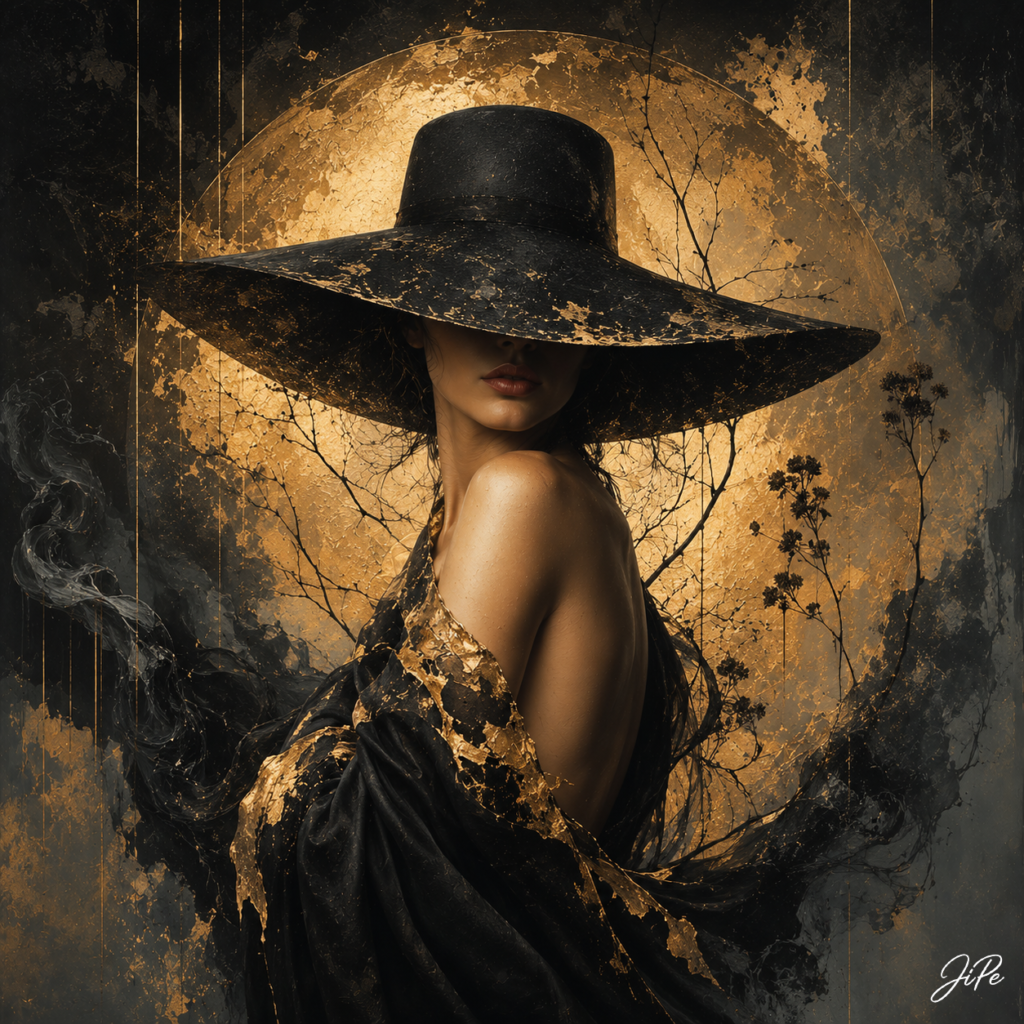
Where Shadows Bloom is a meditation on mystery, identity, and the quiet beauty that emerges from what remains unseen. Rather than portraying darkness as absence or fear, the painting presents shadow as fertile ground—a place where transformation begins, imagination flourishes, and inner truth quietly reveals itself. Existing between portraiture and symbolism, realism and abstraction, the work invites viewers into a contemplative space where concealment becomes a form of revelation, and elegance is found not in complete visibility, but in carefully preserved mystery.
The title, Where Shadows Bloom, suggests a paradox. Shadows are commonly associated with endings, uncertainty, or concealment, while blooming evokes growth, life, and renewal. By joining these opposing ideas, the artwork proposes that beauty does not arise despite darkness, but often because of it. Some of life’s most profound transformations occur beneath the surface, beyond immediate perception, in the silent spaces where certainty gives way to intuition.
At the heart of the composition stands a solitary female figure, wrapped in flowing black fabric and crowned by an oversized hat whose dramatic silhouette obscures much of her face. This concealment immediately shifts the viewer’s attention away from identity in the conventional sense. Without visible eyes to establish direct psychological contact, the figure becomes both individual and universal. She is less a portrait of one person than an embodiment of introspection itself—a presence suspended between visibility and invisibility, reality and imagination.
The hidden gaze is among the painting’s most compelling visual decisions. Throughout the history of portraiture, the eyes have traditionally served as the primary point of emotional connection. Here, their absence transforms the encounter. The viewer is denied immediate certainty and is instead invited to participate actively in the construction of meaning. Mystery becomes the emotional language of the work.
What remains unseen becomes just as important as what is revealed.
Behind the figure, a monumental golden disc radiates with quiet intensity, functioning simultaneously as halo, moon, eclipse, and celestial portal. Its circular geometry establishes both visual balance and symbolic depth. Across civilizations, the circle has represented eternity, wholeness, cosmic order, and spiritual continuity. In Where Shadows Bloom, this luminous form does not merely illuminate the figure—it frames her as though she exists within a sacred threshold between worlds.
The gold itself carries multiple layers of meaning. Rather than appearing polished and flawless, it reveals a weathered surface rich with cracks, textures, and imperfections. These tactile qualities evoke ancient frescoes, worn gilding, and archaeological remnants, suggesting that beauty deepens with time rather than diminishing. Gold here is not a symbol of wealth or ornamentation but of endurance, wisdom, and inner illumination earned through experience.
Throughout the composition, delicate fragments of gold seem to merge seamlessly with the flowing black garments, dissolving the traditional boundary between light and darkness. Neither dominates the other. Instead, they exist in continuous dialogue, reminding us that every source of light creates shadow, and every shadow gives shape to light.
The flowing fabric surrounding the figure behaves almost like living smoke or liquid ink. It expands beyond the body, becoming an expressive extension of inner emotion rather than simple clothing. These organic forms dissolve into abstraction, allowing movement itself to become symbolic. The darkness appears to breathe, carrying fragments of gold like memories suspended within time.
This fluid relationship between figure and environment dissolves distinctions between subject and atmosphere.
The woman does not merely inhabit the shadows.
She becomes part of them.
Subtle botanical elements emerge almost imperceptibly behind the figure, their delicate branches and dried blossoms introducing another symbolic layer. Plants have long represented cycles of life, renewal, and quiet resilience. Here they appear fragile yet enduring, suggesting growth that occurs silently, without spectacle. Their understated presence reinforces the central theme that flourishing often happens beneath outward appearances.
Compositionally, the work achieves remarkable equilibrium through restraint. Every visual element has been reduced to its essential form. Large areas of negative space allow the figure to command attention without theatrical excess. Vertical golden lines descending through the background introduce architectural rhythm while subtly suggesting invisible connections between earthly existence and higher consciousness.
The oversized hat serves as both physical object and symbolic device. Historically associated with elegance, protection, and social identity, it here becomes something more profound. Its expansive form creates a deliberate barrier between the external world and the figure’s interior life. Rather than concealing weakness, it protects contemplation. The hidden face becomes a sanctuary where identity remains self-defined rather than externally interpreted.
This quiet autonomy gives the work extraordinary psychological depth.
The viewer cannot possess the figure through observation.
Instead, one is invited to respect her silence.
Materially, Where Shadows Bloom celebrates the expressive possibilities of textured contemporary painting. Thick painterly surfaces, visible cracks, weathered finishes, and layered mixed-media effects create an object whose physical presence is inseparable from its conceptual meaning. Every imperfection contributes to the painting’s emotional authenticity. The surface feels lived rather than manufactured, carrying traces of time, memory, and transformation.
The restrained color palette amplifies this atmosphere. Rich charcoal blacks establish depth and gravity, while warm ivory skin tones provide subtle humanity amid the darker surroundings. Gold functions as the emotional heartbeat of the composition, drawing the eye without overwhelming the delicate balance of silence and space.
Rather than relying upon dramatic contrast, the painting builds emotional intensity through gradual transitions of tone, texture, and light.
From an art historical perspective, Where Shadows Bloom exists at the intersection of symbolic portraiture, contemporary surreal realism, minimalist elegance, and textured abstraction. Its visual language recalls traditions of sacred icon painting while embracing the expressive materiality of contemporary mixed-media practice. The result is a work that feels simultaneously timeless and unmistakably modern.
The influence of fashion portraiture is equally apparent, yet the painting transcends aesthetics alone. The figure’s elegance is never superficial. Beauty here functions as a vehicle for philosophical reflection rather than visual luxury. The carefully orchestrated composition transforms couture-inspired imagery into an exploration of identity, solitude, and spiritual presence.
Psychologically, the painting speaks to the human desire for inwardness in an increasingly visible world. In an age defined by constant exposure and immediate self-disclosure, Where Shadows Bloom celebrates the dignity of privacy. It reminds viewers that not every truth requires explanation, and that mystery itself possesses emotional power.
The work proposes that concealment is not deception.
It is preservation.
Some aspects of identity grow strongest when protected from constant observation.
The silence within the composition becomes almost audible. Nothing dramatic occurs. There is no visible narrative, no action demanding interpretation. Instead, the painting creates a contemplative pause—a moment suspended outside measurable time. This stillness encourages prolonged viewing, allowing subtle relationships between light, texture, and form to unfold gradually.
As viewers remain with the work, its emotional atmosphere deepens. The figure transforms from stranger into archetype, from portrait into reflection. She may become memory, intuition, resilience, longing, or simply the quiet part of ourselves that modern life rarely allows us to encounter.
This openness is among the painting’s greatest strengths.
It refuses definitive explanation.
Every interpretation remains valid because the work operates through emotional recognition rather than literal storytelling.
Ultimately, Where Shadows Bloom is an invitation to reconsider our relationship with darkness. It suggests that shadows are not merely places where light fails to reach, but environments in which beauty matures, identity evolves, and wisdom quietly takes root. Just as flowers require unseen roots beneath the earth, the human spirit often grows within invisible landscapes of reflection, uncertainty, and solitude.
The luminous circle becomes a symbol of eternal possibility.
The flowing black garments become the fertile soil of transformation.
The hidden face becomes the mirror through which viewers encounter themselves.
Standing before the painting, one senses that true elegance is not found in complete revelation, but in the graceful balance between what is offered and what is lovingly kept hidden.
In Where Shadows Bloom, the artist transforms portraiture into a profound meditation on presence, mystery, and quiet strength. It is a work that reminds us that the deepest beauty often blossoms in silence—and that within every shadow lies the possibility of extraordinary light waiting to bloom.