Monumental Visionary Fine Art exploring mythology, consciousness, sacred light, and timeless visual storytelling.

Monumental Visionary Fine Art exploring mythology, consciousness, sacred light, and timeless visual storytelling.

Fantasy Paintings

Blackwater Psalm

Blackwater Psalm
Blackwater Psalm

Blackwater Psalm is a contemplative exploration of memory, mystery, and the silent dialogue between beauty and darkness. Rather than presenting the legendary mermaid as a figure of myth or fantasy alone, the painting transforms her into an archetype of the unconscious—a symbolic presence that inhabits the depths of both water and the human psyche. It is a work about what remains unseen beneath the surface: forgotten memories, hidden emotions, and the quiet forces that shape identity long before they become visible.

The title carries deliberate poetic ambiguity. A psalm is traditionally understood as a sacred song, a prayer, or a meditation spoken into silence. Here, however, the prayer is not sung in light but whispered through dark waters. Blackwater Psalm becomes a hymn dedicated to the hidden aspects of existence—a visual meditation on solitude, transformation, and the profound beauty found within mystery. It suggests that darkness is not merely the absence of light, but a place where reflection, healing, and self-discovery begin.

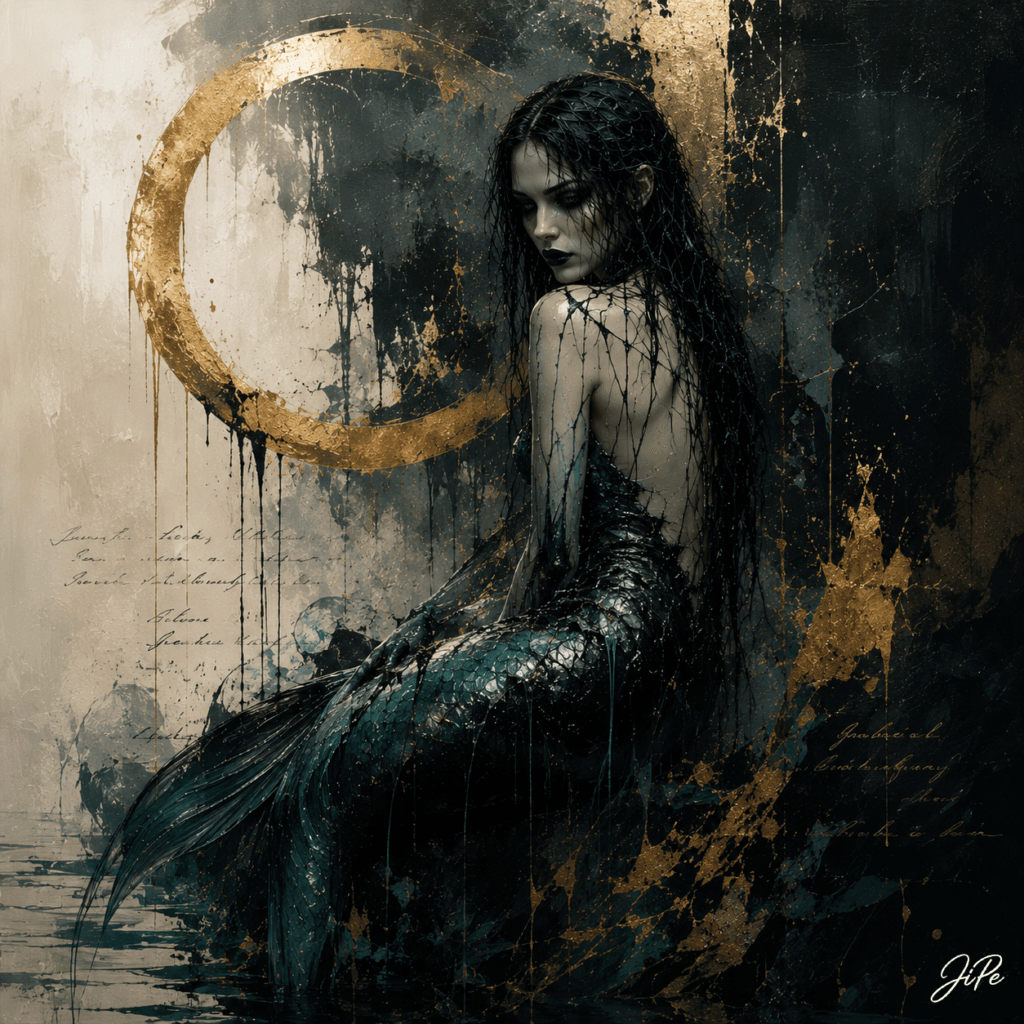
At the heart of the composition sits a solitary mermaid emerging from still, shadowed waters. Her posture is neither seductive nor defensive. Instead, she appears suspended between presence and disappearance, turning toward the viewer while remaining emotionally distant. Her gaze is calm yet enigmatic, inviting observation without surrendering explanation. This carefully restrained expression becomes central to the work’s emotional power. Rather than revealing her story, she preserves it, allowing silence itself to become the painting’s primary narrative.

The figure deliberately departs from conventional interpretations of the mermaid. Throughout mythology, mermaids have often embodied temptation, danger, romance, or unattainable beauty. In Blackwater Psalm, these familiar narratives are replaced by psychological symbolism. The mermaid becomes a guardian of forgotten knowledge, an embodiment of intuition, memory, and emotional depth. She is less a mythical creature than a visual metaphor for those parts of ourselves that remain submerged beneath conscious awareness.

Water functions as one of the painting’s most significant symbolic elements. Traditionally associated with the unconscious, transformation, and emotional truth, it serves here as both environment and psychological landscape. The dark surface conceals far more than it reveals, emphasizing the idea that human identity is composed as much of hidden experience as visible expression. The stillness of the water reinforces this atmosphere of contemplation, suggesting a space untouched by time where reflection becomes possible.

Behind the figure, a monumental golden circle introduces a powerful symbolic counterbalance. Evoking the imagery of halos, eclipses, celestial bodies, and sacred geometry, it creates a visual axis around which the composition quietly revolves. The circle may be interpreted as the moon reflected upon water, a portal between worlds, or an emblem of eternity itself. Its imperfect, weathered texture resists decorative perfection, suggesting that transcendence is found not through idealization but through lived experience and transformation.

The dialogue between gold and darkness forms the conceptual foundation of the work. Gold has historically symbolized illumination, divinity, permanence, and spiritual insight. Black, by contrast, often evokes mystery, introspection, depth, and the unknown. Rather than opposing one another, these two visual languages coexist throughout the composition, revealing that light derives meaning from shadow just as silence gains meaning through sound. Their relationship transforms the painting into an exploration of balance rather than contrast.

The restricted palette contributes significantly to the emotional atmosphere. Muted ivory, weathered gold, charcoal, deep teal, and profound black establish a timeless visual language that recalls both ancient icon painting and contemporary symbolic abstraction. The subdued colors encourage prolonged observation, allowing subtle tonal relationships to emerge gradually rather than overwhelming the viewer with immediate spectacle.

The mermaid’s elongated form is rendered with remarkable sensitivity, combining classical figurative elegance with expressive painterly textures. Her scales shimmer with subdued iridescence rather than brilliant color, suggesting life hidden beneath darkness rather than displayed upon the surface. The flowing black hair dissolves into surrounding brushwork, blurring distinctions between body, water, and shadow. This gradual dissolution of form reinforces the conceptual theme that identity itself is fluid, constantly shaped by forces beyond direct perception.

Surface texture plays a central role throughout the painting. Layers of fractured pigment, expressive brushstrokes, weathered surfaces, and cascading paint drips create an impression of time etched directly into the canvas. These painterly interventions resist polished illusionism, reminding the viewer that memory itself is fragmented, incomplete, and continuously rewritten. The visible texture transforms the surface into an archaeological landscape where traces of the past remain embedded beneath each successive layer.

Scattered handwritten script appears throughout the composition like fragments of forgotten manuscripts. Though largely illegible, these inscriptions introduce themes of memory, language, and lost histories. They suggest narratives that have faded beyond complete understanding, inviting viewers to imagine stories that remain forever unfinished. Rather than communicating specific meaning, the script functions as visual memory—echoes of voices carried across time and dissolved into silence.

Compositionally, Blackwater Psalm achieves remarkable balance through asymmetry. The mermaid occupies the right side of the canvas, allowing expansive negative space to dominate the opposite half. This openness creates emotional resonance, emphasizing solitude rather than isolation. The viewer becomes acutely aware not only of the figure’s presence but also of the surrounding silence that gives her presence meaning.

The circular halo establishes a powerful structural anchor while the vertical figure introduces gentle upward movement. Flowing lines within the tail and cascading textures create subtle rhythms that guide the eye throughout the composition without disturbing its contemplative stillness. Every visual element contributes to an atmosphere of restrained elegance and quiet emotional intensity.

From an art historical perspective, Blackwater Psalm occupies a distinctive position within contemporary symbolic realism. It draws inspiration from Symbolist painting, Romantic notions of the sublime, Art Nouveau’s organic elegance, and the expressive materiality of modern mixed-media practices. Echoes of Gustav Klimt’s ornamental luminosity, Odilon Redon’s dreamlike symbolism, and contemporary figurative abstraction coexist within a unified visual language that feels both timeless and unmistakably modern. Rather than illustrating mythology, the painting reimagines myth as psychological experience.

Conceptually, the work reflects upon humanity’s relationship with the hidden dimensions of the self. Modern life often values clarity, certainty, and constant visibility. Blackwater Psalm quietly proposes another form of understanding—one rooted in introspection, ambiguity, and emotional depth. It suggests that wisdom is often discovered not through illumination alone, but through the willingness to enter uncertainty without immediately seeking resolution.

The mermaid therefore becomes a universal symbol of interior life. She inhabits the threshold between civilization and nature, consciousness and instinct, memory and forgetting. Her silence is neither emptiness nor absence; it is a deliberate space in which the viewer may encounter their own reflections. Every observer inevitably projects personal experiences onto her enigmatic expression, transforming the painting into a deeply individual experience.

The title’s invocation of a psalm ultimately reveals the painting’s deepest intention. This is not a prayer asking for answers, but one inviting contemplation. It is a hymn composed not through words but through texture, light, silence, and shadow. Every brushstroke contributes to a visual liturgy in which darkness becomes sacred rather than feared.

Ultimately, Blackwater Psalm is an invitation to slow down and listen to what cannot easily be spoken. It reminds us that beneath every calm surface lies an immeasurable depth, and within every silence resides a story waiting to be remembered. Standing before this work, the viewer is invited not simply to observe a mythical figure emerging from black water, but to recognize the hidden landscapes within themselves—those quiet places where memory, mystery, and transformation continue to flow beneath the surface of ordinary life.

Lämna ett svar