
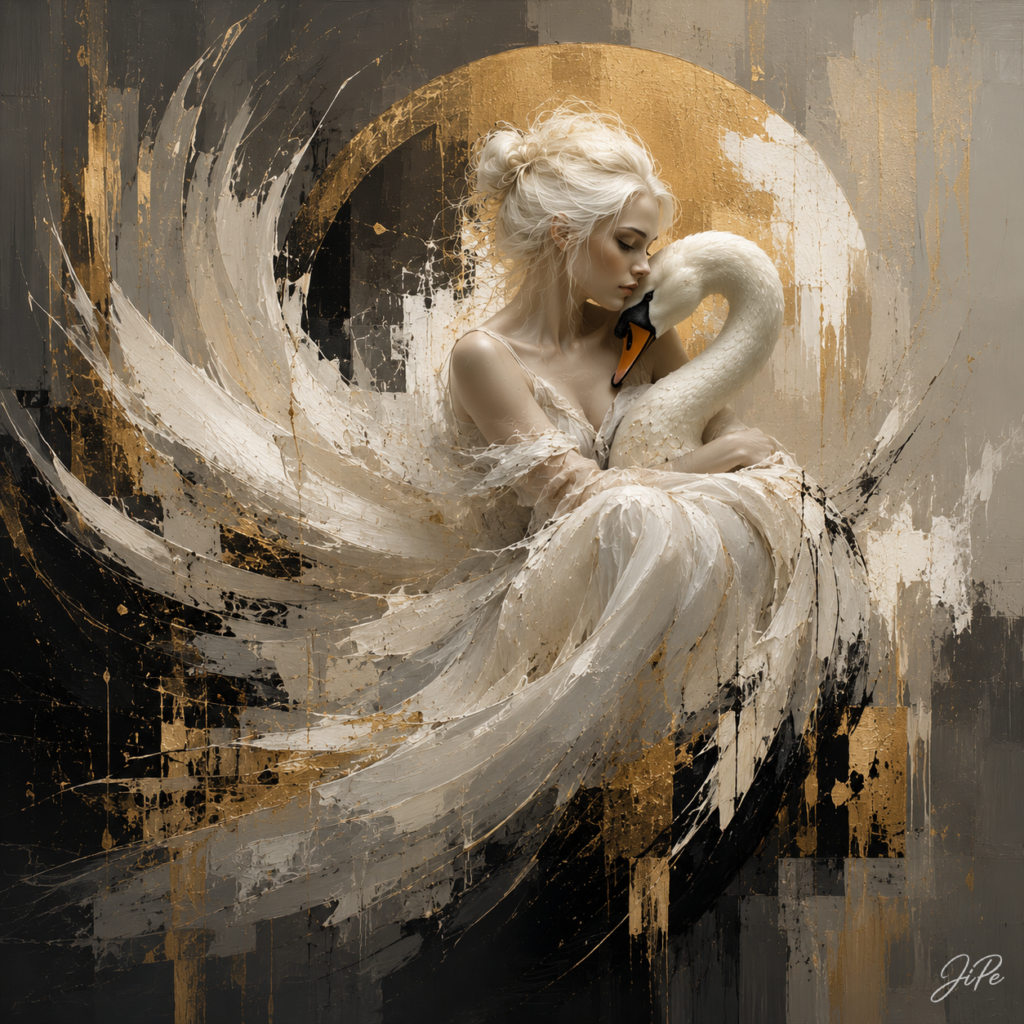
The Swan’s Silence

The Swan’s Silence is a poetic meditation on purity, tenderness, and the profound eloquence of unspoken emotion. Combining contemporary visionary symbolism with expressive mixed-media techniques, the artwork transcends the traditional boundaries between portraiture and allegory, presenting a visual narrative in which human and nature become inseparable reflections of one another. Rather than illustrating a specific story, the painting invites the viewer into an emotional landscape where serenity, vulnerability, and timeless beauty exist in perfect equilibrium.
At the heart of the composition sits a young woman, delicately embracing a white swan whose graceful neck mirrors the gentle curvature of her own posture. Their faces rest together in complete trust, creating an intimate circle of silence that immediately becomes the emotional center of the work. Around them, sweeping painterly gestures unfold like wings, dissolving into abstract textures of black, ivory, weathered stone, and luminous gold. Behind the figures, a radiant golden disc functions simultaneously as halo, rising sun, celestial portal, and sacred geometry, elevating the scene beyond ordinary reality into the realm of symbolic contemplation.
The title, The Swan’s Silence, carries multiple layers of meaning. Silence is often misunderstood as emptiness or absence, yet within this work it becomes a language more profound than speech. The silence shared between the woman and the swan is not one of isolation, but of complete understanding. It represents the rare moment when connection no longer depends upon words, where presence itself becomes communication.
Throughout mythology, literature, and art history, the swan has served as one of humanity’s most enduring symbols. It has embodied purity, transformation, fidelity, divine beauty, and the mysterious relationship between the earthly and the transcendent. In Greek mythology, the swan appears as a messenger of the gods; in Celtic traditions it represents the soul’s journey between worlds; in Nordic folklore it often signifies grace emerging from hardship. The artist draws upon these rich symbolic traditions while allowing the swan to become something deeply contemporary—a living metaphor for emotional vulnerability and spiritual companionship.
Unlike many historical depictions that emphasize the swan’s majestic elegance from a distance, this work presents the bird as an intimate companion. Its bowed neck echoes the posture of affection rather than grandeur, transforming the animal into a participant within a shared emotional experience. The relationship portrayed is neither ownership nor domestication but mutual trust, where human and creature exist as equals within a sacred moment of quiet connection.
The woman herself remains intentionally anonymous. Her softly lowered gaze and relaxed posture remove any sense of theatrical performance, allowing her to function as an archetype rather than an individual portrait. She becomes an embodiment of contemplation, compassion, and receptive strength. There is no indication of conflict or narrative climax. Instead, the painting captures the stillness that follows emotional surrender—a state in which identity is no longer defined by achievement, but by openness.
Her flowing white garments merge seamlessly into sweeping brushstrokes that resemble both fabric and feathers. This visual integration blurs the distinction between the human figure and the swan, suggesting that they are not separate beings but complementary expressions of the same inner essence. The boundaries between body, spirit, and nature gradually dissolve, inviting viewers to consider unity as one of the painting’s central philosophical themes.
The circular golden form behind the figures functions as the composition’s symbolic anchor. Its geometric perfection contrasts beautifully with the organic movement of feathers and flowing drapery, creating a harmonious dialogue between structure and spontaneity. The circle has long represented eternity, wholeness, and cosmic order across countless civilizations. Here it serves not merely as a decorative backdrop but as a visual affirmation that the intimate encounter between woman and swan participates in something infinitely larger than itself.
Light plays a transformative role throughout the painting. Rather than illuminating from a single identifiable source, warm golden radiance appears to emerge from within the composition itself. The figures seem gently enveloped by light rather than simply exposed to it. This creates an atmosphere of quiet transcendence where illumination becomes symbolic of awareness, compassion, and spiritual presence rather than physical brightness.
Equally significant is the restrained palette. Layers of ivory, charcoal, warm stone gray, deep black, and antique gold establish a refined visual harmony that feels simultaneously contemporary and timeless. Gold leaf textures shimmer subtly across the surface, recalling ancient iconography while remaining integrated into a distinctly modern mixed-media aesthetic. The result is a composition that bridges historical artistic traditions with contemporary symbolic painting.
The artist’s treatment of surface deserves particular attention. Thick painterly textures, expressive brushwork, fractured plaster effects, and layered abstract marks create remarkable material depth. These weathered surfaces evoke both ancient frescoes and contemporary abstraction, suggesting that memory itself leaves physical traces upon the world. The visible imperfections within the painted surface become metaphors for lived experience, reinforcing the idea that beauty is often inseparable from vulnerability.
Subtle references to the philosophy of kintsugi—the Japanese practice of repairing broken objects with gold—can also be perceived throughout the composition. The golden accents do not conceal fracture but illuminate it. In doing so, the painting proposes that emotional healing does not erase the past; it transforms it into part of one’s enduring identity. Every visible imperfection becomes evidence of resilience rather than loss.
Compositionally, The Swan’s Silence demonstrates exceptional sophistication. The central embrace establishes immediate emotional focus, while the sweeping movement of abstract wings expands the visual rhythm outward into the surrounding space. Large areas of negative space allow the figures to breathe within the composition, emphasizing stillness over spectacle. Curved forms dominate the visual language, reinforcing themes of protection, continuity, and cyclical harmony.
Although deeply symbolic, the painting avoids becoming overly prescriptive. It does not dictate a singular interpretation but instead encourages quiet reflection. For one viewer, the swan may represent innocence preserved despite suffering. For another, it may symbolize memory, unconditional love, or the fragile beauty of trust. The woman herself may be interpreted as the soul, as nature, or as humanity seeking reconciliation with its own forgotten tenderness.
From an art historical perspective, the work establishes meaningful dialogue with Symbolism, Romanticism, and contemporary visionary art. The dreamlike atmosphere recalls the Symbolist painters of the late nineteenth century, while the emotional sincerity echoes Romantic explorations of nature as a mirror of human consciousness. Simultaneously, the layered abstraction, expressive textures, and digital painterly techniques position the work firmly within contemporary fine art practice.
Psychologically, the painting resonates with Jungian ideas concerning archetypes and individuation. The swan may be understood as an external manifestation of the anima—an image of inner purity and emotional authenticity—while the embrace symbolizes the reconciliation of conscious identity with deeper aspects of the self. In this reading, the silence between the two figures represents the moment when internal conflict gives way to integration.
Yet perhaps the painting’s greatest achievement lies in its extraordinary restraint. In an era often defined by visual excess and relentless stimulation, The Swan’s Silence reminds us that the most transformative experiences frequently unfold in quietness. It suggests that tenderness possesses its own form of strength and that true beauty often resides not in dramatic action but in moments of profound stillness.
Standing before this work, the viewer is invited to slow down. The painting asks no immediate questions and offers no definitive answers. Instead, it creates a contemplative space where silence becomes luminous, where vulnerability becomes sacred, and where human connection extends gently beyond language into something timeless.
Ultimately, The Swan’s Silence is a celebration of the quiet forces that shape our lives but often remain unseen—trust, compassion, grace, and unconditional presence. It reminds us that not all revelations arrive through words. Some emerge only in silence, where the soul listens, beauty speaks without sound, and love reveals itself in its purest and most enduring form.