
The World She Carries
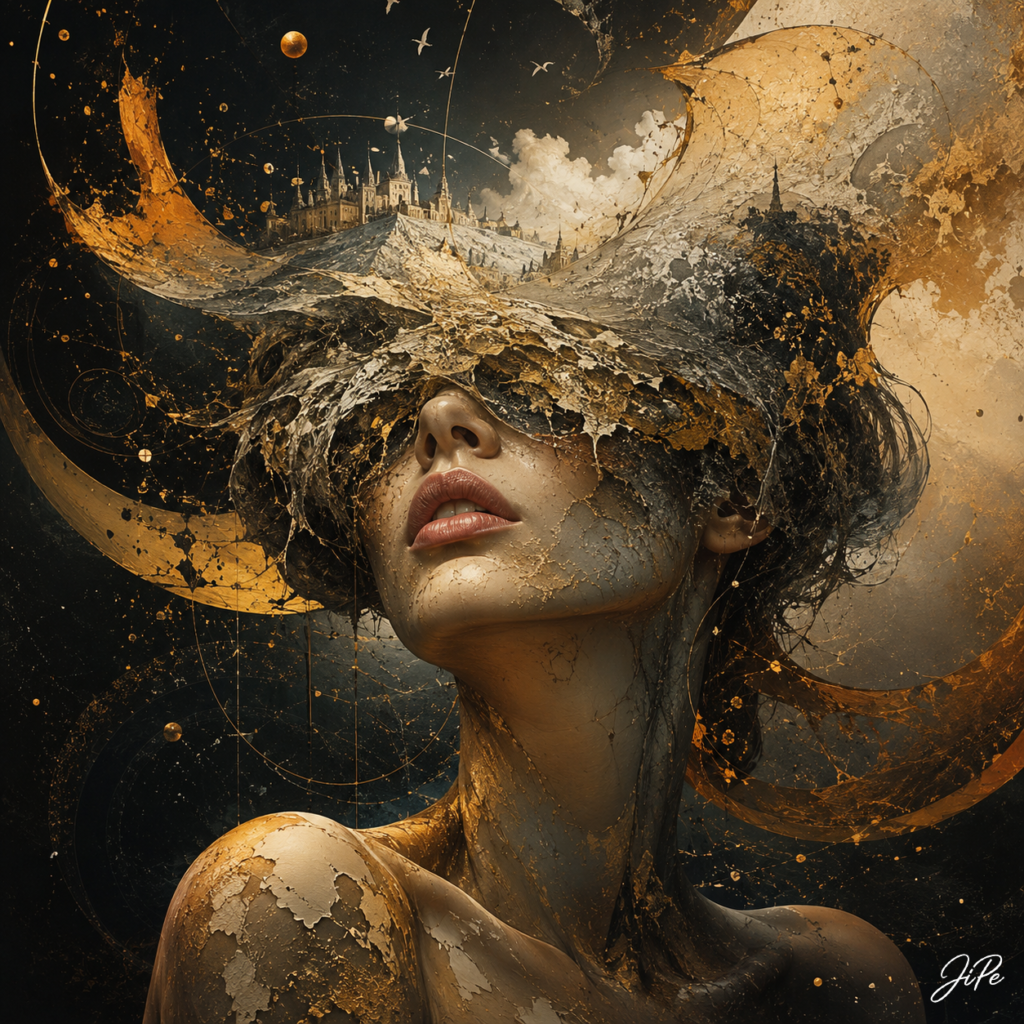
The World She Carries is a meditation on imagination as an act of creation, memory as architecture, and consciousness as an infinite landscape. Rather than depicting the world as an external reality, the painting proposes that every individual carries within them an entire universe—formed by dreams, experiences, forgotten histories, hopes yet unrealized, and countless unseen possibilities. It is a work about the invisible worlds that shape human identity and the extraordinary responsibility of carrying them through life.
Situated within the language of contemporary visionary symbolism, the painting merges portraiture, surrealism, metaphysical architecture, and cosmic abstraction into a single visual narrative. Every element functions symbolically, inviting viewers to move beyond literal interpretation and into a contemplative experience where emotion, philosophy, and imagination intersect. The work does not present answers; it opens a space where meaning continually evolves with the observer.
At the center of the composition stands an enigmatic female figure whose face is partially concealed by a sweeping veil of fractured textures, celestial landscapes, and flowing architectural forms. The obscured eyes immediately transform the portrait from a depiction of an individual into an archetype. She becomes less a person than a universal consciousness—someone who sees beyond ordinary sight.
Her vision is turned inward.
Her gaze belongs to another realm.
She carries worlds that cannot be seen.
The veil itself is among the painting’s most compelling symbolic elements. It dissolves the boundary between the physical face and an imagined universe. Rather than functioning as a mask that conceals identity, it becomes a portal through which hidden realities emerge. Ancient cities rise from its surface. Celestial bodies orbit within its curves. Vast horizons unfold across what should simply be skin and fabric.
Identity, the painting suggests, is never confined to the visible self.
It contains landscapes.
Civilizations.
Entire histories.
Emerging from the veil is an elegant city suspended upon an elevated ridge, illuminated by distant celestial light. The architecture recalls both ancient kingdoms and visionary utopias, existing beyond any identifiable place or historical period. These structures symbolize the worlds constructed within memory—the emotional cities we inhabit throughout life, built from love, loss, aspiration, and imagination.
The city is neither distant nor external.
It exists because she carries it.
The monumental crescent forms surrounding the portrait reinforce this symbolic expansion. These sweeping celestial arcs simultaneously evoke moons, eclipses, planetary orbits, sacred geometry, and cycles of time. Their elegant movement creates an invisible rhythm throughout the composition, suggesting that existence unfolds according to patterns far greater than individual perception.
Nothing remains isolated.
Everything revolves.
Everything belongs.
The painting continually blurs distinctions between human anatomy and cosmic architecture. Hair transforms into landscapes. Veils become horizons. Skin appears weathered like ancient stone, enriched with luminous golden fractures that recall the Japanese philosophy of kintsugi. Here, however, these repairs extend beyond material restoration. The gold does not merely mend broken surfaces—it reveals accumulated wisdom.
Every fracture becomes illumination.
Every scar becomes memory made visible.
Nothing meaningful remains untouched by time.
This philosophy permeates the entire composition. The figure’s body appears simultaneously fragile and monumental, suggesting that human consciousness is both vulnerable and immeasurably expansive. She carries invisible weight, yet her posture remains serene. Rather than expressing exhaustion, she radiates quiet acceptance.
The burden has become purpose.
The responsibility has become grace.
The restrained color palette of charcoal black, soft ivory, warm bronze, and luminous gold reinforces this emotional equilibrium. Darkness is never portrayed as emptiness or despair. Instead, it functions as fertile space—a cosmic canvas from which imagination continually emerges. Gold, by contrast, represents revelation. It traces hidden pathways through the composition, illuminating architectural details, celestial forms, and subtle transitions between reality and dream.
Light, within this painting, is not merely visual.
It is intellectual.
Emotional.
Spiritual.
Throughout the work, flowing abstract gestures sweep across the background like celestial currents or streams of consciousness. Their movement dissolves conventional spatial logic, replacing perspective with emotional geography. Time appears compressed. Distance becomes irrelevant. Past, present, and future coexist within the same symbolic landscape.
This temporal ambiguity allows the work to transcend narrative illustration. Rather than depicting a specific moment, it portrays a perpetual state of becoming—an ongoing dialogue between memory and imagination.
The viewer does not witness an event.
The viewer enters a state of mind.
The painterly textures further enrich this experience. Layered surfaces resemble weathered frescoes, eroded stone, cracked porcelain, and gilded manuscripts, creating an extraordinary tactile presence. The painting appears ancient and contemporary simultaneously, suggesting that its themes belong equally to forgotten civilizations and modern psychological inquiry.
Its surface carries the memory of time itself.
From an art historical perspective, The World She Carries synthesizes diverse visual traditions into a unified contemporary language. Echoes of Symbolism, Surrealism, Romanticism, Byzantine iconography, and metaphysical painting can all be recognized, yet none dominates. Instead, these influences become foundations for an entirely personal symbolic vocabulary centered upon inner consciousness and emotional architecture.
The portrait also resonates strongly with Jungian concepts of the psyche. The concealed eyes represent introspection rather than blindness. The floating city symbolizes the internal structures through which identity is organized. The celestial orbits evoke the unconscious patterns guiding personal evolution. Together, these elements create an allegory of the inner self—not as something fixed, but as an ever-expanding universe.
The world we inhabit externally, the painting suggests, is always shaped by the worlds we carry within.
Perhaps the most remarkable quality of the composition is its quiet refusal to separate imagination from reality. The floating architecture, celestial mechanics, fractured textures, and human portrait all exist with equal legitimacy. Dreams are treated with the same visual authority as stone. Memory becomes as tangible as architecture.
Fantasy is not presented as escape.
It becomes another form of truth.
The title, The World She Carries, encapsulates the painting’s central philosophy with elegant simplicity. The ”world” is not merely geographical or physical. It represents everything accumulated within a lifetime—beliefs, memories, grief, joy, hope, culture, imagination, and identity itself. Every individual carries such a world, though few become consciously aware of its vastness.
The woman portrayed here has embraced that awareness.
She does not flee from the weight of her inner universe.
She carries it with dignity.
She allows it to define neither limitation nor burden, but purpose.
Ultimately, The World She Carries is a celebration of the extraordinary richness concealed within ordinary human existence. It reminds us that every face contains unseen landscapes, every silence shelters entire histories, and every life is immeasurably larger than its visible form.
The painting invites viewers to pause before judging what they believe they understand. Behind every expression lies an invisible architecture. Behind every memory lives another world waiting to be discovered.
In the end, this work offers a timeless reflection:
We are not shaped solely by the world around us.
We are shaped by the worlds we choose to carry within ourselves.