The Memory of Many Lives

The Memory of Many Lives is a profound exploration of identity, memory, and the layered nature of human existence. In this extraordinary composition, JiPe moves beyond the boundaries of portraiture to create a symbolic vision of consciousness itself. The painting invites viewers into a realm where time no longer unfolds as a linear sequence, but instead exists as a vast constellation of experiences, emotions, and forgotten selves that continue to inhabit the present. Rather than asking who we are, the work poses a far more enduring question: How many versions of ourselves continue to live within us?
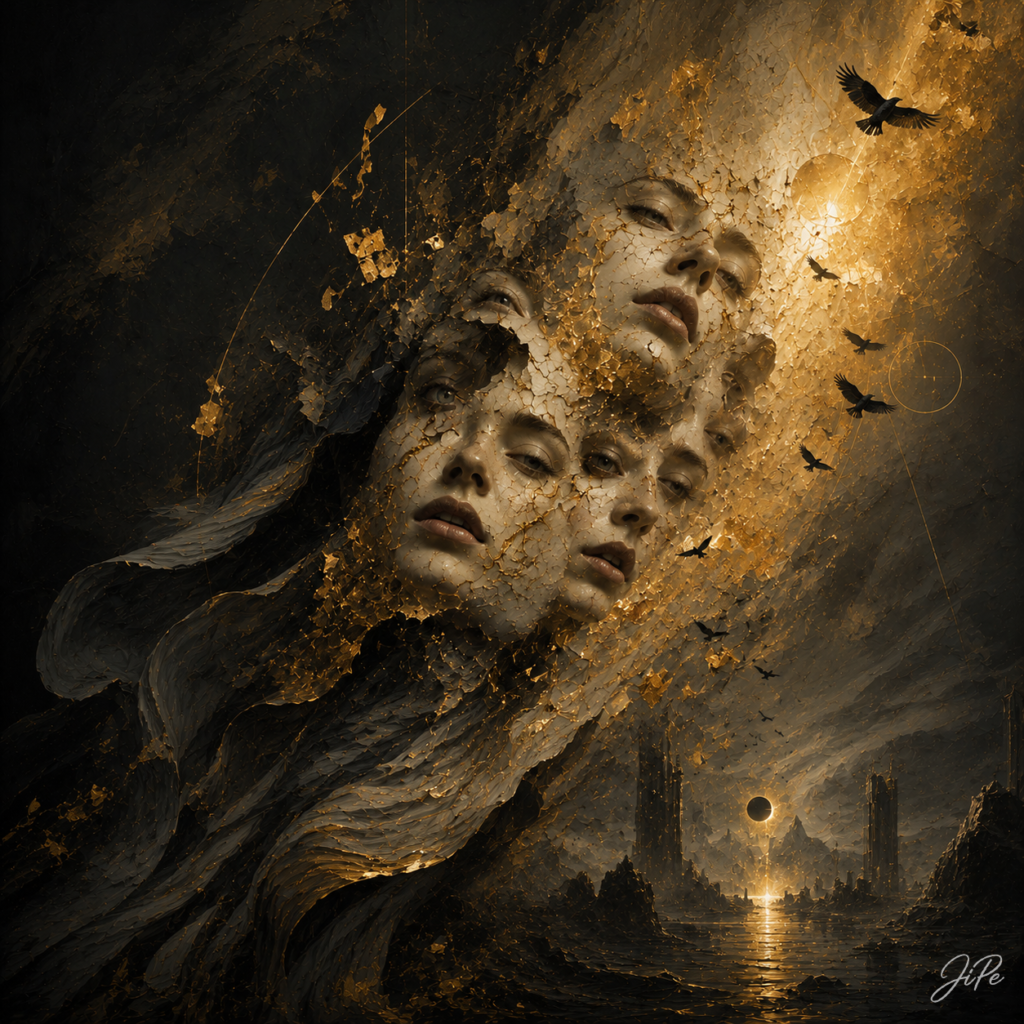
At first encounter, the viewer is drawn toward a monumental arrangement of intertwined faces emerging from one another like fragments of memory surfacing from the depths of the unconscious. Each face appears complete in itself, yet simultaneously inseparable from the others. They do not represent different individuals, but successive layers of a single soul evolving across time. Their expressions remain calm, introspective, and suspended between awakening and remembrance, suggesting that identity is never singular but continuously unfolding.
The title, The Memory of Many Lives, immediately broadens the painting’s philosophical horizon. It does not insist upon any particular interpretation of ”many lives.” For some viewers, the phrase may evoke spiritual traditions that contemplate reincarnation and the continuity of consciousness beyond a single lifetime. For others, it may symbolize the countless psychological lives each person inhabits throughout existence—the child, the dreamer, the survivor, the creator, the seeker, the one who was lost, and the one who finally emerged transformed. JiPe deliberately leaves this ambiguity unresolved, allowing the painting to become a universal meditation on the complexity of human identity.
Compositionally, the work achieves remarkable fluidity through its seamless fusion of portraiture and abstraction. Faces dissolve into one another through delicate fractures of gold, textured surfaces, and painterly transitions that erase conventional boundaries between one identity and the next. There is no definitive beginning or conclusion. Consciousness appears as a continuous current rather than a collection of isolated moments.
This flowing structure mirrors the nature of memory itself. Human recollection is rarely chronological. Instead, memories overlap, echo, and reshape one another, creating a living internal landscape where the past constantly informs the present. JiPe transforms this psychological reality into visual form, constructing an image that feels less like a portrait than like the architecture of remembrance.
The extensive network of golden fractures running throughout the faces plays a central symbolic role. These luminous lines recall the philosophy of kintsugi, where brokenness becomes an integral part of beauty rather than a flaw to conceal. Here, however, the fractures carry an additional dimension. They resemble pathways through consciousness, suggesting that every wound, every experience, and every transformation becomes part of a greater internal map. Memory itself is constructed through these invisible connections.
Rather than weakening the figures, the fractures illuminate them from within. Gold becomes the visible manifestation of wisdom acquired through living. Every crack speaks of experience; every luminous vein suggests resilience. JiPe repeatedly returns to this philosophy throughout his artistic practice, proposing that authenticity is never born from perfection, but from the graceful integration of life’s imperfections.
Light occupies an equally profound symbolic function. Emerging from the upper right portion of the composition, it bathes the faces in warm, ethereal illumination while leaving portions of the painting immersed in shadow. This selective use of light reinforces the idea that memory itself is incomplete. Some experiences remain vividly illuminated within consciousness, while others fade into darkness, only occasionally returning through intuition, dreams, or emotional resonance.
The celestial atmosphere surrounding the portraits deepens this metaphysical interpretation. Planets, distant spheres, subtle geometric circles, and immense architectural silhouettes populate the background, suggesting that individual consciousness exists within a far greater cosmic order. The landscape does not represent physical geography but an interior universe where memory, imagination, and eternity intersect.
The distant horizon introduces another recurring motif within JiPe’s work: the luminous pathway leading toward transcendence. A radiant point of light reflects across still water beneath an eclipsed sun, creating a quiet visual counterpoint to the complexity of the layered faces above. This distant light reminds viewers that despite the multiplicity of identities contained within every individual, there remains a singular destination toward which consciousness continually moves—a search for unity beyond fragmentation.
The ravens flying through the composition further enrich its symbolic language. Throughout mythology and folklore, ravens have served as messengers between worlds, guardians of memory, and companions of wisdom. Within this painting, they appear as silent witnesses moving freely between visible reality and unseen dimensions. Their flight introduces movement into an otherwise contemplative composition, suggesting that memory is never entirely static. It remains alive, continually travelling between past and present.
Colour is handled with exceptional sophistication. JiPe limits his palette to deep charcoal blacks, muted ivory, warm earth tones, and radiant gold, allowing symbolic relationships to emerge through subtle tonal variation rather than dramatic chromatic contrast. Gold dominates without overwhelming, functioning as a visual metaphor for consciousness, transcendence, and enduring truth. Against the surrounding darkness, every illuminated fragment acquires extraordinary emotional significance.
The richly textured surfaces contribute substantially to the painting’s psychological depth. Cracked plaster effects, layered painterly brushwork, metallic gold leaf textures, and weathered mixed-media elements create a tactile quality that recalls ancient frescoes partially uncovered through archaeology. The image appears simultaneously newly created and impossibly ancient, as though it has always existed beneath the surface of human consciousness, waiting to be remembered.
From an art historical perspective, The Memory of Many Lives occupies an intriguing dialogue with Symbolism, Surrealism, Romanticism, and contemporary visionary art. The fragmented portrait recalls Symbolist explorations of the inner self, while the dreamlike spatial relationships resonate with Surrealist investigations into subconscious reality. Yet JiPe synthesizes these traditions into an unmistakably contemporary visual language rooted in psychological symbolism, cinematic composition, and refined painterly realism.
The work also reflects philosophical traditions extending from Plato’s concept of anamnesis—the notion that learning is a form of remembering—to Carl Jung’s theory of the collective unconscious, where archetypal images transcend individual experience. The multiple faces may therefore be understood not only as personal memories but as expressions of humanity’s shared psychological inheritance. Each face becomes both individual and universal.
Psychologically, the painting speaks to the modern understanding that identity is fluid rather than fixed. Throughout life, people continuously reconstruct themselves through experience. Earlier versions of the self never entirely disappear; they remain embedded within memory, shaping perception long after circumstances have changed. JiPe visualizes this ongoing evolution with extraordinary sensitivity. The viewer recognizes that every face within the composition continues to exist simultaneously, forming a complete emotional biography.
Yet despite its complexity, the painting never becomes overwhelming. A profound stillness governs every aspect of the composition. The expressions remain peaceful, almost meditative, suggesting acceptance rather than conflict. The many selves coexist without competition. Instead of fragmentation leading to confusion, JiPe presents multiplicity as a source of wisdom.
Within JiPe’s broader body of work, The Memory of Many Lives represents one of his most introspective examinations of consciousness. While many of his paintings employ monumental architecture, mythological symbolism, and visionary landscapes to explore humanity’s relationship with transcendence, this work turns inward. The monument is no longer external—it has become psychological. The cathedral exists within memory itself.
Ultimately, The Memory of Many Lives is not a painting about reincarnation alone, nor merely about memory. It is a meditation on continuity. It reminds us that every experience leaves an imprint, every transformation becomes part of our invisible architecture, and every forgotten version of ourselves continues to contribute quietly to the person we are becoming.
Standing before this extraordinary work, viewers may find themselves searching not for the identities portrayed within the painting, but for those hidden within themselves. The layered faces gradually become mirrors, reflecting forgotten hopes, abandoned dreams, healed wounds, and silent moments of transformation. JiPe leaves us with a timeless realization: perhaps the soul is not a single face moving through time, but an entire constellation of lives learning, remembering, and slowly becoming whole.