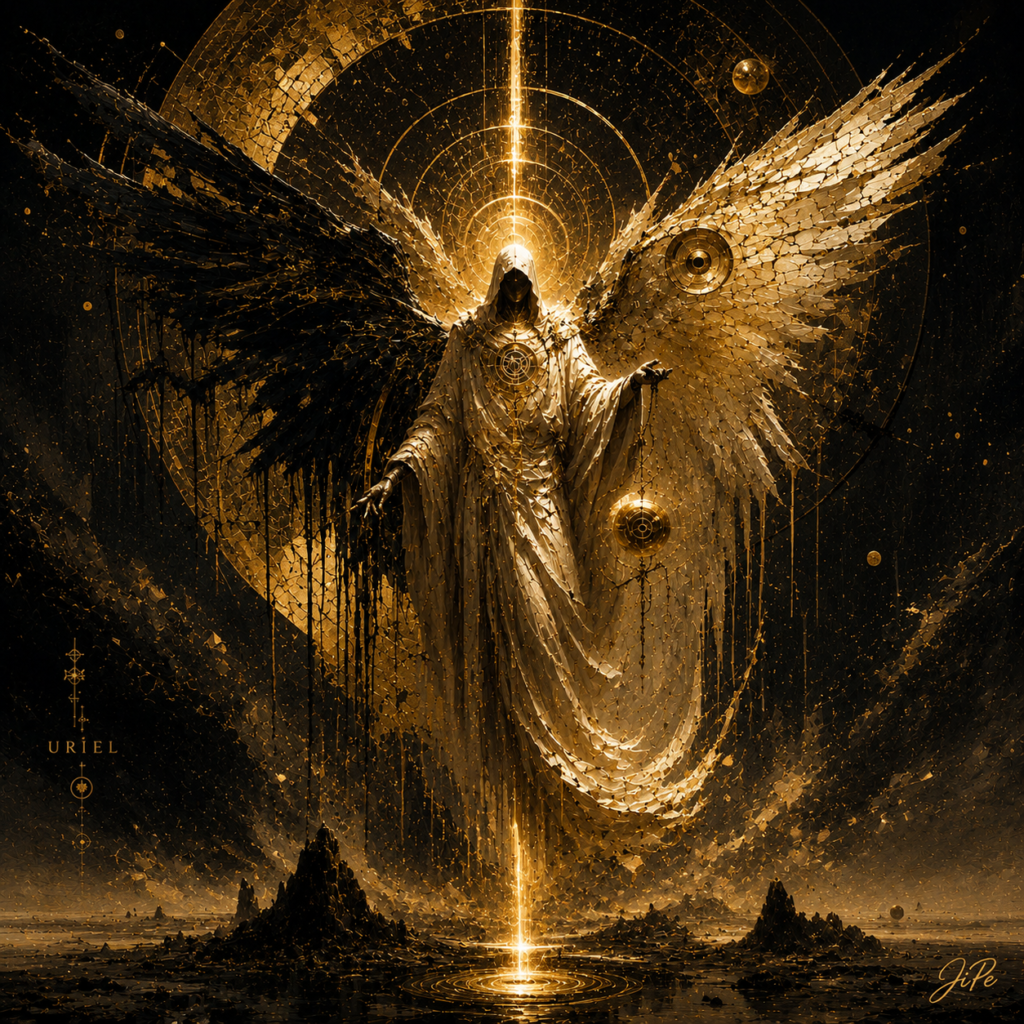
Uriel: Keeper of the Sacred Flame emerges as a presence suspended between radiance and obscurity, monumental yet curiously remote. The figure does not seem to occupy the surrounding space so much as divide it, holding opposing forces in a state of severe and precarious equilibrium. Silence becomes almost architectural around this vertical axis.
Light descends with an authority that feels less consoling than absolute. It illuminates without fully revealing, leaving the central presence guarded by shadow even at the point of greatest brilliance. The asymmetry surrounding the figure intensifies this tension: darkness and luminosity coexist without reconciliation, suggesting that what is sacred may contain contradiction rather than transcend it.
The title introduces guardianship as a burden as much as a privilege. To keep a flame is to preserve something vulnerable, but also to remain bound to it—to stand watch while worlds alter, disappear, or forget. Uriel’s anonymity deepens this sense of distance; identity recedes behind function, endurance, and an obligation whose origin remains unknowable.
What is being protected may be knowledge, memory, judgment, or simply the possibility of renewal. Uriel: Keeper of the Sacred Flame leaves the greater uncertainty untouched: whether the flame is guarded from the darkness beyond it, or from those who would approach its light.