Monumental Visionary Fine Art exploring mythology, consciousness, sacred light, and timeless visual storytelling.

Monumental Visionary Fine Art exploring mythology, consciousness, sacred light, and timeless visual storytelling.

Viking and Norse Mythology Paintings

Before the Ancient Light

Before the Ancient Light

Before the Ancient Light is a contemplative vision of memory, destiny, and spiritual awakening, where mythology, symbolism, and contemporary visionary art converge into a single poetic composition. The painting explores the profound moment that exists before revelation—the silent threshold where the soul stands suspended between the known world and an older, eternal wisdom. Rather than depicting a specific historical or mythological event, the work presents an archetypal encounter with what may be understood as primordial consciousness: the light that existed before civilizations, before language, and perhaps even before time itself.

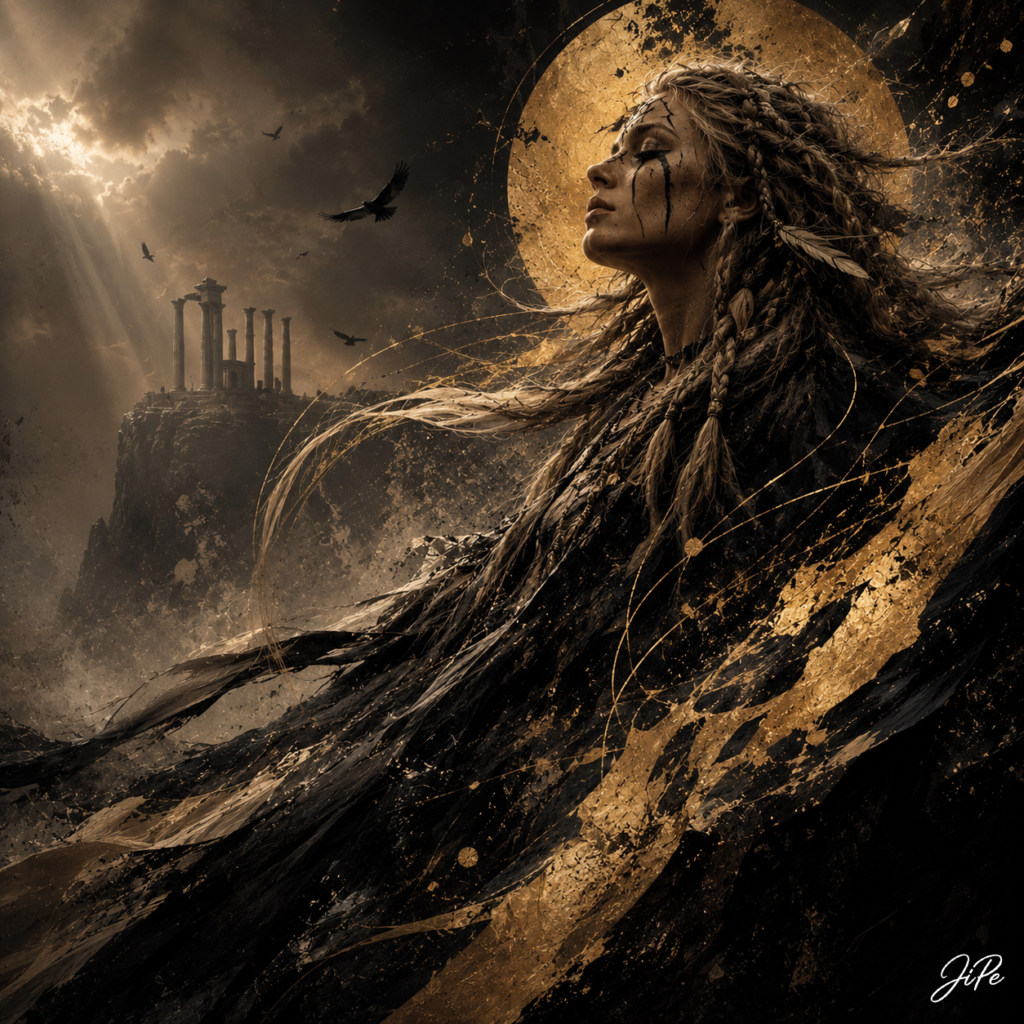
At the heart of the composition stands a solitary female figure, wrapped in flowing black garments that dissolve into sweeping painterly gestures. Her eyes remain closed, her face lifted gently toward an unseen source beyond the visible horizon. She neither commands nor resists the surrounding forces. Instead, she surrenders to them with remarkable serenity, embodying the universal human experience of listening for something greater than oneself.

The title immediately establishes the philosophical framework of the work. Before the Ancient Light suggests that the most significant transformations occur not in moments of action, but in moments of preparation. It speaks of the silence before creation, the breath before inspiration, and the stillness before enlightenment. The ”Ancient Light” is not merely sunlight or celestial illumination—it is symbolic of primordial truth, timeless wisdom, and the eternal source from which all existence emerges.

The figure occupies the foreground with monumental presence, yet her posture remains profoundly inward. Her closed eyes redirect the viewer away from external spectacle and toward interior vision. She becomes less a portrait of an individual than an embodiment of contemplation itself. In this state of inward awareness, sight is replaced by intuition, suggesting that the deepest forms of knowledge are experienced rather than observed.

Surrounding her head, a radiant golden disc evokes both halo and celestial body. Throughout art history, the circular form has symbolized perfection, eternity, and cosmic order. Here, however, it functions as something more intimate. It appears not simply behind the figure but almost within her consciousness, suggesting that illumination originates from an inner awakening rather than descending solely from the heavens. The halo becomes less a sign of sanctity than of remembrance—the visual manifestation of forgotten knowledge gradually returning.

The dramatic landscape expands this symbolic narrative. Across a rugged chasm, atop towering cliffs, stand the weathered remains of an ancient temple. Reduced to little more than solitary columns, the structure exists simultaneously as architecture and memory. It recalls the lost sanctuaries of forgotten civilizations—places where humanity once sought communion with the divine through ritual, philosophy, and silence. Yet the temple remains distant, almost unreachable, emphasizing that sacred wisdom cannot simply be inherited. It must be rediscovered through one’s own journey.

Light streams through heavy clouds in magnificent shafts, illuminating the temple without fully revealing it. This restrained use of light is central to the emotional power of the composition. The illumination never overwhelms the darkness. Instead, it gently pierces it, suggesting that truth often arrives gradually rather than dramatically. Revelation is portrayed not as an explosion of certainty but as a quiet invitation toward deeper understanding.

The presence of ravens circling the distant sanctuary introduces another significant symbolic layer. Within Norse mythology, ravens have long represented memory, wisdom, prophecy, and divine observation. They serve as intermediaries between earthly existence and higher knowledge, carrying messages across visible and invisible worlds. Their flight above the temple reinforces the painting’s meditation on remembrance, suggesting that wisdom is never entirely lost—it simply waits for those prepared to receive it.

The artist masterfully contrasts permanence with impermanence throughout the work. The temple, despite its ruined condition, endures across centuries. The cliffs remain immovable against wind and storm. In contrast, the flowing garments surrounding the central figure dissolve into sweeping abstract brushstrokes that appear almost weightless. These painterly movements blur the distinction between body and atmosphere, implying that identity itself is fluid while truth remains eternal.

One of the painting’s most compelling achievements lies in its extraordinary treatment of texture. Thick layered surfaces, weathered plaster effects, fractured paint, and expressive brushwork create a tactile experience reminiscent of ancient frescoes exposed to centuries of time. Gold appears not as decoration but as living substance—embedded within cracks, dispersed across sweeping gestures, and integrated into the very structure of the composition. This visual language recalls the philosophy of kintsugi, where fractures become sites of transformation rather than evidence of decay. Time, in this work, is not destructive but revelatory.

The restrained palette of charcoal, warm ivory, deep black, and luminous gold contributes significantly to the painting’s emotional atmosphere. Darkness dominates much of the composition, yet it never becomes oppressive. Instead, it functions as fertile space—a place where revelation may quietly emerge. Gold interrupts this darkness not as ornament but as consciousness itself, suggesting that illumination exists wherever the soul becomes receptive.

Compositionally, the work demonstrates remarkable balance between monumentality and intimacy. The sweeping diagonal movement of the garments draws the viewer across the canvas while simultaneously anchoring attention upon the tranquil face of the central figure. The distant temple creates narrative depth, transforming the landscape into both physical environment and psychological space. Every element contributes to a visual rhythm that encourages slow contemplation rather than immediate interpretation.

From an art historical perspective, Before the Ancient Light establishes dialogue with Symbolism, Romantic landscape painting, contemporary visionary art, and sacred portraiture. Its atmospheric treatment of light recalls the spiritual landscapes of the nineteenth century, while its fractured surfaces and mixed-media textures firmly position it within contemporary artistic practice. The fusion of realism and abstraction allows the painting to transcend literal storytelling, functioning instead as visual philosophy.

Thematically, the work resonates strongly with archetypal psychology. The central figure represents the Seeker—the individual who has reached the threshold between ordinary consciousness and spiritual awakening. The ancient temple becomes an image of the collective unconscious, containing forgotten truths preserved beyond historical time. The ravens symbolize intuition, while the descending light represents the emergence of higher awareness into conscious experience.

Perhaps most remarkable is the painting’s profound embrace of silence. Nothing dramatic occurs in the conventional sense. There is no conflict, no visible miracle, no explicit narrative resolution. Yet this stillness carries extraordinary emotional weight. The viewer senses that something immense is about to unfold—not through spectacle, but through quiet recognition. The painting captures that elusive psychological moment when transformation begins invisibly, long before it becomes outwardly apparent.

For contemporary audiences, Before the Ancient Light speaks to a universal longing for meaning in an increasingly fragmented world. It reminds us that wisdom cannot always be found through movement, accumulation, or constant activity. Sometimes it requires stillness, patience, and the willingness to stand quietly before mysteries that cannot yet be explained.

Ultimately, Before the Ancient Light is not simply a portrait, a landscape, or a mythological vision. It is a meditation on remembrance itself. Through its masterful interplay of sacred symbolism, atmospheric light, monumental composition, and richly textured surfaces, the painting invites viewers to consider that the deepest truths are not newly discovered—they are ancient realities patiently waiting to be remembered. In its silence, the work becomes both sanctuary and threshold, encouraging each observer to pause before the eternal light that has always existed, quietly illuminating the path long before humanity first learned to see it.

Lämna ett svar