Monumental Visionary Fine Art exploring mythology, consciousness, sacred light, and timeless visual storytelling.

Monumental Visionary Fine Art exploring mythology, consciousness, sacred light, and timeless visual storytelling.

Surreal Paintings

Sanctuary of the Broken Sun

Sanctuary of the Broken Sun

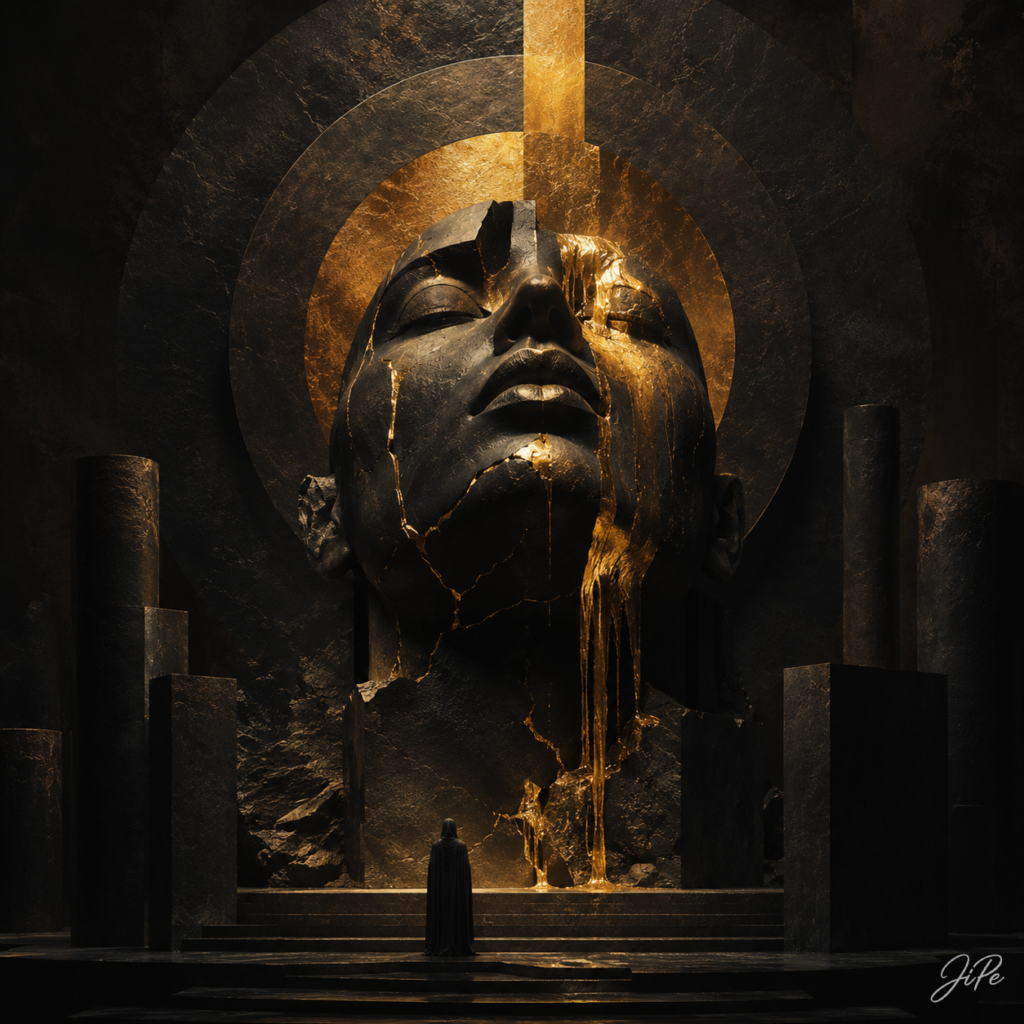
Sanctuary of the Broken Sun is a monumental meditation on fracture, transcendence, and the enduring presence of light within what appears irrevocably broken. Combining the visual language of sacred architecture, monumental sculpture, and symbolic abstraction, the work transforms destruction into revelation. Rather than portraying ruin as an ending, the painting presents it as a sacred threshold—a place where collapse becomes illumination and silence becomes the beginning of renewal.

The title itself introduces the central paradox that defines the composition. A sanctuary traditionally represents protection, healing, and spiritual refuge, while a broken sun suggests the collapse of certainty, divinity, or cosmic order. Together, these opposing ideas create a profound philosophical statement: even when the source of light appears fractured, its radiance remains capable of illuminating the world.

The sanctuary is therefore not built despite the broken sun.

It exists because of it.

The painting immediately confronts the viewer with an overwhelming architectural presence. Rising from darkness is a colossal human face carved into stone, monumental in scale and timeless in expression. Its eyes remain peacefully closed, detached from earthly perception, while the upward inclination of the head suggests surrender rather than defeat. This immense sculpture dominates the surrounding space, transforming the chamber into something that exists somewhere between temple, tomb, cathedral, and inner sanctuary.

The face functions simultaneously as monument, deity, memory, and mirror.

It belongs to no single culture.

It belongs to humanity itself.

Despite its immense scale, the sculpture bears unmistakable signs of damage. Deep fractures divide its surface, sections have broken away, and large pieces appear permanently lost. Yet instead of concealing these wounds, the artist allows molten gold to flow through them, filling cracks with luminous brilliance that appears almost alive.

Here, destruction becomes transformation.

The fractures do not diminish the monument.

They reveal its hidden light.

This visual philosophy recalls the ancient wisdom embodied in kintsugi, the Japanese practice of repairing broken ceramics with precious metals. Yet Sanctuary of the Broken Sun expands this concept far beyond material restoration. Gold becomes more than repair—it becomes memory, resilience, and spiritual illumination. Every crack tells the story of survival. Every golden stream suggests that suffering can become a source of unexpected beauty.

The monumental face itself remains emotionally ambiguous. Its expression is one of profound stillness rather than sorrow or triumph. With closed eyes and relaxed features, it seems suspended in a timeless state between sleep, meditation, and transcendence. This ambiguity invites viewers to project their own emotional experiences onto the sculpture.

Is it awakening?

Is it remembering?

Or has it already passed beyond human understanding?

The painting deliberately refuses to answer.

Above the sculpture descends an intense vertical beam of radiant gold that penetrates the composition with extraordinary force. This singular column of light functions as the painting’s spiritual axis, visually connecting heaven and earth, transcendence and matter, eternity and time. It strikes the fractured forehead of the monument almost like divine revelation entering wounded consciousness.

Unlike natural sunlight, this illumination possesses an almost metaphysical quality.

It is not simply light.

It is presence.

Behind the head unfolds a series of concentric golden circles that recall halos, celestial diagrams, sacred geometry, astronomical instruments, and ancient cosmological maps. These circles stabilize the entire composition while reinforcing the artwork’s exploration of eternity and universal order.

Their perfect geometry contrasts beautifully with the broken surface of the sculpture.

Order meets fracture.

Perfection embraces imperfection.

Together they form visual harmony rather than opposition.

The surrounding architecture further deepens the symbolic language of the work. Massive monolithic columns rise silently from darkness, stripped of ornament yet monumental in scale. Their austere forms evoke forgotten civilizations, sacred temples, and spaces devoted entirely to contemplation. These structures frame the central monument without competing for attention, reinforcing the atmosphere of solemn reverence.

The architecture feels timeless.

Ancient yet futuristic.

Real yet imagined.

At the foot of this immense sanctuary stands a solitary cloaked figure, almost invisible compared to the colossal monument above. The dramatic difference in scale immediately establishes one of the painting’s most compelling emotional dynamics. Humanity appears fragile before eternity, yet not insignificant. The figure does not kneel in fear nor retreat into shadow.

Instead, they simply stand.

Present.

Witnessing.

Their anonymity transforms them into an archetype rather than an individual. They become every visitor who has ever stood before mystery, every pilgrim searching for meaning, every observer confronting forces greater than themselves.

The viewer naturally assumes the figure’s perspective.

The sanctuary becomes ours.

Its silence becomes ours.

Materiality plays an essential role throughout the painting. Thick sculptural textures suggest weathered stone, eroded monuments, cracked plaster, volcanic rock, and precious metal simultaneously. Gold appears not as decorative ornament but as an active material flowing across surfaces with extraordinary vitality. It drips downward through the fractures like molten sunlight, dissolving the boundary between solid sculpture and living substance.

This interplay between permanence and fluidity creates remarkable visual tension.

Stone should remain fixed.

Gold appears alive.

The painting continuously challenges expectations.

The restricted palette of charcoal black, deep earth tones, and radiant gold amplifies this emotional intensity. Darkness occupies the majority of the composition, allowing every golden highlight to emerge with exceptional brilliance. Rather than overwhelming the viewer with color, the artist relies upon value, texture, and luminosity to construct emotional depth.

The darkness never feels empty.

It feels sacred.

It protects the light rather than opposing it.

The title’s reference to the ”Broken Sun” resonates throughout every symbolic layer of the composition. Traditionally, the sun represents life, knowledge, truth, divinity, and consciousness. Here, however, its apparent fracture introduces another possibility: illumination need not remain perfect to remain powerful.

Light survives even after collapse.

Wisdom survives disappointment.

Hope survives fracture.

This philosophical inversion transforms the entire emotional narrative of the painting. Rather than mourning what has been lost, Sanctuary of the Broken Sun celebrates what remains possible after loss. It proposes that spiritual growth rarely emerges through perfection. Instead, it is born through endurance, acceptance, and transformation.

The sanctuary itself therefore becomes an interior space.

It is less a physical temple than a psychological one.

Its walls exist within consciousness.

From an art historical perspective, the work occupies a compelling intersection between Symbolism, contemporary visionary art, sacred portraiture, monumental sculpture, and architectural abstraction. Echoes of ancient Egyptian colossi, Byzantine iconography, Renaissance monumentality, and modern minimalism coexist without direct quotation. The result is not historical reconstruction but timeless synthesis.

The work feels simultaneously ancient and contemporary because it speaks to universal human questions rather than historical events.

Who remains after identity fractures?

Where does light originate?

Can brokenness become sacred?

Rather than illustrating mythology, the painting creates its own visual mythology. Every symbol remains intentionally open, allowing multiple interpretations while maintaining extraordinary compositional coherence. This openness gives the work remarkable longevity, inviting repeated viewing and continual rediscovery.

Psychologically, the enormous face may be understood as the deeper self emerging from beneath accumulated experience. Its fractures represent memory, vulnerability, and transformation, while the descending beam of light symbolizes moments of profound insight capable of reshaping identity forever.

The viewer does not merely observe healing.

They witness becoming.

Silence plays an equally significant role. There are no gestures of violence, no dramatic movement, no narrative climax. Everything unfolds through stillness. This restraint grants the composition extraordinary emotional authority. The painting trusts contemplation rather than spectacle, allowing viewers to experience the sanctuary at their own pace.

Every shadow becomes meaningful.

Every crack becomes language.

Every beam of light becomes revelation.

Ultimately, Sanctuary of the Broken Sun is a profound meditation on resilience, transcendence, and the hidden beauty that emerges when the human spirit refuses to surrender to fragmentation. It reminds us that brokenness need not signify failure. Instead, fracture may become the very place where light first enters consciousness.

The monument is broken.

Yet it endures.

The sun is fractured.

Yet it still shines.

The sanctuary is silent.

Yet it speaks with extraordinary clarity.

Through its masterful balance of monumental symbolism, architectural grandeur, sculptural texture, and luminous gold, Sanctuary of the Broken Sun stands as a timeless reflection on healing, memory, and spiritual transformation. It invites every viewer to recognize that our deepest wounds do not diminish our capacity for light—they become the very channels through which illumination is finally revealed.

Lämna ett svar