Genesis of Light

Genesis of Light is an exploration of creation, transformation, and the primal forces that give rise to existence itself. Neither entirely abstract nor wholly representational, the painting occupies a space where matter dissolves into energy and light becomes the language through which the universe reveals its hidden order. Drawing upon the visual traditions of Abstract Expressionism, Symbolism, and contemporary visionary art, the work invites the viewer into a moment that exists before form, before certainty, and perhaps even before time itself.
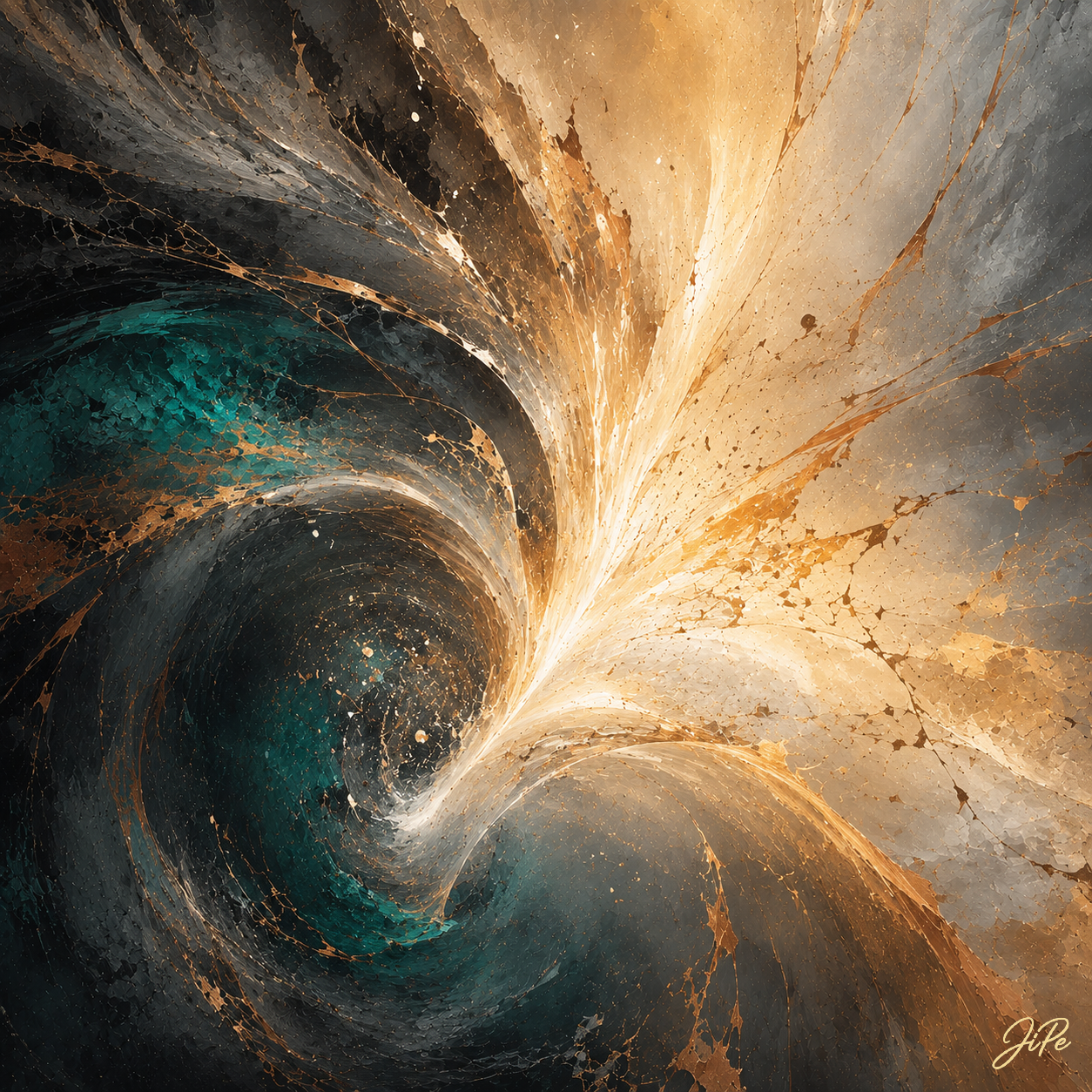
At the center of the composition, two immense currents collide in an explosive union of luminous gold and profound sapphire blue. Rather than opposing one another, these elemental forces appear engaged in an eternal dance—a dynamic equilibrium where tension becomes harmony and separation gives birth to creation. The painting captures neither the beginning nor the end of this encounter, but the precise instant in which opposing energies become inseparable, generating a new reality through their convergence.
The title, Genesis of Light, deliberately evokes the timeless concept of creation found throughout philosophy, mythology, and sacred literature. Yet the painting avoids illustrating any single narrative or theological tradition. Instead, it presents creation as an ongoing process rather than a singular event. Light is not portrayed as something that merely appears; it emerges through relationship, movement, and transformation. The radiant center becomes the symbolic birthplace of possibility itself, suggesting that every act of creation begins where contrast finds balance.
The opposing streams carry profound symbolic resonance. The flowing blue current evokes water, intuition, memory, and the unconscious—the ancient element associated with depth, emotion, and infinite potential. In contrast, the golden current suggests fire, illumination, consciousness, and creative energy. Throughout human history, water and fire have often been understood as opposing elemental principles. Here, however, they are liberated from conflict. They intertwine with extraordinary elegance, demonstrating that creation arises not through domination but through union.
The fluidity of the composition reinforces this philosophical vision. Every curve appears alive with motion, as though the painting itself continues to evolve before the viewer’s eyes. No edge remains entirely fixed, and no form is completely stable. The swirling movement dissolves conventional spatial boundaries, encouraging the viewer to experience the work not as a static image but as a living process unfolding across time and space. This dynamic quality reflects the continuous transformation that defines both the natural world and human experience.
Light functions as the true protagonist of the painting. The radiant golden core expands outward with extraordinary intensity, dissolving darkness without erasing it. Rather than overwhelming the surrounding forms, the illumination reveals their hidden complexity, allowing every droplet, flowing surface, and suspended particle to become part of a larger cosmic choreography. The light appears simultaneously natural and transcendent, existing somewhere between a sunrise, a stellar birth, and an inner awakening. It is not simply visible—it feels generative, as though reality itself is being formed through its presence.
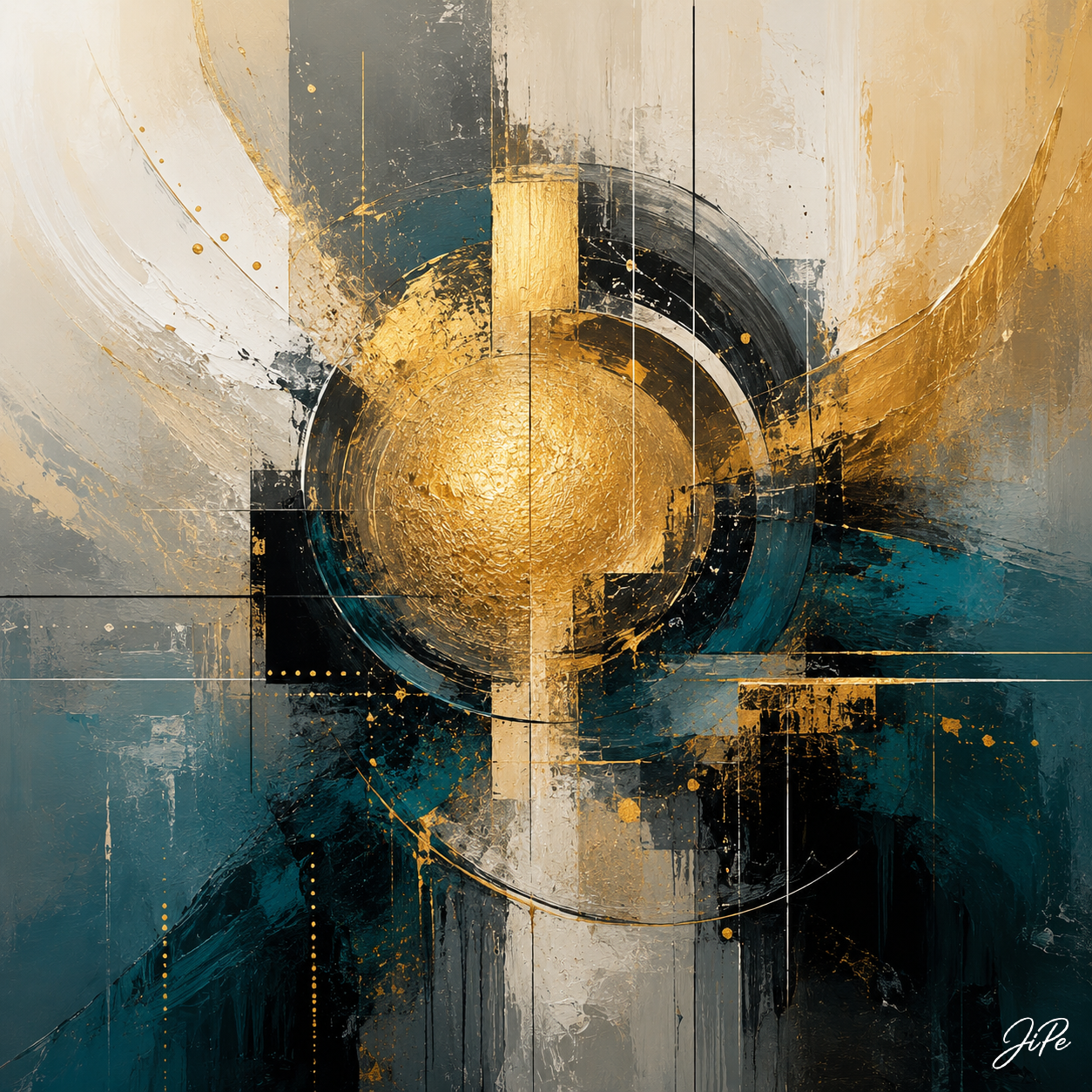
The subtle circular geometries embedded within the luminous atmosphere introduce another conceptual layer. Barely perceptible beneath the flowing currents, these delicate structures evoke sacred geometry, celestial mechanics, and the invisible mathematical order that underlies the universe. Their restrained presence suggests that beneath apparent chaos exists profound harmony—a reminder that the most dynamic natural phenomena often emerge from elegant underlying principles.
Gold permeates the painting with exceptional symbolic richness. Throughout art history, gold has represented divinity, wisdom, incorruptibility, and eternal truth. In Genesis of Light, however, it also becomes the visual expression of creative energy itself. The luminous splashes, fractured textures, and radiant reflections suggest that inspiration rarely appears in perfect symmetry. Instead, it erupts, expands, fractures old structures, and continuously reshapes the world around it. Gold becomes the visible trace of transformation in motion.
The deep sapphire blues provide a powerful emotional counterbalance. They introduce depth, contemplation, and mystery while preventing the composition from becoming purely radiant. These cool tones evoke the immeasurable depths of oceans and the silent expanses of the cosmos, reminding viewers that creation requires both stillness and movement, darkness and illumination. The dialogue between blue and gold becomes one of the painting’s defining visual achievements, establishing a chromatic harmony that resonates emotionally as much as aesthetically.
Compositionally, the work demonstrates remarkable sophistication through its controlled asymmetry. The converging currents establish a powerful diagonal movement that energizes the entire surface, while the radiant center anchors the composition with extraordinary clarity. Despite the apparent spontaneity of the flowing forms, every gesture contributes to a carefully orchestrated rhythm. The viewer’s eye is continually drawn through the painting in an endless cycle of movement, reflection, and rediscovery, mirroring the eternal cycles suggested by the work’s thematic content.
Within the broader history of art, Genesis of Light engages with several influential traditions while establishing a distinctly contemporary voice. The expressive energy recalls the gestural freedom of Abstract Expressionism, where movement itself becomes meaning. Its symbolic ambition aligns with the aspirations of nineteenth-century Symbolism, while its immersive atmosphere and cosmic vision place it firmly within the evolving tradition of contemporary visionary art. Yet the work remains uniquely its own, synthesizing these influences into a visual language that feels both timeless and unmistakably modern.
For art historians, the painting may be interpreted as a contemporary meditation on one of humanity’s oldest philosophical questions: how does creation begin? Rather than offering a literal answer, the work proposes that creation is an eternal dialogue between complementary forces. It suggests that order emerges through interaction, beauty through contrast, and light through relationship. In this sense, the painting transcends abstraction to become a visual philosophy—a reflection on the interconnected nature of existence itself.
Ultimately, Genesis of Light is not merely an image of elemental beauty; it is an invitation to contemplate the invisible forces that shape both the cosmos and the human spirit. It reminds us that every beginning contains the memory of what came before, and every moment of illumination is born from the meeting of seemingly opposite worlds. Standing before this radiant convergence of water and fire, shadow and brilliance, motion and stillness, the viewer is invited to witness creation not as a distant event in the past, but as an eternal process unfolding within nature, within consciousness, and within every act of imagination.