Monumental Visionary Fine Art exploring mythology, consciousness, sacred light, and timeless visual storytelling.

Monumental Visionary Fine Art exploring mythology, consciousness, sacred light, and timeless visual storytelling.

Surreal Paintings

Queen of the Golden Eclipse

Queen of the Golden Eclipse

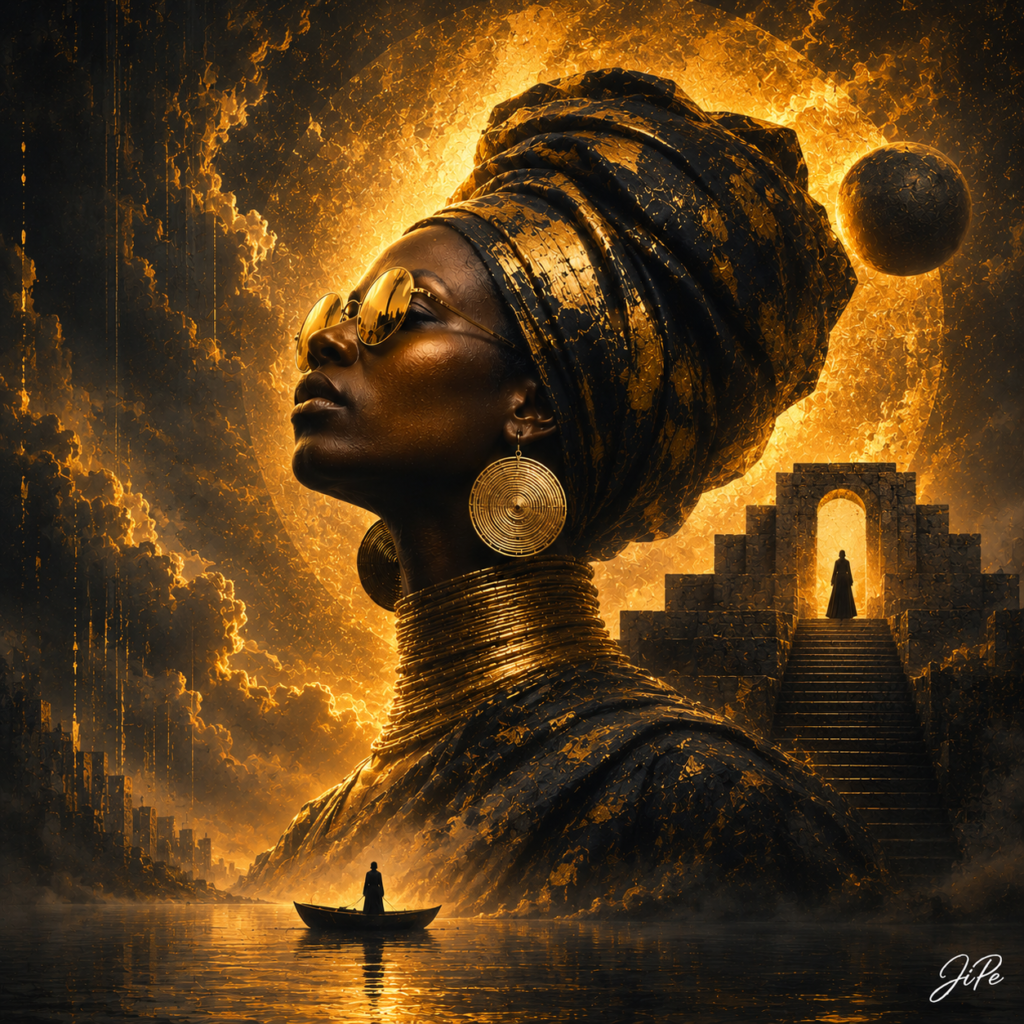
Queen of the Golden Eclipse is a monumental meditation on sovereignty, identity, transcendence, and the convergence of the ancient and the eternal. Combining elements of symbolic portraiture, visionary realism, Afrofuturist aesthetics, and mythological storytelling, the work transcends conventional portraiture to become a visual allegory of spiritual authority. Rather than portraying royalty through political power or earthly dominion, the painting redefines queenship as an inner state—one founded upon wisdom, resilience, enlightenment, and an unshakable connection to the cosmos.

Dominating the composition is the commanding profile of a regal woman whose serene expression radiates dignity and quiet confidence. Her face is lifted toward the heavens, suggesting neither pride nor conquest but profound awareness. She appears suspended in a moment of communion with forces far greater than herself, embodying an individual who has transcended the limitations of the material world while remaining deeply rooted in it. Her upward gaze invites viewers to contemplate their own relationship with destiny, purpose, and the infinite.

The monumental figure is framed by an immense golden eclipse that functions as the symbolic heart of the composition. Throughout history, eclipses have represented moments of profound transformation—thresholds where familiar realities dissolve and new perspectives emerge. Here, the eclipse is not an omen of darkness but a radiant portal of illumination. The glowing celestial disc surrounding the Queen transforms her into both witness and embodiment of cosmic harmony, suggesting that true enlightenment arises through embracing both shadow and light rather than choosing between them.

Her elaborate headwrap rises like an architectural monument, merging the traditions of ceremonial dress with sculptural abstraction. It evokes ideas of cultural heritage, ancestral wisdom, and enduring strength. The carefully layered folds create an impression of permanence and monumentality, elevating the portrait beyond individual likeness into the realm of timeless iconography. The garment itself becomes a crown—not fashioned from jewels, but from history, memory, and inherited knowledge.

Encircling her neck are numerous golden rings, symbols that resonate across multiple civilizations and traditions. They speak of continuity, dignity, spiritual elevation, and accumulated experience. Rather than functioning merely as ornamentation, these luminous forms establish a visual rhythm that reinforces the work’s central themes of ascension and resilience. Each ring may be understood as a chapter in a life’s journey, marking the gradual accumulation of wisdom rather than material wealth.

Her mirrored golden glasses introduce a striking dialogue between antiquity and modernity. They transform the figure into a bridge between historical memory and contemporary vision, suggesting that true perception requires looking simultaneously backward and forward. The reflective lenses conceal the eyes while inviting viewers to question what is truly seen and what remains hidden. In doing so, the portrait challenges traditional notions of visibility and identity, emphasizing that wisdom often resides beyond direct observation.

Surrounding the Queen is an expansive symbolic landscape that unfolds across multiple scales of reality. At the lower edge of the composition, a lone traveler stands within a small boat upon calm waters. This diminutive figure introduces a profoundly human dimension to the monumental scene. The boat represents the timeless journey of self-discovery, while the vast surrounding waters evoke both the subconscious and the limitless possibilities of the unknown. The Queen towers above this solitary voyager, not as a distant ruler, but as a guiding presence—a celestial embodiment of aspiration and inner guidance.

To the right, an ascending staircase culminates in an illuminated stone gateway where another solitary figure stands poised between darkness and radiant light. This architectural element recalls ancient temples, sacred sanctuaries, and ceremonial pathways found throughout civilizations across the world. The staircase functions as an archetype of spiritual ascent, reminding viewers that enlightenment is reached not through sudden revelation but through deliberate, often difficult progression. The gateway itself becomes a threshold between worlds, suggesting that every transformation begins with the courage to step into the unknown.

Suspended in the celestial background, a dark planetary sphere quietly orbits beside the radiant eclipse, introducing a subtle tension between opposing cosmic forces. Rather than disrupting harmony, this contrast reinforces the painting’s central philosophy: that light derives its meaning through dialogue with darkness. The universe presented here is not divided into opposing absolutes but exists as an elegant balance of complementary energies.

The extraordinary material richness of the work plays a fundamental role in its emotional impact. Layered painterly textures, weathered surfaces, fractured gold, expressive brushwork, and luminous atmospheric effects create a tactile visual language that recalls traditional mixed-media painting while embracing the possibilities of contemporary digital fine art. Every surface appears touched by time, suggesting that beauty acquires its greatest depth through experience rather than perfection.

Gold dominates the chromatic language with exceptional symbolic sophistication. Throughout art history, gold has represented divinity, immortality, enlightenment, and transcendence. Within Queen of the Golden Eclipse, however, gold becomes something even more profound. It is the visible manifestation of inner light—a force emerging from within the figure rather than merely illuminating her from without. Against the surrounding charcoal blacks, warm umbers, and atmospheric shadows, the radiant gold achieves extraordinary emotional resonance, transforming the composition into a celebration of hope, endurance, and spiritual awakening.

From an art historical perspective, the work occupies a compelling intersection between Symbolism, Romanticism, visionary realism, Afrofuturism, and contemporary mythological portraiture. Echoes of Gustav Klimt’s ornamental luminosity, the psychological depth of Symbolist painting, and the cinematic grandeur of modern fantasy art converge within a distinctly contemporary visual language. Yet despite these historical resonances, the painting remains entirely its own, constructing an original symbolic universe where mythology, cultural identity, architecture, and cosmology merge seamlessly.

The composition demonstrates remarkable control over visual hierarchy and rhythm. The monumental profile anchors the image while concentric circles of the eclipse establish an almost sacred geometry around the central figure. The vertical ascent of the staircase contrasts elegantly with the horizontal stillness of the water below, while the solitary figures create subtle narrative pathways that encourage viewers to journey through the composition rather than merely observe it. Every visual element contributes to an orchestrated balance between monumentality and intimacy.

Ultimately, Queen of the Golden Eclipse is not simply a portrait of an extraordinary woman—it is an allegory of awakened consciousness. It celebrates the quiet authority that emerges from self-knowledge, the resilience forged through adversity, and the enduring connection between humanity and the cosmos. The Queen does not command through force, but through presence. She embodies a form of leadership rooted in wisdom, compassion, and spiritual clarity, reminding viewers that the greatest kingdoms are not territories to be conquered but states of being cultivated within.

Through its masterful synthesis of symbolic storytelling, luminous atmosphere, monumental composition, and extraordinary painterly craftsmanship, Queen of the Golden Eclipse stands as a compelling example of contemporary symbolic fine art. It invites viewers into a world where ancient memory and future possibility coexist, where celestial phenomena become metaphors for human transformation, and where every encounter with light reveals not only the universe above, but the infinite potential that resides within the human spirit.

Lämna ett svar