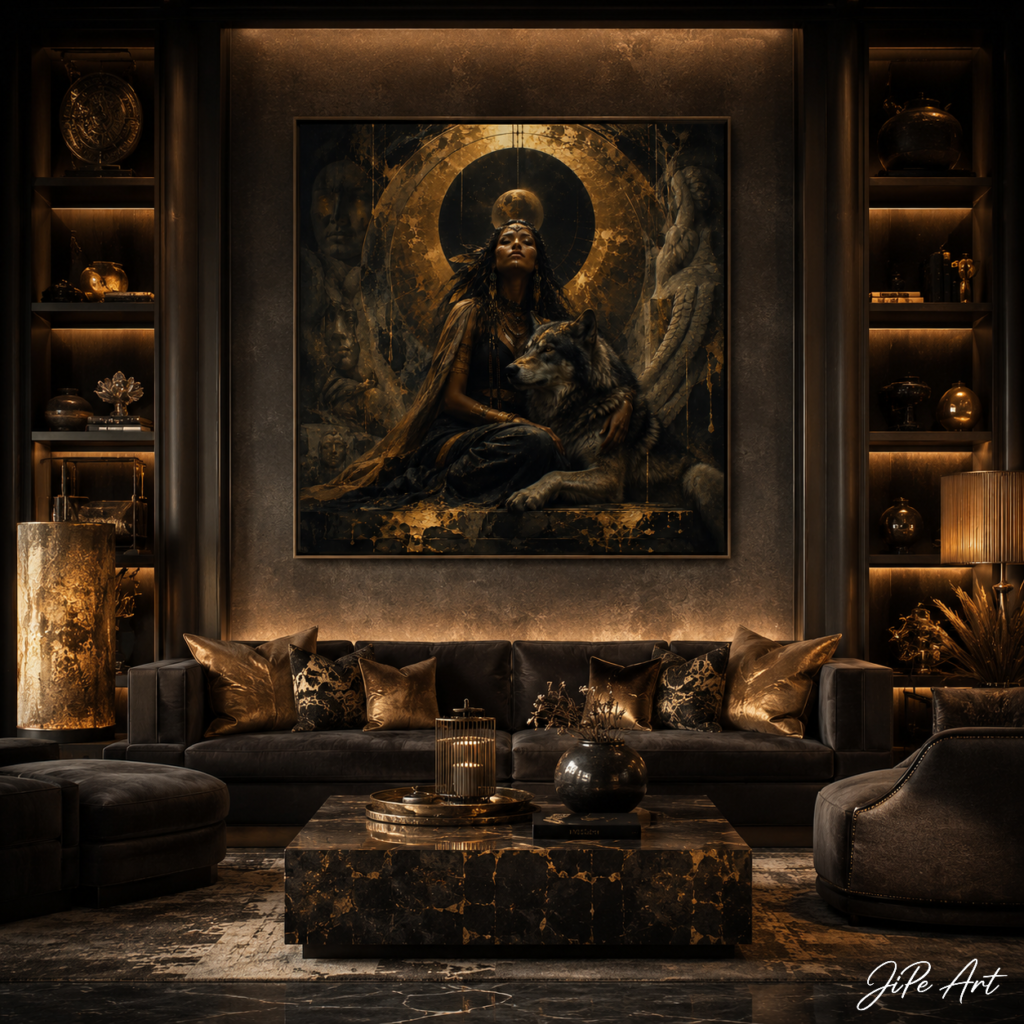
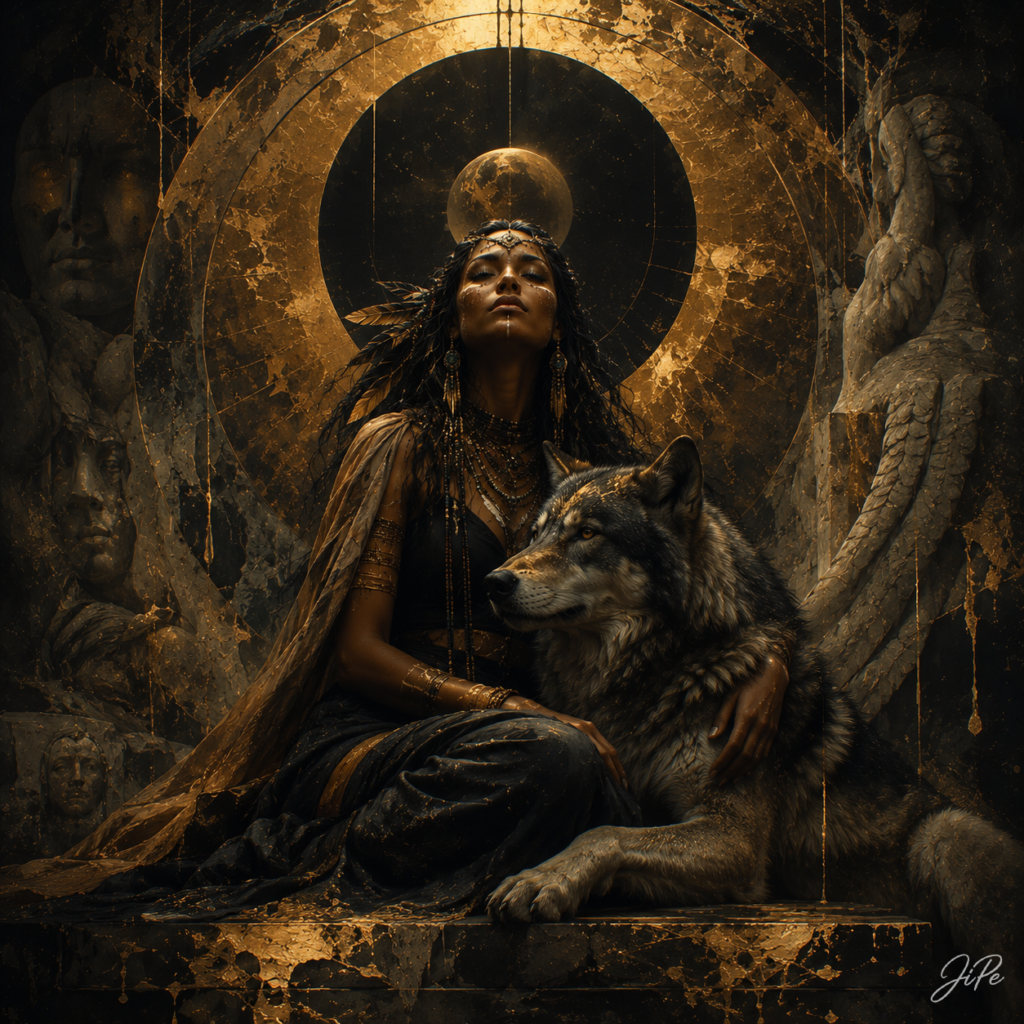
A Kingdom of Shadows and Gold holds its central presence in a state of profound composure, surrounded by forces that seem older than language. The atmosphere is dense with silence—not peaceful, but watchful. Intimacy and monumentality coexist, creating the sense of a private moment unfolding within a realm whose scale exceeds ordinary experience.
Darkness does not merely surround the figure; it gives her presence its gravity. Gold appears within that darkness as a restrained counterforce, suggesting value without certainty, illumination without release. The relationship between vulnerability and protection remains equally unresolved. What appears close and protective may also belong to a more instinctive, unknowable order.
The title evokes sovereignty, yet this kingdom seems governed less by possession than by equilibrium. Shadow and radiance are not opposing territories but interdependent conditions, each defining the other. The figure’s stillness suggests neither triumph nor surrender, but an acceptance of their coexistence.
Perhaps the deepest form of sovereignty is not dominion over darkness, but the capacity to remain present within it. A Kingdom of Shadows and Gold leaves open whether this is a place she rules, a place she remembers, or a place within herself from which she has never truly departed.