Awakening the Eternal

Awakening the Eternal is a monumental meditation on transcendence, transformation, and the enduring nature of consciousness. Balancing monumental symbolism with psychological intimacy, the painting explores the invisible threshold between mortality and eternity. Rather than depicting a specific religious or mythological narrative, it creates a universal visual language through which themes of awakening, self-discovery, sacrifice, and spiritual illumination are expressed. It is a work that speaks equally to personal introspection and collective human experience.
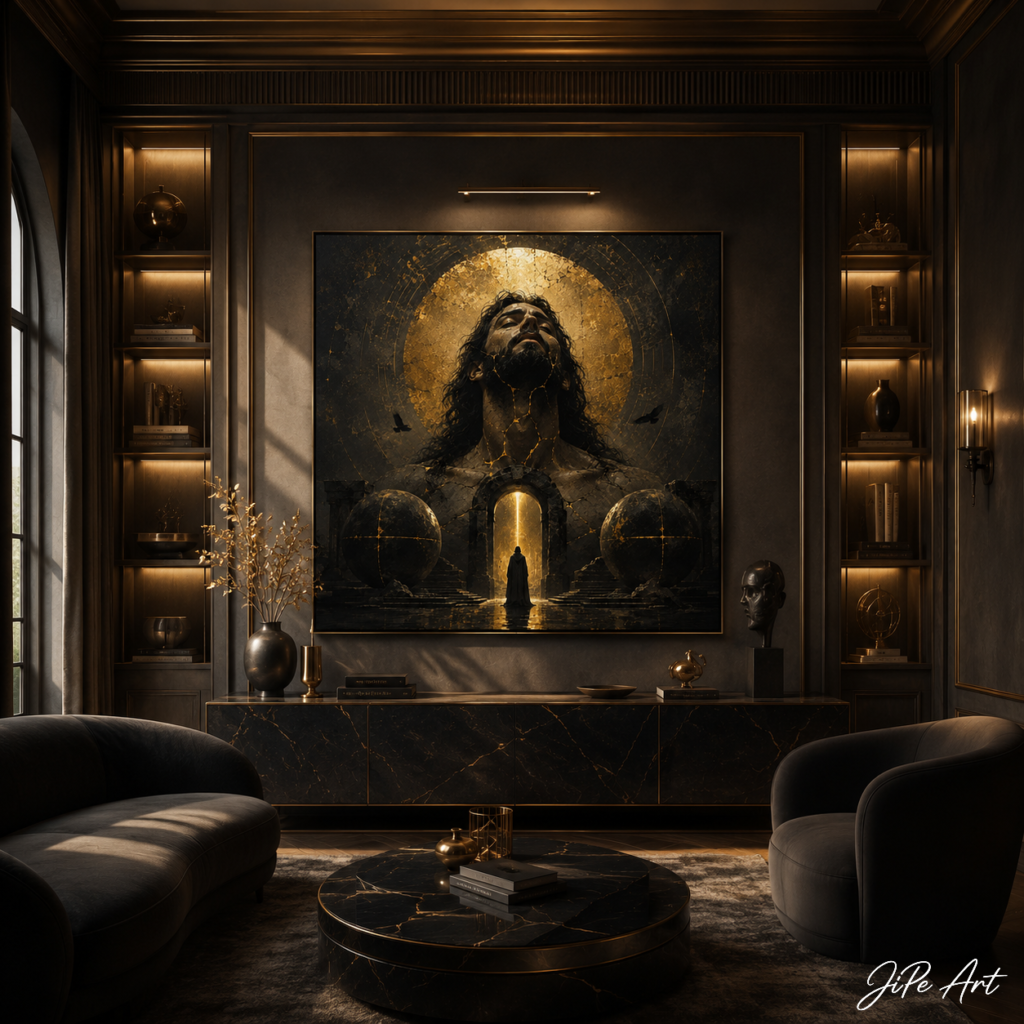
At the center of the composition stands a solitary cloaked figure before an illuminated gateway, dwarfed by the immense architectural and symbolic structures that surround them. This figure functions as the viewer’s surrogate, inviting us to stand at the same threshold between the known and the unknown. The doorway, flooded with radiant golden light, represents far more than a physical entrance. It becomes a metaphysical passage—an opening between material existence and higher consciousness, between limitation and infinite possibility.
Dominating the upper half of the composition is the colossal face emerging from darkness. With closed eyes and an upward gaze, the monumental figure appears suspended between meditation and revelation. It is impossible to determine whether this presence is awakening from ancient sleep, ascending into enlightenment, or dissolving into cosmic unity. This deliberate ambiguity allows the figure to transcend individual identity and become an archetype of humanity itself—a symbol of the eternal self that exists beneath personality, history, and time.

Golden fractures spread across the face and body like luminous veins of transformation. Inspired by the philosophy of kintsugi, these radiant fissures reject the notion that perfection lies in flawlessness. Instead, they suggest that every wound, every fracture, and every moment of vulnerability contributes to a greater wholeness. The light does not conceal imperfection—it emerges through it. In this sense, the painting proposes that awakening is not achieved despite suffering but often because of it.
Behind the monumental figure radiates an immense circular halo composed of layered concentric forms. The geometry evokes celestial bodies, sacred architecture, ancient cosmology, and universal cycles of creation and renewal. These circles establish a powerful visual rhythm that draws the viewer inward while simultaneously expanding the sense of infinite space. The composition becomes both deeply personal and cosmological, suggesting that individual transformation reflects universal order.
The architectural elements surrounding the gateway reinforce this dialogue between permanence and transcendence. Weathered columns, monumental spheres, and ancient stone structures appear simultaneously archaeological and futuristic, as though belonging to a civilization existing beyond conventional history. They embody humanity’s enduring search for meaning, reminding the viewer that every culture has sought symbols capable of expressing what ultimately lies beyond language.
The two immense celestial spheres positioned on either side of the portal establish an extraordinary compositional balance. They may be interpreted as representations of duality—matter and spirit, darkness and light, beginning and end, knowledge and mystery. Yet they remain perfectly still, suggesting that true equilibrium is achieved not by choosing one force over another, but by understanding their inseparable relationship. Their presence reinforces the painting’s central meditation on harmony between opposing realities.
The restrained colour palette of deep charcoal, weathered black, warm ochre, and luminous gold contributes significantly to the emotional atmosphere. Gold becomes the visual embodiment of consciousness itself. Against the surrounding darkness, every illuminated surface acquires extraordinary symbolic weight. Rather than functioning as decoration, the gilded textures recall centuries of sacred art, Byzantine iconography, illuminated manuscripts, and ceremonial objects in which gold represented divine presence, eternal light, and spiritual revelation.
Materiality plays an equally important role within the painting. Rich painterly textures, weathered surfaces, expressive brushwork, and layered mixed-media effects create an impression that the work has evolved over centuries rather than being completed in a single moment. The visible cracks, worn stone, and fractured gold blur the distinction between painting, sculpture, and ancient monument. This tactile quality reinforces the illusion that memory itself has become material.
Art historically, Awakening the Eternal occupies a compelling intersection between contemporary visionary symbolism, monumental figurative painting, symbolic realism, and abstract material expression. Classical proportions and Renaissance-inspired monumentality merge seamlessly with cinematic lighting, contemporary mixed-media aesthetics, and psychologically charged symbolism. The result is a visual language that feels both timeless and unmistakably contemporary, honouring historical traditions while speaking to modern existential questions.
Conceptually, the work explores the idea that awakening is not an event but a process of remembering. The eternal suggested by the title is not something external to be discovered but an inner presence waiting to be recognised. The immense face above the portal may therefore be understood as the awakened self already existing beyond ordinary perception, while the solitary figure below represents every individual standing at the beginning of that journey. Together they illustrate the paradox that what we seek has always existed within us.
Ultimately, Awakening the Eternal invites sustained contemplation rather than immediate interpretation. Its symbols remain deliberately open, allowing each viewer to engage through personal experience, philosophical reflection, or spiritual imagination. The painting offers no definitive doctrine, only a profound visual meditation on transformation, resilience, and the enduring light that emerges when the human spirit confronts both its deepest fractures and its greatest possibilities. In doing so, it reminds us that eternity is not merely measured in time, but in the awakening of consciousness itself.