Monumental Visionary Fine Art exploring mythology, consciousness, sacred light, and timeless visual storytelling.

Monumental Visionary Fine Art exploring mythology, consciousness, sacred light, and timeless visual storytelling.

Figurative Paintings

Where the Soul Blossoms

Where the Soul Blossoms

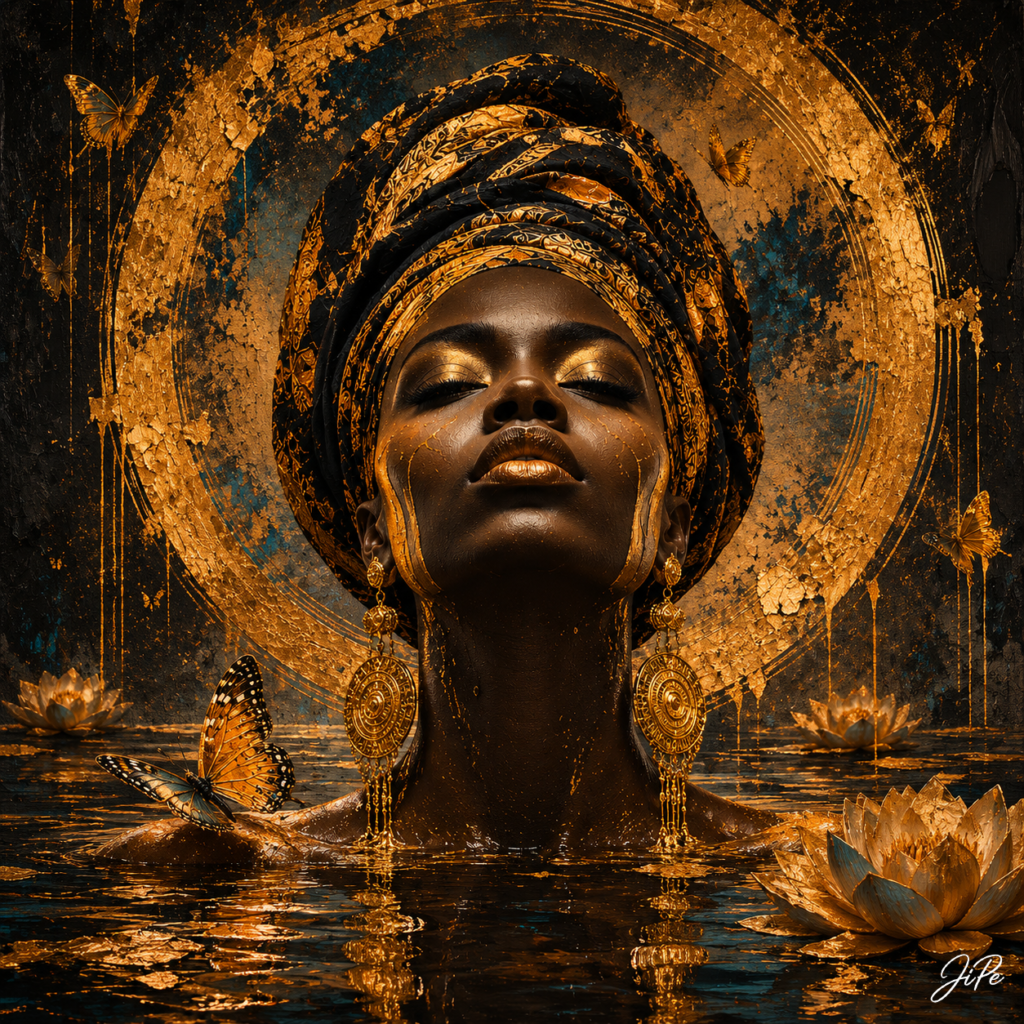
Where the Soul Blossoms is a poetic meditation on inner awakening, spiritual transformation, and the quiet unfolding of human consciousness. Blending symbolic portraiture with contemporary mixed-media aesthetics, the painting explores the moment when the soul, having journeyed through darkness, emerges into its fullest expression. It is not a portrait of an individual alone, but an archetype of renewal—a visual hymn to the beauty that grows from silence, resilience, and self-discovery.

The title itself serves as both invitation and revelation. Where the Soul Blossoms suggests that the most profound flowering does not occur in the external world but within the unseen landscapes of the human spirit. Like the lotus rising from still waters or the butterfly emerging from its chrysalis, the soul unfolds gradually, shaped by experience, vulnerability, and time. This work celebrates that invisible process, transforming it into an image of timeless elegance and quiet transcendence.

At the center of the composition stands a serene female figure, immersed in luminous water that reflects both the surrounding light and her own inner radiance. Her eyes remain gently closed, her face lifted toward an unseen source beyond the visible world. This upward gesture is neither dramatic nor theatrical; instead, it conveys complete surrender—a state of profound trust in the unfolding of life. She appears suspended between earth and sky, body and spirit, presence and eternity.

The closed eyes are essential to the emotional language of the work.

Rather than withdrawing from the world, they suggest a deeper form of seeing. The figure no longer searches outward for meaning; instead, she turns inward, where intuition replaces certainty and silence becomes its own form of wisdom. In this inward gaze, the painting proposes that true awakening begins when external distractions dissolve and the soul finally listens to itself.

Behind the figure glows a monumental golden circle whose luminous presence dominates the composition. This radiant disc may be interpreted simultaneously as halo, sun, celestial portal, eclipse, or sacred mandala. Throughout art history, the circle has symbolized wholeness, infinity, and the eternal cycle of existence. Here it becomes the visual heart of the painting, surrounding the figure with an atmosphere of spiritual illumination while reinforcing the idea that enlightenment is not something attained from outside, but something remembered from within.

Gold plays a central symbolic role throughout the work. Rather than appearing polished or ornamental, it emerges organically through weathered textures, expressive brushwork, and fractured surfaces. It flows gently across the skin like liquid light, tracing delicate paths that resemble sacred markings rather than decoration. These golden streams suggest the visible manifestation of inner transformation—as though wisdom itself has become luminous enough to appear upon the body.

The gold recalls ancient traditions in which precious metals represented divinity, eternity, and incorruptible truth. Yet in Where the Soul Blossoms, gold does not signify perfection. Instead, it represents experience refined through struggle. Like veins of precious ore revealed within stone, its brilliance becomes meaningful precisely because it emerges from complexity rather than flawlessness.

The surrounding water introduces another profound symbolic dimension. Water has always represented purification, memory, emotion, rebirth, and the unconscious. Here it is remarkably calm, disturbed only by gentle reflections that dissolve the boundary between reality and dream. The figure appears neither submerged nor fully emerged, existing instead within a liminal state—a threshold where transformation quietly unfolds.

Floating across this sacred surface are lotus flowers, among the most enduring symbols of spiritual awakening in human history. Growing from dark waters yet blooming untouched above them, the lotus has long represented purity arising from adversity. Within the context of this painting, these blossoms echo the central theme: beauty does not deny hardship; it grows through it.

The soul, like the lotus, blossoms because it has journeyed through darkness.

Golden butterflies drift gracefully through the composition, introducing the symbolism of metamorphosis. Their delicate presence contrasts beautifully with the monumentality of the portrait, reminding viewers that even the greatest transformations often begin with the smallest movements. Butterflies embody renewal, freedom, impermanence, and the continuous evolution of identity.

Together, the butterflies and lotus flowers establish a visual dialogue between transformation above and transformation below, surrounding the central figure with living metaphors of spiritual growth.

Compositionally, the work achieves extraordinary harmony. Every element radiates from the central portrait without overwhelming it. Circular geometry, flowing water, organic floral forms, and delicate vertical lines create an elegant rhythm that guides the viewer’s eye naturally throughout the composition. Nothing feels accidental. Every gesture contributes to an atmosphere of contemplative stillness.

The artist’s use of negative space further enhances this meditative quality. Despite the richness of detail, the painting never feels crowded. Silence exists between forms, allowing the viewer’s gaze to rest before continuing deeper into the work. This measured pacing reflects the very process of spiritual awakening itself—never hurried, always unfolding gradually.

Materially, Where the Soul Blossoms demonstrates a sophisticated balance between realism and expressive abstraction. Thick painterly textures, weathered surfaces, layered mixed-media effects, and visible traces of impasto create remarkable physical depth. The painting becomes almost sculptural, inviting not only visual observation but an awareness of its tactile presence.

Every crack, layered surface, and textured passage carries symbolic significance.

The material itself mirrors the emotional landscape it represents.

Nothing is perfectly smooth.

Everything bears the marks of transformation.

The restrained palette amplifies this emotional resonance. Deep blacks provide visual gravity while warm gold dominates the composition with extraordinary luminosity. Subtle hints of turquoise hidden within the background introduce a quiet sense of life and renewal, balancing the warmth of the gold with moments of cooling reflection. The result is a chromatic harmony that feels simultaneously luxurious and deeply contemplative.

From an art historical perspective, Where the Soul Blossoms occupies a compelling space between symbolic portraiture, visionary realism, sacred iconography, and contemporary textured abstraction. The work recalls the visual language of Byzantine gold grounds, Renaissance devotional painting, and modern mixed-media practice while remaining entirely contemporary in its emotional accessibility.

Its symbolism remains deliberately universal. Although viewers may recognize echoes of multiple spiritual traditions, the painting belongs exclusively to none of them. Instead, it speaks to shared human experiences of healing, growth, surrender, and self-realization. This openness allows each viewer to encounter the work through their own philosophical, cultural, or emotional framework.

Psychologically, the portrait reflects the process of integration. The serene expression suggests a consciousness no longer fragmented by external expectation or internal conflict. The figure embodies emotional equilibrium—a state in which vulnerability and strength coexist without contradiction. She is not escaping the world but inhabiting it more completely, having discovered stillness within herself.

The painting therefore becomes less about transcendence in the traditional sense than about presence.

Its central message is not to leave life behind.

It is to awaken fully within it.

Perhaps the most remarkable quality of Where the Soul Blossoms is its silence. There is no dramatic narrative, no visible action demanding immediate interpretation. Instead, the painting unfolds slowly, revealing new layers of meaning with prolonged contemplation. The viewer begins not by understanding the work intellectually, but by feeling it emotionally.

Standing before the painting becomes an experience of stillness rather than observation.

The portrait does not ask to be analyzed.

It asks to be inhabited.

Ultimately, Where the Soul Blossoms is a celebration of the extraordinary beauty that emerges when the human spirit embraces its own journey. It reminds us that every season of darkness carries the possibility of renewal, that every challenge contains the seed of wisdom, and that the deepest forms of growth often unfold invisibly before they are ever seen by the world.

The luminous halo becomes a symbol of awakened consciousness.

The lotus flowers become reminders that purity can rise from adversity.

The butterflies become quiet messengers of transformation.

And the serene figure becomes an enduring image of the soul at peace with itself.

In Where the Soul Blossoms, the artist transforms portraiture into a timeless meditation on awakening, resilience, and inner illumination. It is an artwork that invites viewers to pause, breathe, and remember that the most meaningful blossoms are rarely found in gardens alone—they bloom within the silent landscapes of the soul, where light, experience, and hope come together to create something eternal.

Lämna ett svar