Monumental Visionary Fine Art exploring mythology, consciousness, sacred light, and timeless visual storytelling.

Monumental Visionary Fine Art exploring mythology, consciousness, sacred light, and timeless visual storytelling.

Surreal Paintings

Where the Soul Begins to See

Where the Soul Begins to See

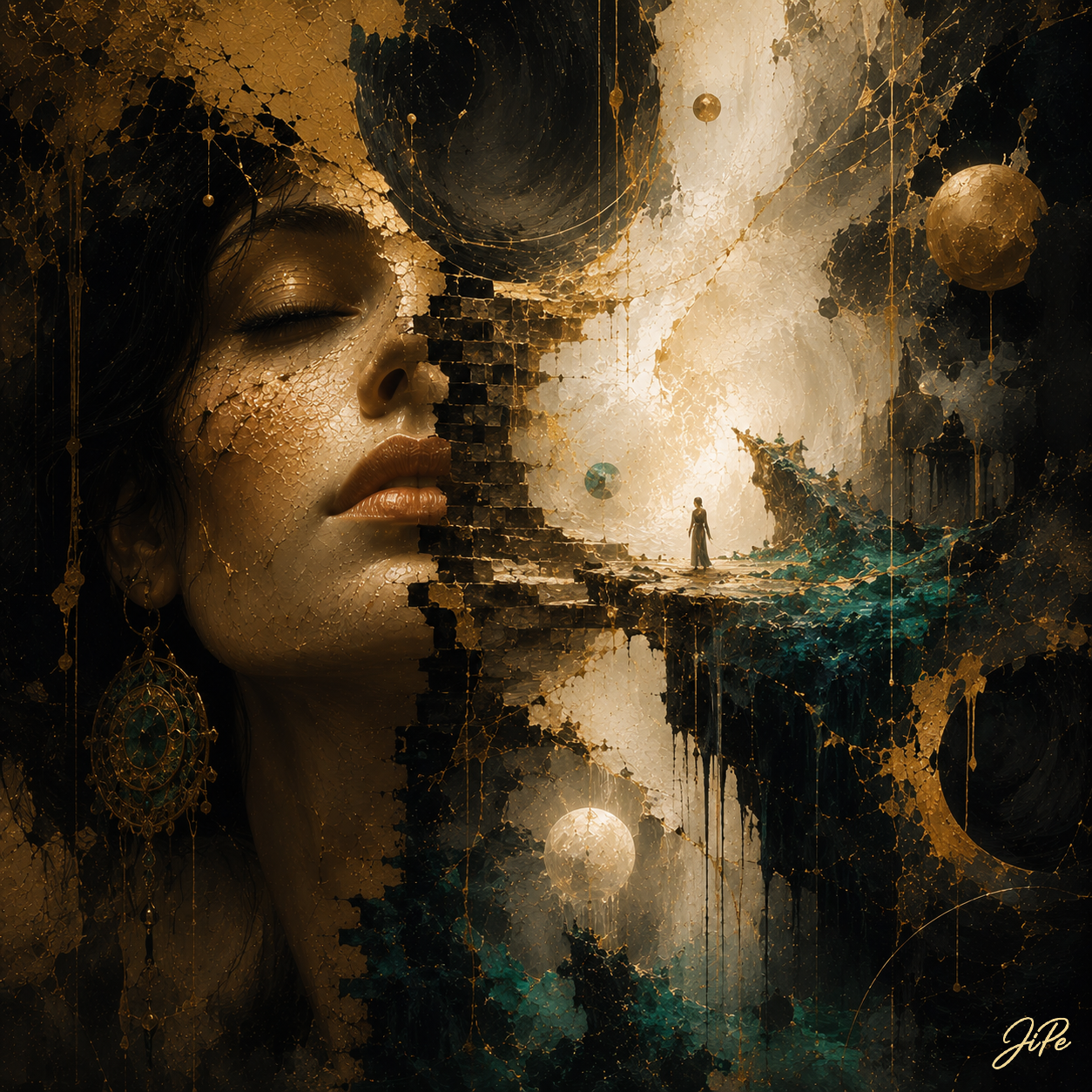
Where the Soul Begins to See is a profound meditation on inner awakening—a monumental exploration of the moment when perception shifts from the eyes to the spirit. In this extraordinary work, JiPe presents a paradox that has echoed through philosophy, psychology, and sacred traditions for centuries: true vision begins only after ordinary sight has surrendered. The blindfold that conceals the woman’s eyes does not represent ignorance, but liberation. It suggests that the deepest truths cannot be observed through external vision alone; they must be encountered through an awakened consciousness.

Rather than illustrating blindness, the painting portrays revelation.

Rather than depicting limitation, it reveals transcendence.

This is the moment where the soul opens before the eyes ever can.

At the heart of the composition stands an immense female figure whose face is wrapped in delicate white cloth. Her head is gently raised toward an unseen source beyond the visible world, while her expression remains remarkably peaceful. There is no fear in her posture, no struggle against darkness. Instead, she appears to have accepted the surrender of certainty, embracing the quiet transformation that unfolds when control gives way to trust.

She is no longer searching.

She is listening.

She has entered the place where understanding arrives without explanation.

The title, Where the Soul Begins to See, establishes the conceptual foundation of the work. It proposes that genuine perception is not an intellectual achievement but an inner awakening. Throughout history, artists and mystics alike have described enlightenment not as acquiring more information, but as learning to perceive reality differently. JiPe transforms this ancient philosophical idea into an unmistakably contemporary visual language, where symbolism, painterly abstraction, and monumental composition merge into a singular emotional experience.

The blindfold immediately commands attention, yet it resists simplistic interpretation. It is neither an instrument of oppression nor an emblem of helplessness. Instead, it becomes an invitation to release dependence upon external appearances. By removing ordinary sight, the painting suggests the emergence of another form of vision—one rooted in intuition, memory, compassion, and spiritual awareness.

Only when the eyes fall silent…

can the soul begin to speak.

Surrounding the figure is an eruption of extraordinary painterly energy. Sweeping explosions of luminous gold collide with deep turquoise, charcoal, and fragments of fractured stone. These expressive gestures appear simultaneously as clouds, shattered walls, streams of consciousness, and emotional landscapes. Their ambiguity is deliberate. JiPe avoids literal storytelling in favour of symbolic atmosphere, allowing viewers to inhabit the emotional architecture of transformation rather than simply observe it.

The turquoise passages introduce a rare chromatic counterpoint within the artist’s characteristic palette of black, ivory, and gold. Here they evoke renewal, emotional depth, and the quiet currents of unseen life beneath the surface of experience. Rather than disrupting the composition, these cool tones intensify the warmth of the golden light, creating a visual dialogue between shadow and illumination, uncertainty and revelation.

Gold remains the dominant symbolic force.

Not as decoration.

But as truth becoming visible.

Throughout JiPe’s body of work, gold functions as a language rather than a colour. It represents healing, transcendence, memory, and the invisible presence that binds fractured realities into coherent wholeness. Here, gold appears to erupt from within the figure herself, suggesting that enlightenment is never imposed from outside. It emerges from the deepest interior of human existence.

The fractured texture of the woman’s skin reinforces this interpretation. Fine cracks spread delicately across her face and body, recalling the Japanese philosophy of kintsugi, where broken objects are restored with precious metal rather than concealed. JiPe extends this philosophy beyond material restoration into the realm of identity itself.

Brokenness becomes illumination.

Scars become pathways.

Every fracture remembers the light.

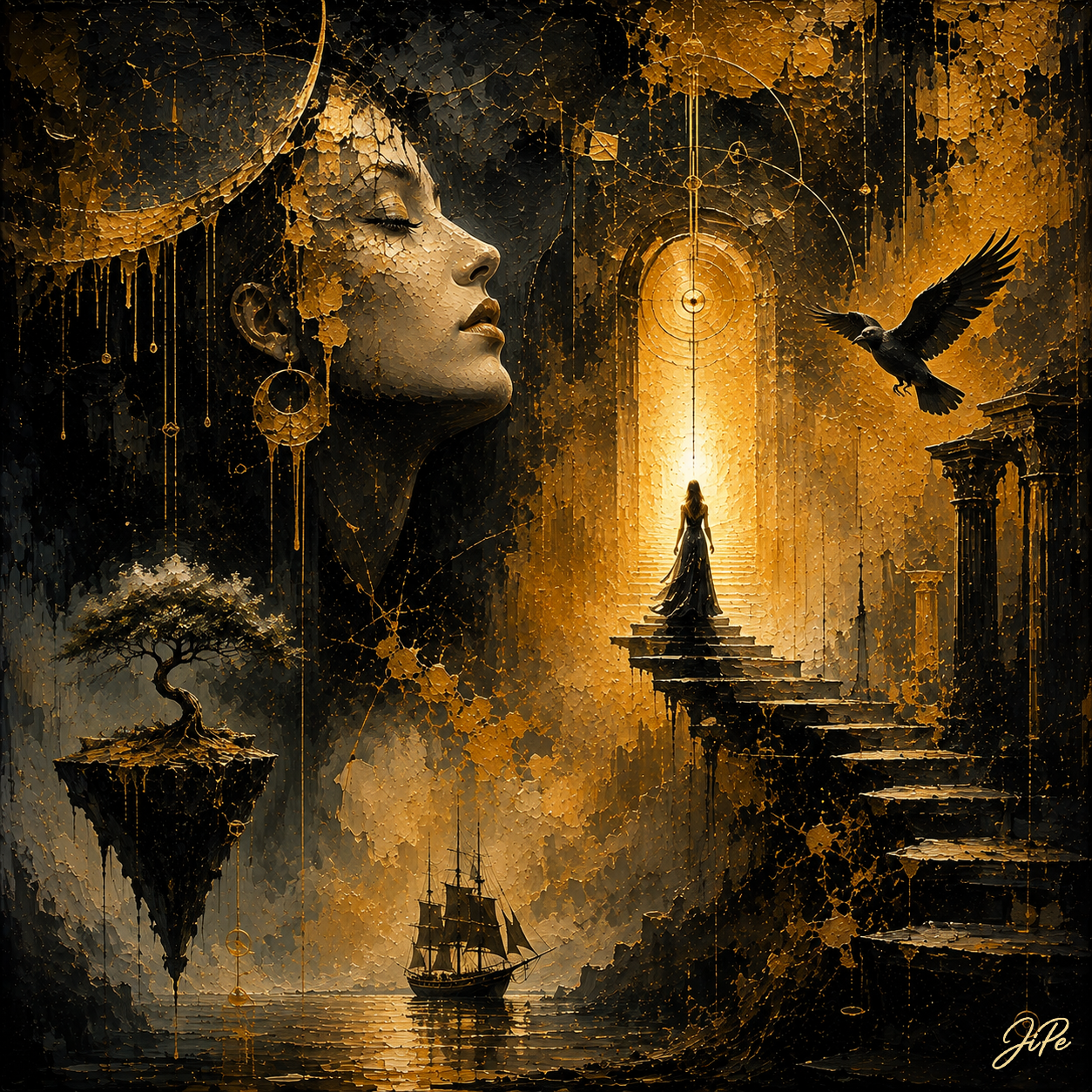
Perhaps the most compelling symbolic element lies near the base of the composition. Hidden within the figure’s chest and the surrounding painterly forms is a luminous doorway reached by a narrow staircase. A solitary human silhouette stands before its radiant opening, creating a second narrative nested inside the larger portrait.

This miniature architectural space transforms the human body into a cathedral.

The heart becomes an entrance.

The soul becomes a sanctuary.

This remarkable visual metaphor suggests that the journey toward awakening is profoundly inward. The doorway does not exist somewhere beyond the horizon or among distant heavens; it exists within the human spirit itself. Every ascent toward transcendence begins by descending into one’s own interior landscape.

The painting’s symbolic complexity extends further through the inclusion of the white dove emerging from radiant clouds behind the figure. Throughout countless artistic traditions, the dove has represented peace, reconciliation, purity, and divine presence. JiPe integrates this familiar symbol without reducing it to religious illustration. Instead, the bird becomes another expression of liberated consciousness—a visual echo of the awakening already unfolding within the central figure.

Nearby, cascading waterfalls and distant architectural ruins appear along the left side of the composition. These landscape elements broaden the symbolic horizon while preserving the emotional focus. Flowing water suggests renewal and memory, while the ancient ruins speak of civilizations, identities, and beliefs that inevitably pass away.

Everything external changes.

Everything internal endures.

The soul alone continues the journey.

Contrasting dramatically with these symbols of renewal is the heavy black chain emerging along the right edge of the composition. Massive links dissolve into fragments as they approach the central figure, suggesting that invisible constraints—fear, grief, shame, illusion, or attachment—are actively breaking apart. Yet the chain does not shatter through violence. It simply loses its power as illumination grows stronger.

Freedom does not always arrive through force.

Sometimes it arrives through awakening.

The prison disappears because the prisoner has finally remembered the door.

Compositionally, Where the Soul Begins to See demonstrates extraordinary sophistication. The portrait dominates the vertical format while multiple symbolic narratives unfold simultaneously around and within it. Despite the density of visual information, the work maintains remarkable clarity through careful orchestration of light, gesture, and directional movement. Every diagonal brushstroke, every floating fragment, and every luminous burst directs the viewer toward the unseen centre of spiritual transformation.

Negative space plays an equally vital role. Areas of darkness surrounding the radiant explosion provide moments of visual stillness that allow the composition to breathe. This balance between intensity and restraint reflects JiPe’s broader artistic philosophy, where silence often carries as much emotional weight as spectacle.

From an art historical perspective, the painting synthesizes influences from Symbolism, visionary art, Romantic spirituality, Surrealism, and contemporary mixed-media aesthetics. Yet it remains unmistakably original through its distinctive integration of monumental portraiture, expressive painterly abstraction, sacred geometry, cinematic lighting, and philosophical symbolism.

Rather than illustrating mythology, JiPe creates modern myths.

Rather than depicting saints, he paints archetypes.

Rather than describing belief, he explores experience itself.

Psychologically, the work resonates with Carl Jung’s concept of individuation—the lifelong process through which fragmented aspects of the self gradually become integrated into a more authentic whole. The blindfold can therefore be understood not as denial of reality but as temporary withdrawal from external distraction in order to encounter deeper psychic truth.

The painting suggests that every genuine transformation requires such a passage.

There comes a moment when outward vision reaches its limit.

Only then can inward vision begin.

Perhaps the greatest achievement of Where the Soul Begins to See lies in its profound emotional generosity. It offers no doctrine, no fixed interpretation, and no prescribed destination. Instead, it creates a contemplative space where viewers may encounter their own questions, wounds, hopes, and awakenings. Each symbol remains deliberately open, allowing individual experience to complete the work’s meaning.

Some will see a story of healing.

Others will recognize liberation from fear.

Some may encounter faith.

Others may simply discover themselves.

Ultimately, Where the Soul Begins to See reminds us that the deepest forms of perception are born not through mastery of the external world, but through reconciliation with the inner one. It is an invitation to trust the wisdom that exists beneath certainty, beneath language, and even beneath sight itself.

For perhaps the soul has always possessed perfect vision.

It simply waits patiently…

until the eyes are willing to close.

Lämna ett svar