Monumental Visionary Fine Art exploring mythology, consciousness, sacred light, and timeless visual storytelling.

Monumental Visionary Fine Art exploring mythology, consciousness, sacred light, and timeless visual storytelling.

Surreal Paintings

She Who Walked Beyond Herself

She Who Walked Beyond Herself

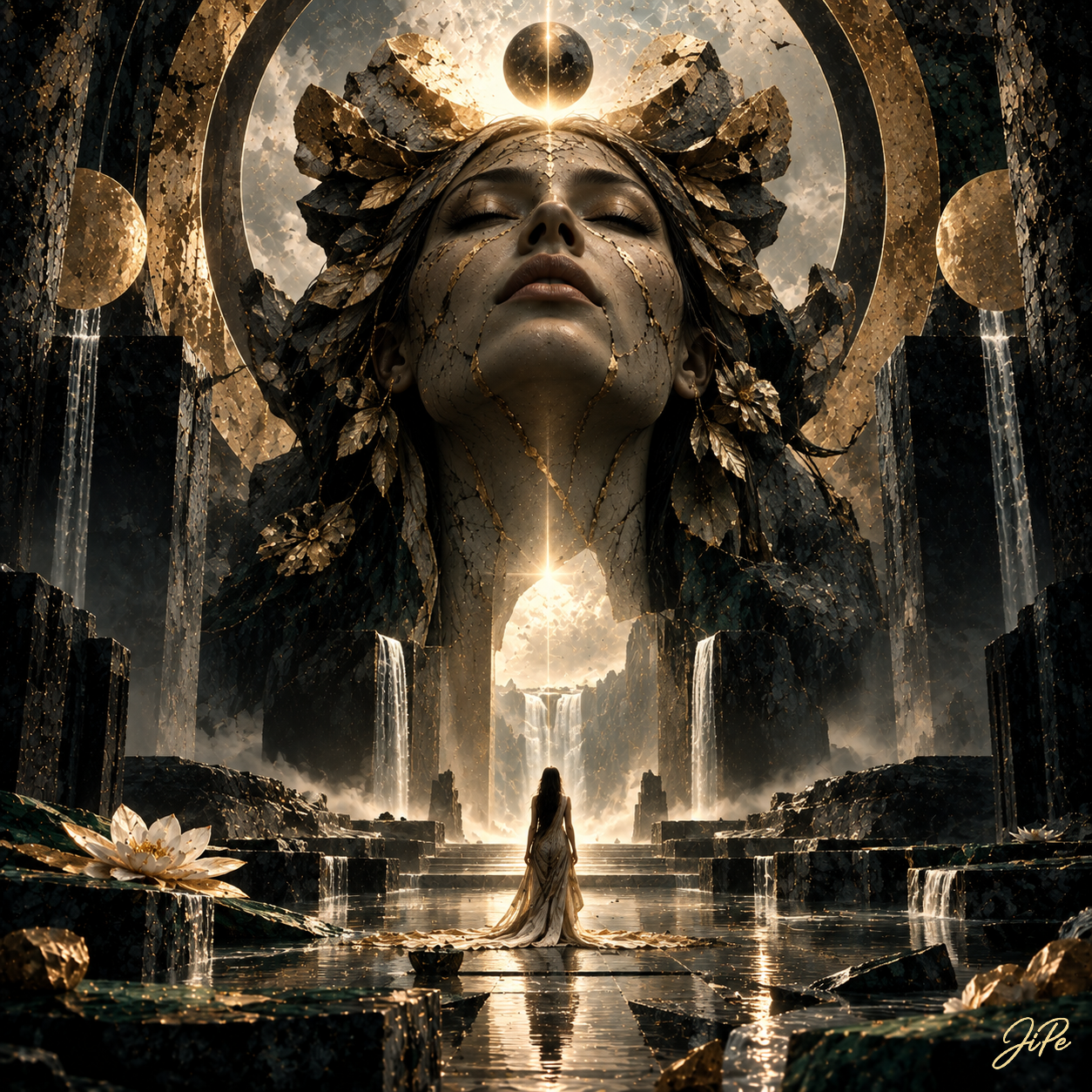
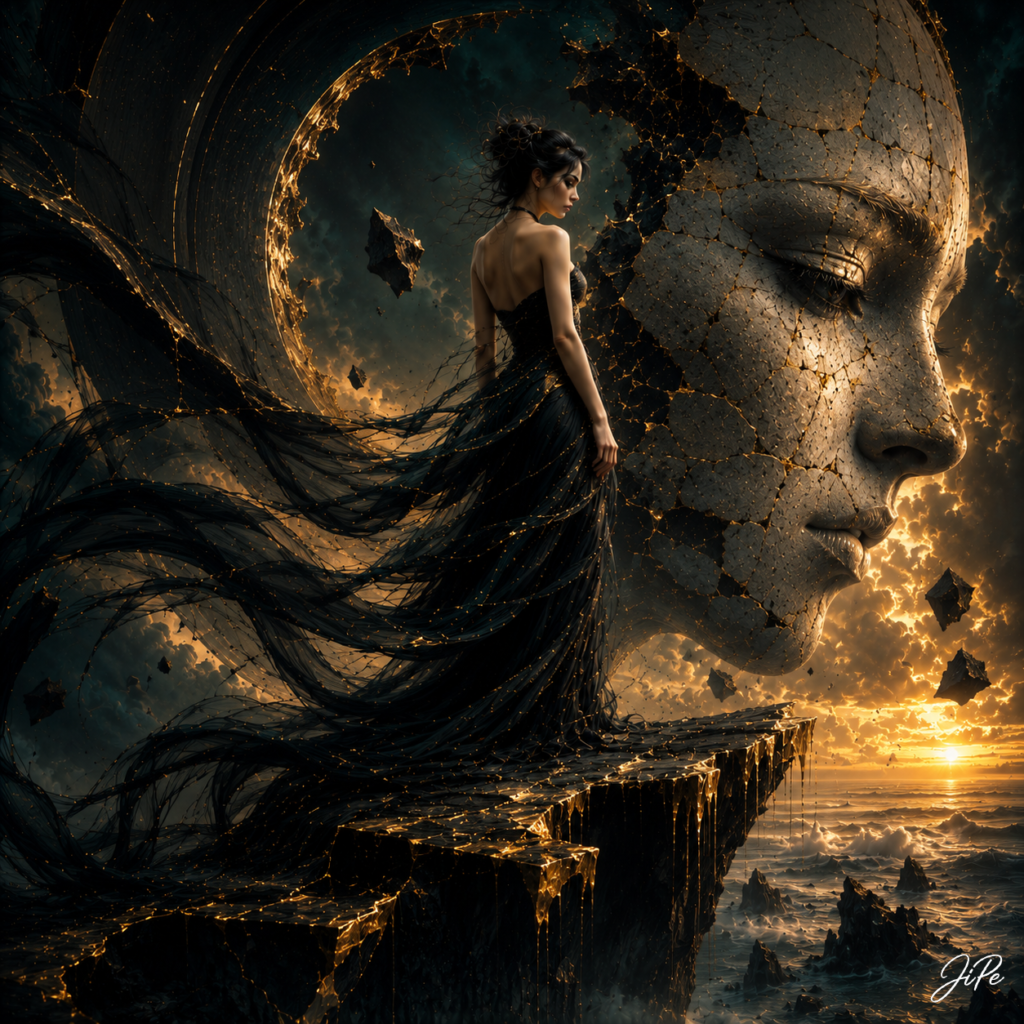
She Who Walked Beyond Herself is a monumental meditation on transformation, self-transcendence, and the quiet courage required to leave behind the familiar in pursuit of a deeper truth. Situated between symbolic realism, visionary art, and contemporary mythological painting, the work explores one of humanity’s most enduring philosophical questions: Who do we become when we are willing to move beyond the limits of the person we once believed ourselves to be? Rather than portraying a physical journey, the painting visualises an inner passage—a crossing from identity shaped by memory into consciousness shaped by awakening.

At the centre of the composition stands a solitary woman dressed in flowing black, walking along a monumental stone pathway that extends toward an infinite horizon. Her posture is calm and composed, neither hurried nor hesitant. She does not appear to flee from the past nor pursue an external destination. Instead, each step suggests deliberate transformation, as though the journey itself has become its own purpose. She embodies quiet resilience—the strength that emerges not through conquest but through the willingness to continue walking when certainty has disappeared.

Her flowing garment becomes one of the painting’s most expressive visual elements. Sweeping outward like living shadow, smoke, or dark water carried by the wind, it dissolves the boundary between the figure and the surrounding landscape. The fabric appears almost sentient, stretching behind her in fluid ribbons that evoke memories, former identities, and emotional histories gradually dissolving into the vastness from which they came. The movement conveys an essential paradox: the past remains part of us even as we move beyond it.

Dominating the right side of the composition is the immense fractured face of a monumental woman emerging from the surrounding darkness. Her eyes remain gently closed, her expression serene despite the visible network of cracks that covers her surface. She resembles an ancient sculpture weathered by centuries, carrying within every fracture the accumulated weight of memory and experience. Yet nothing about her presence suggests decay. Instead, she becomes a timeless monument to endurance, reminding viewers that wisdom is never untouched by suffering but is often shaped through it.

The relationship between the colossal face and the walking figure forms the emotional heart of the painting. They appear to represent two dimensions of the same consciousness. The monumental face embodies the self that has already endured transformation—the silent witness who contains every memory without being imprisoned by it. The walking figure represents the active self, continually evolving toward new horizons. Together they create a profound dialogue between becoming and being, between movement and stillness, suggesting that personal growth arises from the harmonious relationship between these two aspects of existence.

Behind the figures rises an immense celestial circle, partially fractured and illuminated with radiant gold. Simultaneously functioning as eclipse, halo, portal, and cosmic threshold, the circle becomes the symbolic centre of the composition. It recalls the eternal cycles of nature, where endings quietly become beginnings and destruction gives birth to renewal. The fractured circumference suggests that perfection is neither possible nor necessary. Even the heavens bear the marks of transformation, reminding us that the universe itself evolves through continual change.

The landscape unfolds toward an expansive ocean illuminated by the final light of the setting sun. Rather than functioning as a literal seascape, the water becomes a symbolic horizon separating the known from the unknown. Throughout mythology and philosophy, oceans have represented the unconscious, the infinite, and the mysterious spaces beyond human certainty. Here the sea stretches endlessly toward the light, inviting contemplation of what lies beyond visible experience. The distant sun becomes less an ending than a promise that every conclusion conceals the beginning of another journey.

Suspended throughout the atmosphere are fragments of floating stone that appear liberated from gravity itself. These drifting forms resemble remnants of collapsed monuments or fragments of forgotten worlds, suspended between creation and dissolution. They suggest that identity is never a fixed structure but a living architecture capable of continual reconstruction. What falls away is not necessarily lost; it becomes material from which new understanding is built.

The restrained palette of charcoal black, deep teal, weathered stone, and radiant gold creates a powerful emotional atmosphere. The deep blue-green passages evoke mystery, introspection, and infinite psychological depth, while luminous gold breaks through the darkness with extraordinary intensity. Gold functions throughout the composition not as decoration but as the visual language of transformation. It flows through fractures in stone, outlines architectural forms, and illuminates the surrounding atmosphere, recalling both ancient gilded icons and the philosophy of kintsugi, where brokenness becomes evidence of resilience rather than imperfection. Every luminous fracture suggests that the soul becomes most radiant not despite its trials, but because of them.

The painting’s richly layered surface further reinforces its symbolic depth. Weathered textures, expressive brushwork, abstract interventions, and subtle painterly erosion create the impression that the image has gradually emerged through immense stretches of emotional and geological time. Realism continually merges with abstraction, allowing the viewer to experience the work simultaneously as portrait, landscape, monument, and psychological space. This tactile richness rewards prolonged observation, revealing new relationships between light, texture, movement, and symbolism with every encounter.

From an art historical perspective, She Who Walked Beyond Herself occupies a compelling position between Symbolist philosophy, contemporary figurative painting, surreal realism, and monumental visionary art. Echoes of Romantic landscape painting, classical sculpture, and mythological allegory coexist within a distinctly contemporary visual language. Yet the work ultimately resists belonging to any single tradition. Instead, it constructs its own symbolic universe—one where architecture becomes memory, landscape becomes consciousness, and portraiture becomes a meditation on the evolving human spirit.

The title serves as the philosophical foundation of the entire composition. She Who Walked Beyond Herself speaks not of physical distance but of inner expansion. It suggests the rare and courageous act of stepping beyond inherited identities, limiting beliefs, fear, and the narratives that once defined us. The painting proposes that authentic transformation does not require abandoning who we have been, but integrating every experience into a larger understanding of who we are becoming. The monumental face and the solitary traveller are therefore not separate individuals but two expressions of the same eternal journey.

Ultimately, She Who Walked Beyond Herself is an invitation to contemplate the quiet heroism of personal transformation. It reminds us that life’s most significant journeys often unfold in silence, beyond public recognition and beyond visible achievement. They occur whenever we choose growth over certainty, wisdom over comfort, and authenticity over fear. Standing before this monumental vision, viewers are encouraged to recognise that the greatest distance any person will ever travel is not measured in miles but in consciousness—the sacred journey from the self we inherit to the self we have the courage to become.

Lämna ett svar