The Birth of an Inner Sun

The Birth of an Inner Sun is a profound meditation on inner transformation, creative awakening, and the emergence of light from the deepest chambers of the human soul. Positioned between symbolic realism, visionary abstraction, and contemporary philosophical painting, the work explores one of humanity’s most enduring spiritual ideas: that true illumination is not discovered in the external world, but born from within. Rather than depicting destruction, the painting presents a moment of extraordinary creation—a visual metaphor for the instant in which the hidden centre of consciousness awakens and radiates outward with irresistible force.
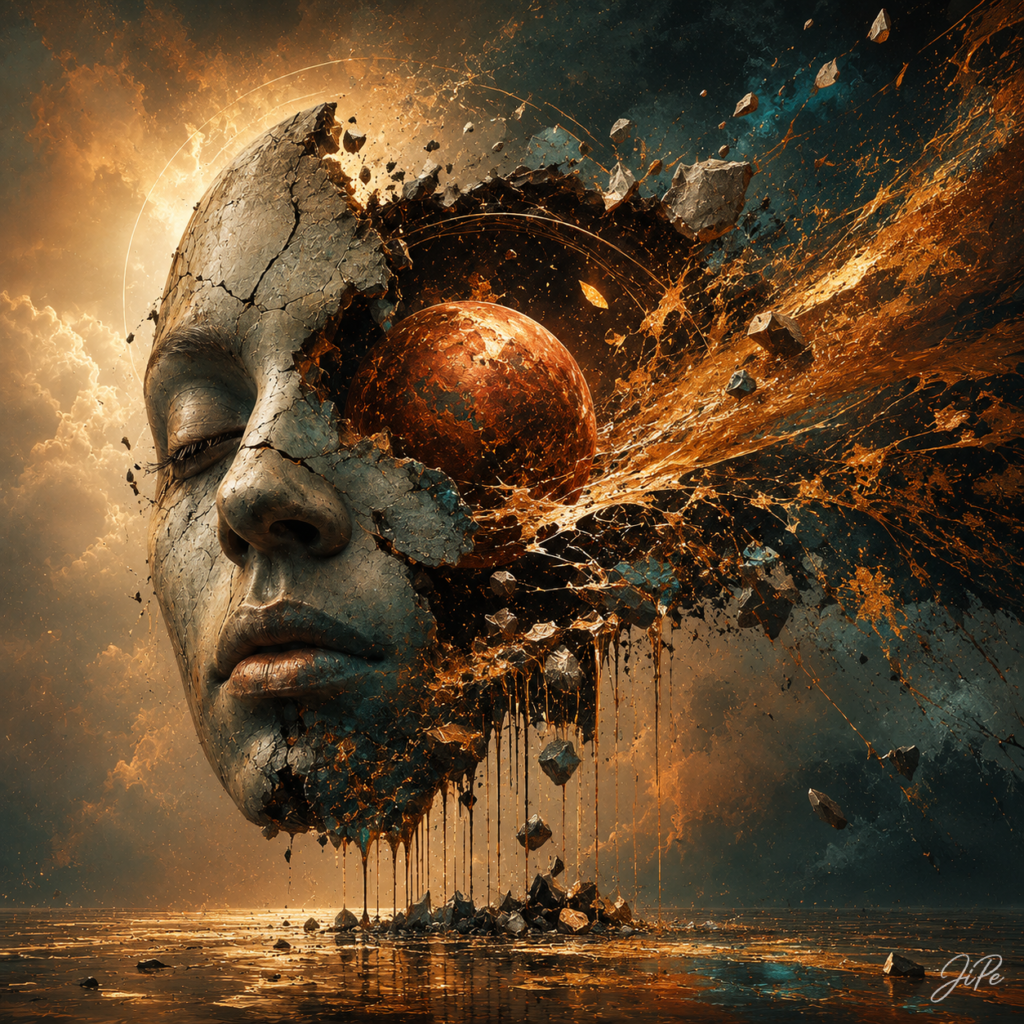
At the heart of the composition floats a monumental stone face suspended between solidity and dissolution. Its eyes remain peacefully closed, its expression untouched by fear or struggle. The figure exists in a state of profound inward contemplation, suggesting that the most significant revolutions occur silently, long before they become visible. This is not a portrait of sleep but of incubation—a consciousness preparing to transcend its former boundaries.
The face itself appears ancient, weathered by immeasurable stretches of time. Fine fractures spread across its surface like geological fault lines, recalling forgotten civilizations, eroded monuments, and the passage of countless generations. Yet these cracks never imply weakness. Instead, they become channels through which a new energy is released. Echoing the philosophy of kintsugi, the visible imperfections reveal that every fracture carries within it the possibility of renewal. The painting suggests that transformation does not erase what has been broken—it allows hidden light to emerge through it.
The most dramatic event unfolds within the figure itself. The right side of the monumental head bursts open, revealing an incandescent celestial sphere suspended where ordinary perception would expect emptiness. This radiant orb functions simultaneously as sun, planet, heart, seed, and cosmic nucleus. It represents the birth of an entirely new centre of being. Rather than entering from outside, the light originates from the innermost depths of the figure, suggesting that enlightenment is never bestowed externally but awakened internally.
Surrounding the emerging sphere is an extraordinary explosion of luminous energy rendered through sweeping painterly gestures, flying fragments of stone, molten gold, and radiant abstract forms. These dynamic elements expand outward with remarkable force, transforming what might initially appear as destruction into an act of creation. Matter itself seems to dissolve into pure energy. The composition proposes that genuine transformation is not a gradual repair of the old self but the courageous emergence of something fundamentally new.
The relationship between the serene face and the erupting inner sun establishes one of the painting’s deepest philosophical tensions. Outwardly, the monument remains tranquil, composed, and almost timeless. Inwardly, however, an entire universe is coming into existence. This contrast suggests that the greatest transformations often remain invisible to the outside world. Beneath calm appearances, consciousness may undergo revolutions of immeasurable magnitude.
The composition is carefully balanced between stillness and explosive movement. The monumental face anchors the image with remarkable stability, while the radiant energy streams diagonally across the composition in sweeping gestures of extraordinary vitality. This dynamic asymmetry creates a visual rhythm that continually draws the viewer’s gaze between silence and motion, contemplation and creation. The painting becomes an elegant dialogue between opposing forces that ultimately exist in harmony rather than conflict.
The celestial sphere itself carries multiple symbolic meanings. It may be understood as the awakened soul, the creative imagination, the divine spark, or the fully realised self hidden beneath layers of memory and conditioning. Simultaneously cosmic and deeply personal, the sphere suggests that the universe exists not only beyond humanity but also within it. Every individual contains an inner sun capable of illuminating even the darkest dimensions of existence.
The surrounding atmosphere reinforces this cosmic perspective. Vast luminous clouds stretch across the horizon, while subtle circular geometries and celestial arcs establish an invisible architecture surrounding the central event. These delicate forms recall astronomical diagrams, sacred mandalas, and the symbolic language of sacred geometry. Their presence quietly suggests that the birth of inner consciousness participates in universal rhythms extending far beyond individual experience.
The restrained palette of weathered stone, deep charcoal, luminous gold, and subtle turquoise creates extraordinary emotional depth. The cool blue-grey passages evoke introspection, mystery, and infinite psychological space, while the radiant gold explodes through the composition with overwhelming vitality. Gold becomes the visual language of awakening itself. It flows through fractured surfaces, abstract gestures, suspended fragments, and atmospheric light, recalling illuminated manuscripts, Byzantine mosaics, and contemporary mixed-media painting. Throughout the work, light never merely illuminates—it transforms.
The richly layered surface further intensifies the painting’s symbolic complexity. Thick painterly textures, weathered stone effects, expressive brushwork, abstract splashes, and fractured architectural passages create an archaeological quality, as though the image has slowly emerged through centuries of memory and contemplation. Every visible layer contributes to the impression that consciousness itself possesses geological depth. The painting rewards prolonged observation, continually revealing new relationships between realism and abstraction, monumentality and dissolution.
From an art historical perspective, The Birth of an Inner Sun occupies a compelling dialogue between Symbolism, visionary realism, abstract expression, and contemporary monumental art. Echoes of Romantic sublime landscapes, classical sculpture, and Surrealist transformation coexist within a distinctly modern visual language. Yet the work ultimately resists belonging to any single tradition. Instead, it constructs its own symbolic universe in which portraiture becomes cosmology and psychological experience assumes monumental physical form.
The title serves as the conceptual key to the entire composition. The Birth of an Inner Sun speaks not of astronomical creation but of spiritual emergence. The inner sun represents the awakening of authentic consciousness—the moment when an individual ceases to seek light outside themselves and discovers that the source has always existed within. It is a powerful reminder that every profound act of creation begins invisibly, deep within the silent landscapes of the soul.
Ultimately, The Birth of an Inner Sun is an invitation to contemplate the immense creative potential concealed within every human being. It suggests that what appears to be collapse may in fact be revelation; what appears to be fragmentation may become the necessary opening through which new life enters. Standing before this monumental vision, viewers are encouraged to reflect upon their own hidden centres of light, recognising that the greatest transformations rarely arrive from beyond the horizon. Instead, they begin quietly within, until one day the inner sun rises with such brilliance that it forever changes the landscape of the self.