Monumental Visionary Fine Art exploring mythology, consciousness, sacred light, and timeless visual storytelling.

Monumental Visionary Fine Art exploring mythology, consciousness, sacred light, and timeless visual storytelling.

Surreal Paintings

Where the Mountain Dreams

Where the Mountain Dreams

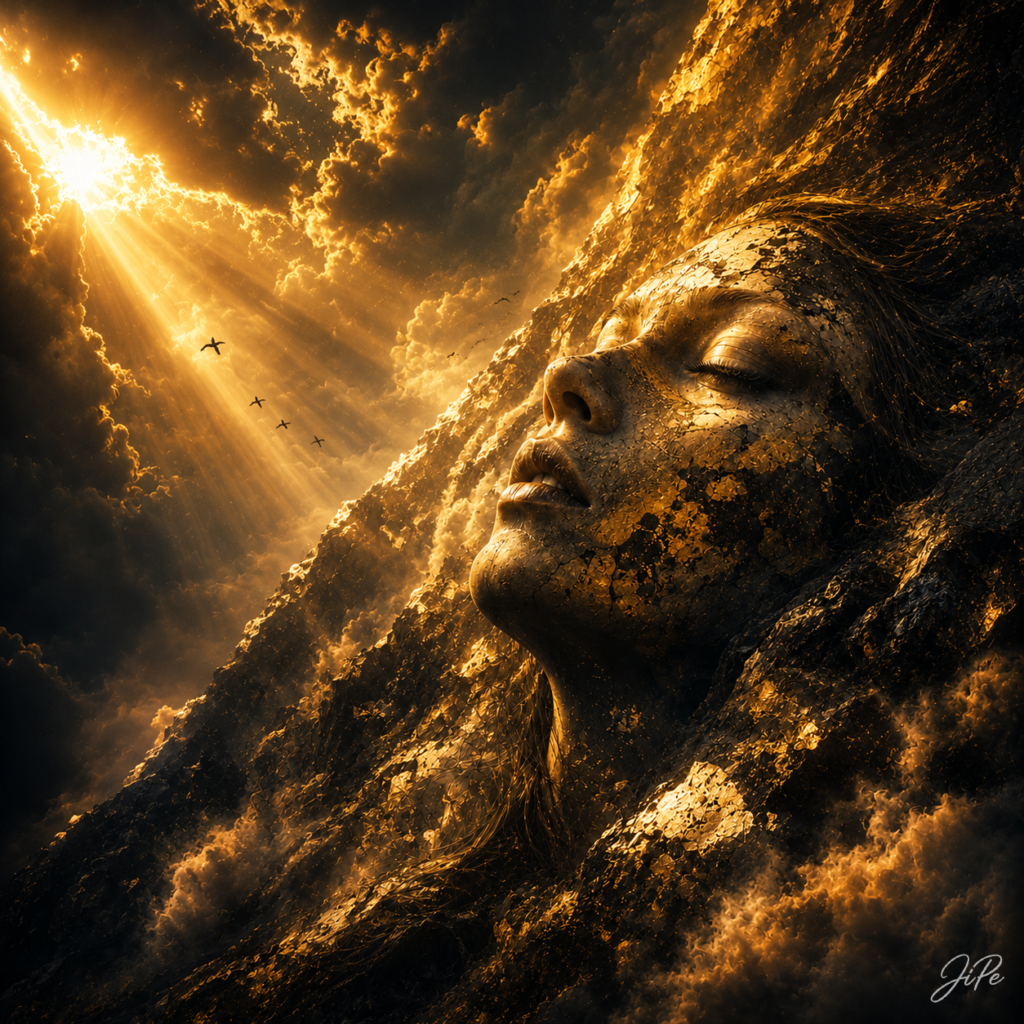
Where the Mountain Dreams is a meditation on the hidden consciousness of the natural world—a monumental vision in which landscape ceases to be mere geography and becomes a living presence. In this extraordinary work, JiPe dissolves the traditional boundary between humanity and nature, suggesting that mountains are not inert masses of stone but ancient beings that remember, witness, and dream beyond the limits of human history. The painting invites viewers into a realm where geology becomes mythology, silence becomes language, and light itself reveals the soul concealed within the earth.

Dominating the composition is the immense face of a sleeping woman emerging seamlessly from the mountainside. She is not carved into the rock, nor imprisoned within it. Rather, she appears to be the mountain itself—its consciousness made visible for a fleeting moment. Her eyes remain gently closed, her expression serene, suggesting neither death nor sleep, but profound contemplation. She embodies an eternal stillness that has existed long before civilization and will remain long after its passing.

The title, Where the Mountain Dreams, transforms the landscape into a psychological and spiritual space. It proposes that nature possesses an inner life, one that unfolds beyond human perception. The mountain is imagined not merely as a physical formation shaped by tectonic forces, but as an ancient dreamer whose thoughts move at the pace of centuries. In this vision, every cliff, valley, and stone becomes part of an immeasurable consciousness silently observing the unfolding story of the world.

The mountain does not speak.

It remembers.

It dreams.

Light enters the composition from the upper left, breaking dramatically through dense clouds in a radiant cascade of golden rays. This illumination functions as far more than atmospheric effect. Throughout JiPe’s artistic language, light symbolizes revelation, grace, and the invisible presence of transcendence. Here it descends not to conquer darkness but to awaken what has always existed within it. The mountain does not receive the light as an external force; it responds as though remembering something long forgotten.

The golden illumination gently traces the contours of the sleeping face, revealing fractured surfaces textured with shimmering veins of luminous gold. These fractures immediately evoke the philosophy of kintsugi, the Japanese art of repairing broken ceramics with precious metal. Rather than concealing damage, kintsugi celebrates fracture as an essential part of an object’s history.

JiPe expands this philosophy to an epic scale.

Even mountains carry scars.

Even eternity bears its memories.

Even the earth heals through light.

The interplay between stone and flesh creates one of the painting’s most compelling visual paradoxes. At first glance, the figure appears entirely geological, yet subtle details—the softness of the lips, the relaxed eyelids, the gentle curve of the neck—introduce unmistakable humanity. This ambiguity allows the viewer to experience both realities simultaneously. The mountain becomes human, while the human becomes landscape.

Identity dissolves.

Nature and consciousness become one.

The surrounding clouds reinforce this symbolic transformation. They envelop the figure like an immense celestial ocean, dissolving clear distinctions between sky, earth, and atmosphere. Rather than framing the mountain, the clouds seem to emerge from its dreaming consciousness, as though the weather itself were an extension of its inner life. Their monumental scale evokes Romantic notions of the sublime, reminding viewers that true grandeur often resides beyond human comprehension.

Flying birds crossing the radiant beam introduce another subtle yet profound layer of symbolism. Traditionally associated with freedom, transcendence, and the movement between earthly and spiritual realms, the birds also establish scale within the immense landscape. Against the colossal face, they appear almost insignificant, emphasizing the unimaginable magnitude of the sleeping mountain.

Yet they also suggest hope.

Dreams travel.

Light travels.

So do souls.

Compositionally, the painting demonstrates remarkable balance through the dynamic relationship between opposing forces. The diagonal rise of the mountain creates powerful visual movement, while the descending rays of light establish an equally strong counter-direction. Their intersection occurs precisely around the face, transforming it into the emotional and symbolic center of the work.

The viewer’s eye naturally follows this luminous path—from the distant heavens, through the descending light, toward the tranquil face resting within stone. This carefully orchestrated visual journey mirrors the painting’s deeper philosophical movement: from transcendence toward inner awakening.

The color palette is restrained yet profoundly expressive. Rich charcoal blacks, deep umber browns, muted earth tones, and luminous gold dominate the composition. The limited chromatic range enhances emotional intensity while reinforcing JiPe’s recurring visual language, in which gold functions not as ornament but as a manifestation of spiritual presence.

Gold here represents illumination without spectacle.

It whispers rather than dazzles.

It reveals rather than decorates.

From an art historical perspective, Where the Mountain Dreams resonates with multiple traditions. Echoes of Romantic landscape painting recall Caspar David Friedrich’s spiritual treatment of nature, while Symbolist influences emerge through the transformation of landscape into psychological metaphor. Elements of Surrealism appear in the seamless fusion of human anatomy and geological form, yet the work ultimately transcends these historical categories through JiPe’s distinctly contemporary synthesis of painterly realism, visionary symbolism, cinematic composition, and monumental scale.

The painting also engages with ancient mythological traditions in which mountains were understood as sacred beings rather than passive environments. Across cultures—from Olympus to Sinai, from Kailash to the sacred mountains of Indigenous cosmologies—mountains have long served as places where heaven and earth intersect. JiPe reimagines this timeless symbolism through a modern visual vocabulary, suggesting that sacredness remains present wherever humanity is willing to perceive it.

Perhaps the painting’s deepest meaning lies in its exploration of silence. Nothing dramatic occurs within the image. There is no visible action, no conflict, no narrative climax. Instead, the work unfolds through profound stillness. This silence is not emptiness but fullness—a state in which transformation occurs beneath the surface, beyond immediate perception.

The mountain teaches patience.

The light teaches trust.

The dream teaches surrender.

The sleeping face may also be understood as a metaphor for the hidden dimensions of human consciousness. Like the mountain, every individual contains vast inner landscapes that remain largely unexplored. Beneath daily activity lies a deeper self—ancient, intuitive, and intimately connected to something greater than personal identity. The painting encourages viewers to recognize that their own interior world may be just as expansive and mysterious as the landscapes they admire.

This psychological reading complements the work’s spiritual interpretation without diminishing either. JiPe consistently creates images capable of sustaining multiple layers of meaning simultaneously. The painting is at once geological, mythological, philosophical, emotional, and deeply personal.

Ultimately, Where the Mountain Dreams is not simply about a mountain.

It is about consciousness itself.

It asks whether the earth dreams through us as much as we dream about the earth.

It suggests that stillness possesses its own wisdom, that silence preserves forgotten truths, and that beneath every visible landscape lies an invisible presence waiting patiently to be discovered.

JiPe invites viewers to slow their gaze, to enter the quiet rhythm of the composition, and to contemplate a reality in which nature is no longer an object to observe but a living companion in humanity’s shared journey through existence.

For perhaps the oldest mountains have never truly been asleep.

Perhaps they have simply been dreaming long enough to remember what we have forgotten.

And perhaps every ray of light that touches the earth is an invitation to awaken alongside them.

Lämna ett svar