Where Empires Dream

Where Empires Dream is a contemplative exploration of memory, civilization, and the enduring dialogue between beauty and impermanence. Merging visionary symbolism, surreal realism, and richly textured contemporary mixed-media techniques, the painting presents history not as a sequence of forgotten events but as a living consciousness that continues to echo through landscapes, ruins, and the human spirit. Monumental in both scale and emotional resonance, the work invites viewers into a dreamscape where ancient civilizations, personal identity, and timeless mythology converge within a single luminous vision.
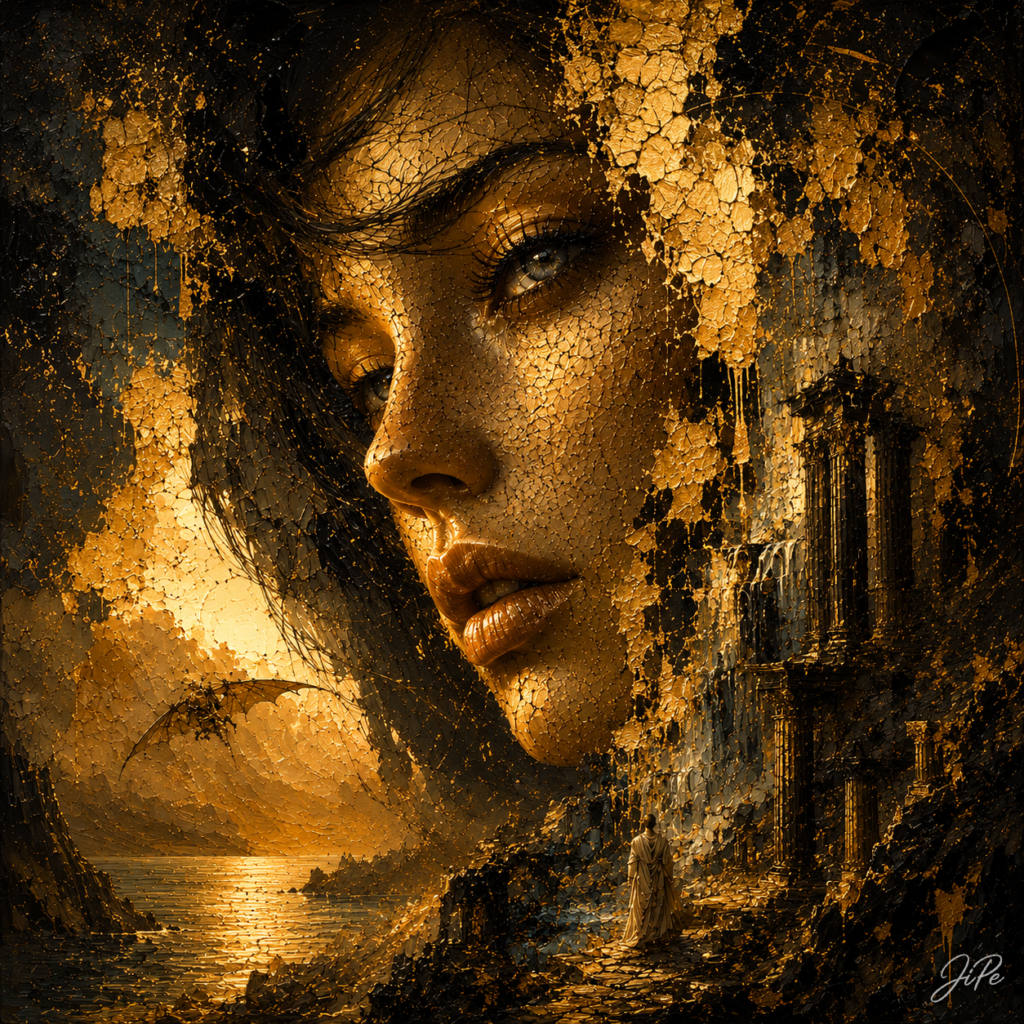
Dominating the composition is the immense portrait of a woman whose face appears to emerge from fractured layers of gold, weathered stone, and shadow. She exists neither fully within the physical world nor entirely beyond it. Instead, she inhabits the threshold between memory and imagination, embodying the soul of civilizations that have long vanished yet continue to shape the present. Her gaze is quiet and introspective, carrying an emotional depth that suggests remembrance rather than observation. She does not simply witness history—she becomes its living archive.
The title, Where Empires Dream, transforms the painting into a philosophical meditation on legacy. Empires are often remembered through monuments, victories, and architecture, yet this work proposes a different perspective. It asks what remains after power has disappeared. When kingdoms fall and cities return to silence, what continues to endure? The answer offered by the painting is neither political nor historical, but poetic: civilizations survive within memory, imagination, and the stories humanity continues to tell. Their dreams become part of our collective consciousness.
One of the work’s most compelling visual features is the integration of monumental portraiture with an expansive symbolic landscape. The woman’s face dissolves organically into towering ruins, weathered cliffs, cascading waterfalls, and luminous horizons, creating a seamless dialogue between the human figure and the passage of time. Rather than separating portrait from landscape, the artist allows both to exist as aspects of the same eternal presence. Humanity and history become inseparable, each reflecting the other.
The ancient ruins positioned beside the central figure evoke the architectural language of classical civilizations while deliberately avoiding reference to any single historical culture. Their fractured columns stand as universal symbols of achievement, ambition, and inevitable decline. Yet the ruins do not communicate loss alone. Bathed in radiant gold, they suggest that beauty often becomes most profound after the ambitions that created it have faded. Architecture becomes memory transformed into stone.
A solitary cloaked figure standing among the ruins introduces a deeply human dimension to the composition. Small against the monumental environment, this individual represents every traveler who has ever sought meaning within the remnants of the past. The figure neither worships nor mourns the ruins but simply inhabits them with quiet reverence. This subtle gesture transforms the viewer into an active participant, encouraging reflection upon humanity’s ongoing search for identity within history itself.
Beyond the ruins stretches a tranquil sea illuminated by the final light of day. The water functions as both geographical space and symbolic passage. Across countless artistic and mythological traditions, the sea represents transition, memory, and the journey between worlds. Here, it becomes the silent distance separating the living from forgotten civilizations, while simultaneously connecting every generation through the continuous flow of time.
The small dragon soaring across the glowing horizon introduces another symbolic layer. Rather than representing conflict, it evokes imagination, myth, and the untamed forces that lie beyond empirical history. Every civilization creates stories that transcend its own existence. The dragon becomes a reminder that mythology often survives far longer than political power, carrying emotional truths that outlive empires themselves.
Light serves as the painting’s primary emotional language. Golden illumination pours across the composition with extraordinary subtlety, emerging from behind the portrait while flowing across stone, sea, and architecture alike. Unlike ordinary sunlight, this radiance appears almost internal, as though memory itself has become luminous. Gold functions not merely as a decorative element but as a visual metaphor for enduring wisdom, sacred inheritance, and the invisible continuity linking past and present.
The artist’s exceptional command of materiality further deepens the work’s conceptual richness. Thick impasto textures, cracked plaster surfaces, weathered pigments, expressive brushwork, and layered gold leaf effects create an archaeological quality that suggests the painting has itself emerged from centuries beneath the earth. The fractured surface becomes inseparable from the subject matter. Time is not simply represented—it is physically embedded within the artwork.
The pervasive network of cracks throughout the portrait subtly recalls the philosophy of kintsugi, where fractures become evidence of survival rather than imperfection. The woman’s face appears weathered by countless centuries, yet every fissure glows with renewed beauty. In this context, brokenness is transformed into wisdom. Memory does not preserve perfection; it preserves resilience.
From an art historical perspective, Where Empires Dream exists at the intersection of several influential artistic traditions. Romanticism contributes its fascination with sublime ruins and humanity’s emotional relationship to history. Symbolism informs the work’s preference for psychological and spiritual meaning over literal narrative. Surrealism dissolves conventional spatial boundaries, allowing portrait, landscape, and architecture to merge into one continuous vision. Contemporary visionary art further enriches the composition through its cinematic atmosphere, layered abstraction, and metaphysical storytelling.
The painting also resonates deeply with archetypal psychology. The monumental feminine figure recalls the Great Mother archetype—not as a figure of fertility alone, but as the eternal keeper of memory. She embodies civilization’s unconscious mind, holding within herself every forgotten language, every vanished kingdom, every act of creation, and every dream that once shaped human history. She becomes history personified—not through chronology, but through emotional truth.
An ecological reading reveals another compelling dimension. Nature quietly reclaims every monument. Stone erodes. Water flows uninterrupted. Light continues to fall upon abandoned temples exactly as it once illuminated thriving cities. The painting therefore challenges humanity’s perception of permanence. Empires rise believing themselves eternal, yet mountains, oceans, and skies patiently outlast them all. Nature becomes the true guardian of history.
The restrained palette of charcoal black, warm ochre, deep amber, and luminous antique gold reinforces the painting’s timeless atmosphere. Gold signifies spiritual continuity and memory, while shadow introduces emotional depth without ever descending into despair. Darkness functions as a space of contemplation rather than absence. It is within shadow that forgotten histories quietly continue to exist.
Emotionally, Where Empires Dream possesses remarkable stillness. Despite its monumental scale and rich symbolic complexity, the composition never feels overwhelming. Instead, it encourages prolonged contemplation. The woman’s expression remains calm, almost compassionate, suggesting that time itself carries neither judgment nor regret. It simply remembers.
This stillness becomes one of the work’s greatest strengths. Every visual element—the ruins, the sea, the dragon, the solitary figure, the luminous cracks, and the monumental face—contributes to a single philosophical reflection: greatness is not measured by conquest but by what continues to inspire long after power has disappeared.
Ultimately, Where Empires Dream is far more than a symbolic portrait or an imagined historical landscape. It is a meditation on civilization’s invisible legacy, on the fragile relationship between ambition and eternity, and on the enduring power of memory to preserve what history alone cannot. Through its masterful synthesis of visionary symbolism, painterly texture, mythological resonance, and contemporary fine art aesthetics, the painting reminds us that while empires inevitably fall, their deepest dreams do not vanish. They remain suspended within art, myth, landscape, and human imagination—waiting for those willing to pause, listen, and remember.