
When the Sun Dreamed in Gold
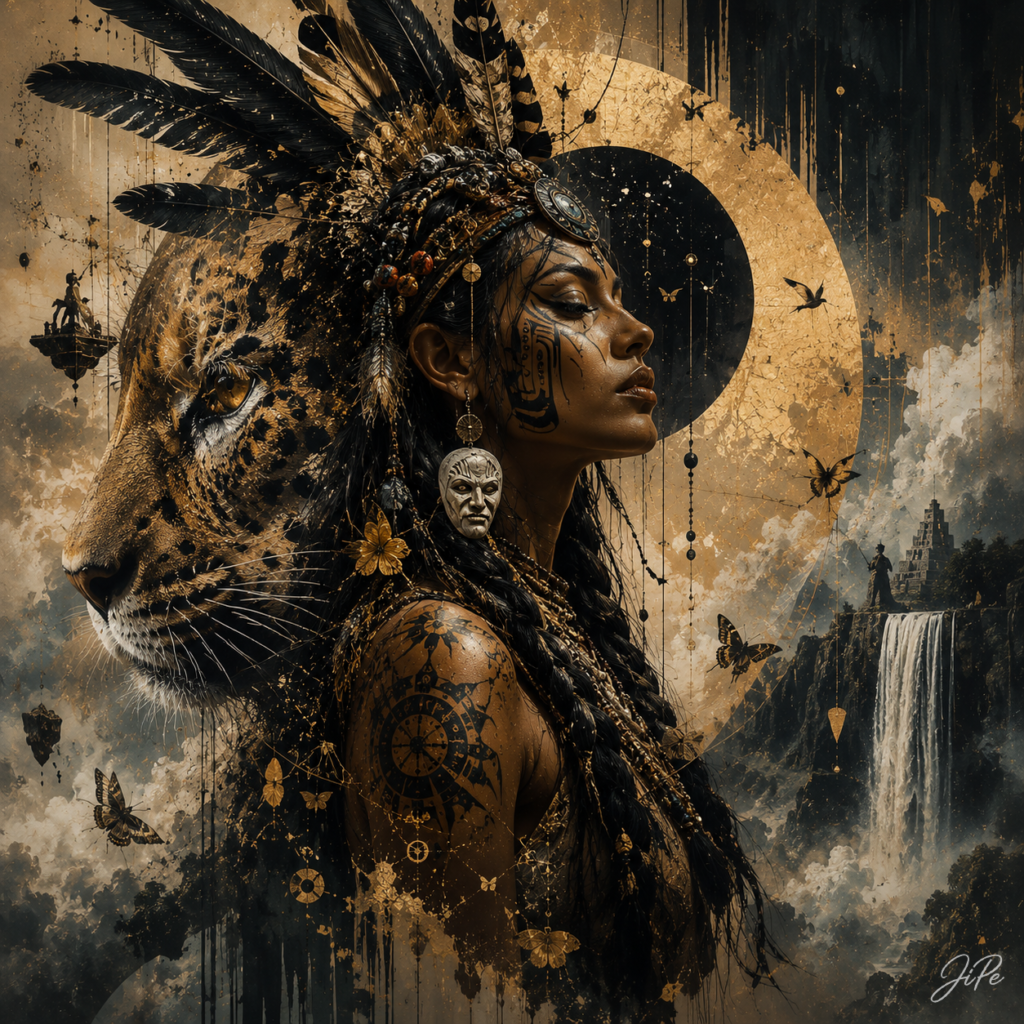
When the Sun Dreamed in Gold is a monumental meditation on memory, ancestry, transformation, and humanity’s enduring relationship with the sacred rhythms of nature. Combining visionary symbolism, mythological storytelling, and contemporary mixed-media aesthetics, the painting unfolds as a visual epic where the boundaries between human consciousness, the natural world, and ancient cosmology dissolve into a single living narrative. Rich with symbolic references drawn from indigenous traditions, archetypal psychology, and timeless mythology, the work invites viewers into a dreamlike landscape where every creature, ornament, and fragment of light carries spiritual significance.
At the center of the composition stands a serene female figure whose closed eyes suggest profound inward vision rather than physical observation. She does not engage the external world but appears immersed in an ancient dialogue that transcends language. Her expression is one of quiet certainty, as though she is listening to voices older than civilization itself. She becomes less an individual portrait than the embodiment of ancestral consciousness—a keeper of forgotten wisdom whose presence bridges the visible and invisible worlds.
Behind her emerges the powerful profile of a jaguar, seamlessly integrated into her own form. Rather than functioning merely as an animal companion, the jaguar represents the untamed force of instinct, courage, transformation, and spiritual guardianship. Across numerous Indigenous American traditions, particularly within Mesoamerican cosmology, the jaguar serves as a guide between worlds, a protector of sacred knowledge, and a symbol of both earthly strength and supernatural awareness. Here, human and animal coexist as complementary aspects of one identity. The woman does not dominate the jaguar, nor does the jaguar overshadow her; together they become a unified expression of the balance between intuition and intellect, vulnerability and power, civilization and wilderness.
The title, When the Sun Dreamed in Gold, immediately establishes a poetic framework that reaches beyond ordinary narrative. Rather than presenting the sun as a physical celestial body, the work imagines it as a conscious dreamer whose golden visions gave birth to worlds, myths, and collective memory. Gold, throughout the composition, becomes far more than a color. It symbolizes divine consciousness, enlightenment, sacred inheritance, and the invisible threads connecting humanity to cosmic origins. Every luminous fragment scattered across the surface appears less like decorative ornamentation than traces of the sun’s dream still lingering upon the earth.
One of the painting’s most compelling visual structures is the immense eclipse positioned behind the central figure. Simultaneously radiant and dark, it functions as the spiritual axis around which every other symbol revolves. The eclipse represents transition, revelation, and the cyclical nature of existence. Within its luminous circumference, opposites coexist: darkness does not extinguish light but reveals its hidden depth. This duality reflects one of the painting’s central philosophical themes—that true wisdom emerges not through certainty but through the reconciliation of opposing forces.
The artist enriches the narrative through an extraordinary accumulation of symbolic elements that reward prolonged observation. Butterflies drift through the atmosphere, suggesting transformation, rebirth, and the soul’s perpetual evolution. A towering waterfall descends beside an ancient stepped temple, invoking purification, continuity, and the eternal flow of time. Suspended islands float effortlessly within the sky, dissolving conventional ideas of gravity and reminding viewers that spiritual landscapes obey different laws than physical reality. Small human figures positioned throughout the distant environment reinforce the monumental scale of the symbolic universe while emphasizing humanity’s humble place within a far greater cosmic order.
The ceremonial adornments worn by the central figure deepen the painting’s cultural resonance. Feathers, beads, medallions, facial markings, and carved masks all function as visual references to ritual, identity, and ancestral lineage. Yet these elements deliberately avoid becoming ethnographic illustration. Instead, they merge influences from multiple traditions into a universal symbolic language that speaks to humanity’s shared search for meaning. The figure becomes less a representative of one particular culture than an archetype embodying collective spiritual memory.
A particularly striking detail is the carved mask suspended beside her face. It introduces the concept of multiple identities existing simultaneously within every human being. The mask may symbolize inherited roles, forgotten ancestors, or the hidden aspects of the self that remain concealed beneath everyday consciousness. Positioned near her closed eyes, it suggests that genuine vision often requires looking beyond the visible face and into deeper psychological and spiritual dimensions.
The painting’s remarkable sense of spatial depth reinforces its dreamlike quality. Monumental forms coexist effortlessly with miniature narrative details, allowing viewers to move continuously between intimate observation and expansive contemplation. This shifting scale mirrors the nature of memory itself, where a single personal experience can resonate across generations, and vast histories may become encapsulated within a fleeting emotion.
Light serves as both compositional and symbolic architecture throughout the work. Rather than illuminating the scene uniformly, golden radiance emerges selectively, highlighting moments of revelation while allowing large passages to remain immersed in shadow. This controlled contrast evokes the tradition of chiaroscuro while simultaneously suggesting that enlightenment always arises from mystery rather than certainty. Darkness is never portrayed as threatening; instead, it becomes the fertile ground from which illumination emerges.
Materiality plays an equally significant role in shaping the emotional experience of the painting. Thick layered textures, weathered surfaces, painterly splashes, cracked gold accents, and expressive brushwork create the impression of an ancient artifact rediscovered after centuries of silence. The surface appears simultaneously timeless and contemporary, inviting comparisons with archaeological relics as well as modern mixed-media abstraction. These tactile qualities reinforce one of the work’s central themes: that memory accumulates through layers rather than remaining fixed in time.
The philosophy of kintsugi subtly echoes throughout the composition. Gold repeatedly appears along fractured surfaces, suggesting that transformation occurs not despite brokenness but because of it. Every apparent imperfection becomes a site of renewed beauty. This visual language elevates resilience into one of the painting’s most profound symbolic messages, proposing that both civilizations and individuals become most luminous through the healing of their deepest fractures.
From an art historical perspective, When the Sun Dreamed in Gold occupies an intriguing intersection between Symbolism, Surrealism, Romanticism, and Contemporary Visionary Art. Like the Symbolists, the artist privileges metaphor over literal narrative. Echoes of Romantic landscape painting emerge through the sublime scale of nature and humanity’s emotional relationship with it. Surrealism contributes the seamless transformation between human, animal, and environment, while the sophisticated layering of textures, sacred geometry, and mixed-media effects firmly situates the work within contemporary fine art practice.
Psychologically, the painting resonates through its exploration of archetypes described by Carl Jung. The central woman embodies aspects of the Great Mother, the Wise Woman, and the Seeker simultaneously, while the jaguar functions as both guardian and shadow—representing instinctive wisdom that modern consciousness often neglects. Together they form an integrated image of psychic wholeness in which rational thought and primal intuition no longer stand in opposition.
The work also speaks powerfully to ecological consciousness. Nature is never presented as passive scenery but as an active participant in spiritual existence. Waterfalls remember. Animals guide. Trees preserve wisdom. Mountains observe. Humanity is portrayed not as ruler of this world but as one voice within a vast living orchestra of creation. Such imagery gently challenges anthropocentric perspectives, encouraging viewers to reconsider their relationship with the natural world as one of reciprocity rather than dominance.
Emotionally, the painting evokes a profound sense of reverence rather than spectacle. Despite its extraordinary visual richness, the composition remains remarkably calm. The closed eyes of the central figure invite silence rather than explanation. She appears to have already found answers that words cannot adequately express. Viewers are therefore encouraged not simply to interpret the work intellectually but to experience it contemplatively, allowing its symbols to unfold gradually through intuition.
The restrained yet luxurious palette of deep charcoals, muted earth tones, luminous ivory, and radiant antique gold contributes significantly to this atmosphere. Gold becomes the visual language of sacred presence, while the darker passages provide depth, mystery, and emotional gravity. Every contrast feels intentional, reinforcing the equilibrium between visible reality and invisible meaning.
Ultimately, When the Sun Dreamed in Gold is not merely a portrait, a mythological scene, or a symbolic landscape. It is a meditation on humanity’s forgotten dialogue with the sacred forces that shape existence. Through its masterful integration of ancestral symbolism, visionary imagination, painterly craftsmanship, and philosophical depth, the work reminds us that wisdom does not disappear with time. It sleeps within memory, within nature, within myth, and within ourselves—waiting patiently for the moment when we become quiet enough to hear the dreams the sun once dreamed in gold.