Monumental Visionary Fine Art exploring mythology, consciousness, sacred light, and timeless visual storytelling.

Monumental Visionary Fine Art exploring mythology, consciousness, sacred light, and timeless visual storytelling.

Surreal Paintings

When the Cosmos Remembered Her

When the Cosmos Remembered Her

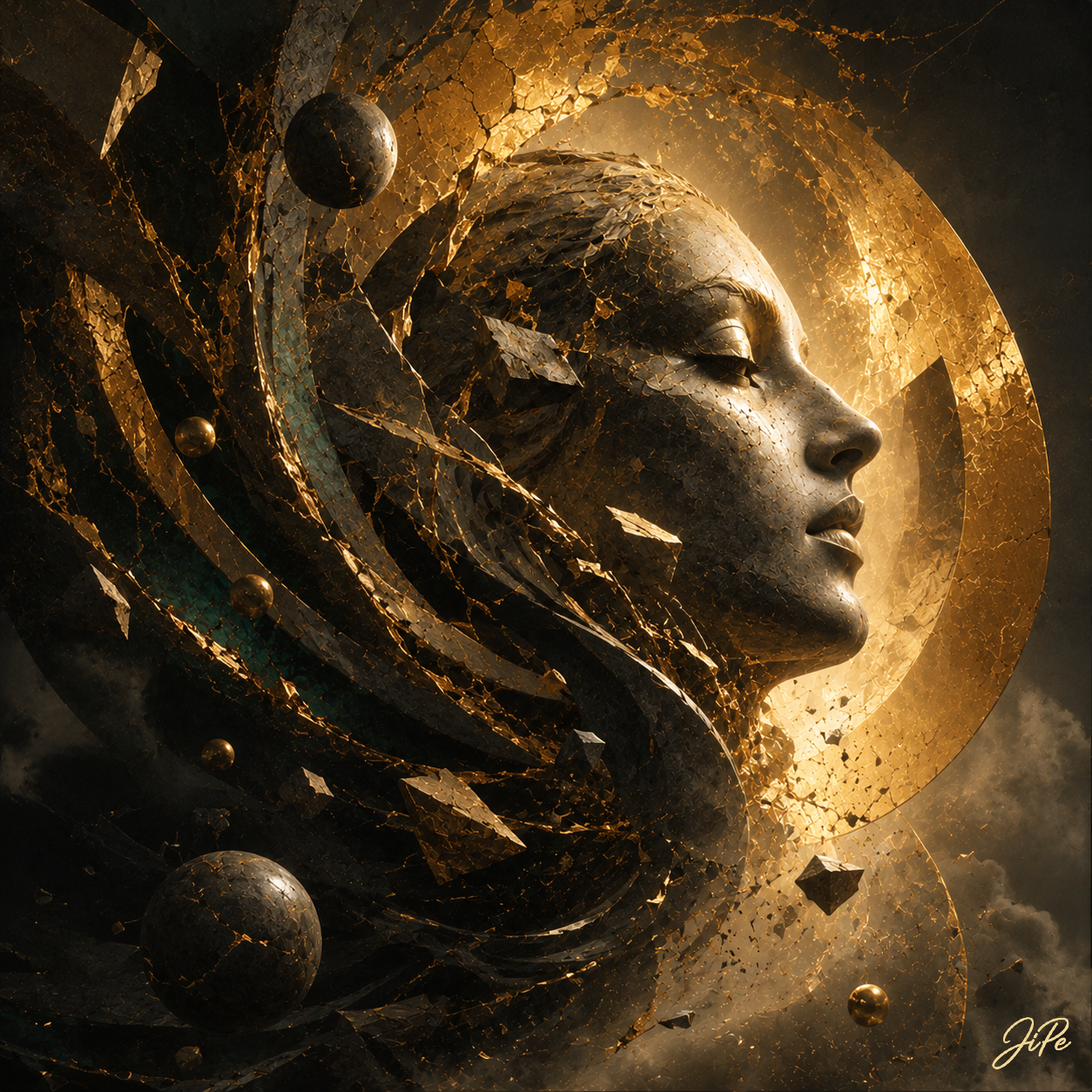
When the Cosmos Remembered Her is a monumental meditation on memory, identity, and the eternal relationship between the individual soul and the universe that gave it birth. In this visionary composition, JiPe presents remembrance not as a human act but as a cosmic event—an awakening that transcends time itself. The painting suggests that there are moments in existence when the universe does not merely observe us but recognizes us, calling forgotten fragments of our deepest nature back into wholeness.

Rather than depicting a narrative or a specific mythological scene, JiPe creates a symbolic landscape where inner consciousness and cosmic architecture merge into one continuous reality. The result is an artwork that exists somewhere between dream and revelation, where the laws of physics surrender to the language of archetypes and where emotion becomes indistinguishable from celestial movement.

Dominating the composition is the serene visage of a woman whose eyes remain peacefully closed, suspended between stone and living flesh. Her face appears ancient, fractured, and luminous, as though it has endured countless ages before emerging once more into light. Fine cracks spread across her features like weathered marble restored through delicate veins of gold, recalling the Japanese philosophy of kintsugi, where fractures are not concealed but transformed into the very source of beauty.

She is not broken.

She has become history itself.

When the Cosmos Remembered Her - Interior Art Mockup
When the Cosmos Remembered Her – Interior Art Mockup

Around her unfolds an immense arc of radiant gold, sweeping across the composition like the orbit of an invisible galaxy. This celestial current does not simply illuminate the landscape—it appears to awaken it. Mountains, ruins, floating fragments of stone, and distant horizons are drawn into its gravitational rhythm, suggesting that every element of existence responds to the silent recognition taking place.

Far below, a solitary figure stands before this overwhelming vision. Small against the immensity surrounding them, the human presence becomes the viewer’s surrogate, inviting us to contemplate our own relationship with the infinite. The scale emphasizes one of JiPe’s recurring philosophical themes: humanity is physically insignificant within the universe, yet spiritually inseparable from it.

The title, When the Cosmos Remembered Her, shifts the traditional relationship between humanity and the divine. Throughout history, countless artistic traditions have depicted individuals seeking enlightenment, searching for God, or attempting to understand the universe. Here, JiPe reverses that direction entirely.

The universe remembers first.

Recognition comes from eternity before it arises within the individual.

This inversion transforms the painting into something profoundly hopeful. Identity is not presented as something that must be constructed through achievement or discovered through endless searching. Instead, the work suggests that our deepest self has always existed beyond time, patiently awaiting the moment when the cosmos calls us back to it.

The woman’s closed eyes become central to this symbolism. She does not gaze outward toward the world because her awareness has already turned inward. Her expression conveys neither ecstasy nor sorrow, but profound stillness—a state in which remembrance becomes possible. Rather than illustrating sleep, JiPe portrays awakening through interior vision.

Her silence speaks louder than movement.

Her stillness becomes the centre around which the universe revolves.

The cracked surface of her face carries multiple symbolic meanings. It evokes the erosion of time, the vulnerability of human experience, and the inevitable fragmentation caused by memory, grief, transformation, and existence itself. Yet the fractures are never presented as damage. They function instead as luminous pathways through which light emerges.

Every wound becomes illumination.

Every fracture becomes revelation.

Every imperfection becomes evidence of survival.

This visual language has become one of JiPe’s defining artistic signatures. His recurring use of weathered surfaces, stone-like anatomy, and golden restoration transforms physical material into psychological metaphor. The body becomes landscape. Memory becomes architecture. The soul becomes something simultaneously fragile and eternal.

The sweeping golden arc dominating the composition is perhaps its most powerful formal element. It can be interpreted as a crescent moon, an eclipse, a celestial orbit, or the curvature of space itself. JiPe intentionally resists singular interpretation, allowing the form to remain open to multiple symbolic readings. It represents movement without beginning or end, a visual reminder that existence unfolds through cycles rather than straight lines.

The cosmos remembers because nothing is ever truly lost.

Everything eventually returns.

Architectural ruins emerging along the distant horizon reinforce this meditation on continuity. They suggest forgotten civilizations, vanished empires, ancient temples, or gateways between worlds. Their incomplete state speaks not of destruction but of persistence. Civilizations disappear, monuments erode, identities transform, yet something essential always remains.

Memory survives stone.

Spirit survives history.

Meaning survives time.

The composition itself is carefully orchestrated to create both grandeur and intimacy. The monumental portrait occupies the upper space like an eternal presence, while the lower landscape invites physical entry into the scene. The sweeping curve of light guides the viewer’s eye through multiple layers of space, creating an almost musical rhythm that moves seamlessly between portrait, landscape, architecture, and horizon.

Every element participates in a single visual sentence.

Nothing exists in isolation.

Light continues to function as JiPe’s primary symbolic language. Rather than simply illuminating objects, it reveals invisible relationships between them. Gold becomes the colour of consciousness itself—a manifestation of wisdom, remembrance, transcendence, and divine presence. Emerging from profound charcoal blacks and muted earth tones, the luminous gold acquires extraordinary emotional resonance, suggesting that illumination is meaningful only because darkness exists beside it.

The restrained palette further strengthens this atmosphere of timeless contemplation. Deep shadows provide visual weight and psychological depth, while subtle variations of ivory, weathered stone, antique bronze, and soft emerald undertones create a richness that unfolds gradually with prolonged viewing. The work never overwhelms through colour; instead, it captivates through balance, restraint, and atmosphere.

Equally significant is JiPe’s sophisticated treatment of surface. Rich painterly textures, cracked mineral finishes, expressive brushwork, and the appearance of layered mixed media evoke the physicality of monumental oil painting. Although contemporary in execution, the artwork possesses the tactile dignity of centuries-old masterpieces, bridging classical craftsmanship with visionary digital expression.

From an art historical perspective, When the Cosmos Remembered Her occupies a compelling position between Symbolism, Surrealism, Visionary Art, Romantic landscape traditions, and contemporary metaphysical painting. Echoes of Gustav Klimt’s luminous ornamentation, Caspar David Friedrich’s spiritual solitude, and the dreamlike symbolism of Odilon Redon may be sensed, yet JiPe synthesizes these influences into an unmistakably personal visual language defined by monumental scale, philosophical symbolism, and cinematic atmosphere.

The painting also engages deeply with Jungian psychology. The central feminine figure may be understood as an archetype of the Self—the complete identity existing beyond the fragmented ego. The surrounding cosmic forms become manifestations of the collective unconscious, while the solitary observer below represents the conscious individual approaching a greater reality that has always existed beyond ordinary perception.

This encounter is not conquest.

It is recognition.

Ultimately, When the Cosmos Remembered Her proposes a profoundly reassuring vision of existence. It suggests that beneath every forgotten dream, every personal loss, every unanswered question, and every fractured identity lies an unbroken connection to something infinitely larger. The universe is not portrayed as cold or indifferent but as deeply relational—as though consciousness itself participates in remembering each soul long after the soul has forgotten itself.

Standing before this work, viewers may first be captivated by its immense scale, radiant light, and breathtaking composition. Yet the painting gradually reveals a quieter truth.

Perhaps the deepest form of belonging does not arise when we discover who we are.

Perhaps it begins when eternity remembers us.

And in that silent moment of recognition, everything that once seemed broken quietly becomes whole again.

Lämna ett svar