Monumental Visionary Fine Art exploring mythology, consciousness, sacred light, and timeless visual storytelling.

Monumental Visionary Fine Art exploring mythology, consciousness, sacred light, and timeless visual storytelling.

Fantasy Paintings

The Soul’s Compass

The Soul’s Compass
The Soul’s Compass

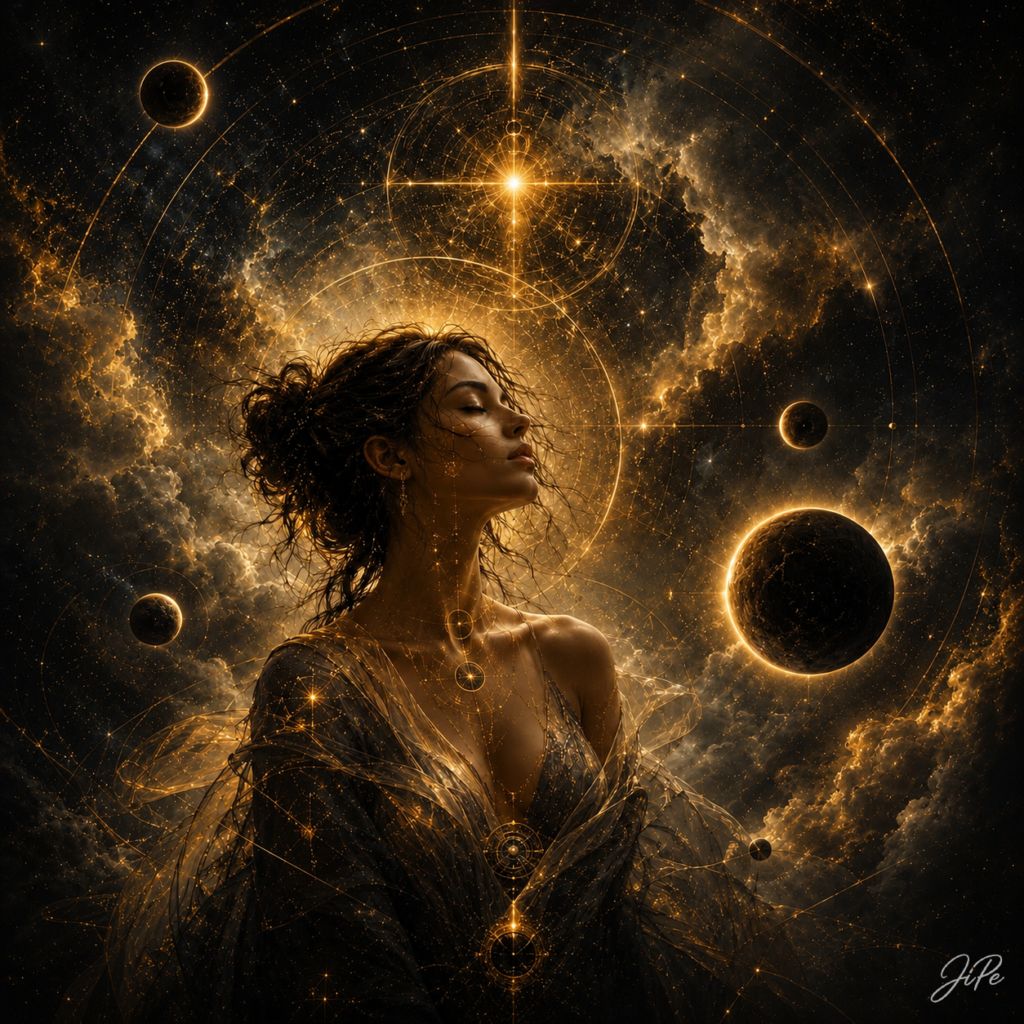
The Soul’s Compass is a contemplative exploration of inner direction, cosmic order, and the invisible forces that guide human existence. In this luminous composition, JiPe presents the soul not as something lost in the vastness of the universe, but as something inherently connected to it. The painting proposes that our deepest guidance does not originate from external certainty, but from an ancient harmony that has always existed between the human spirit and the architecture of creation itself.

Rather than depicting a physical journey, the artwork visualizes an interior one. It invites viewers into a space where astronomy becomes psychology, sacred geometry becomes intuition, and the stars themselves appear to participate in the silent language of consciousness. Every celestial body, every orbit, every line of golden light becomes part of a greater symbolic system—a map not of the heavens above, but of the universe within.

At the heart of the composition stands a solitary female figure, immersed in quiet stillness. Her eyes remain gently closed, her expression calm and untroubled, as though she is listening to something beyond ordinary perception. She neither reaches outward nor resists the unknown. Instead, she surrenders completely to an unseen current, embodying a profound trust in the intelligence that exists beyond conscious thought.

She does not search for the way.

She has become still enough to hear it.

Around her unfolds a magnificent celestial network of luminous circles, planetary forms, radiant intersections, and intricate golden geometry. These elements evoke ancient astronomical diagrams, sacred mandalas, and the timeless language of cosmic mathematics. Yet JiPe does not present them as scientific illustrations. Instead, they become metaphors for the invisible patterns that shape every life.

The universe appears ordered.

The soul belongs to that order.

One of the painting’s most compelling visual elements is the brilliant vertical axis of light that passes directly through the centre of the composition. This radiant line functions simultaneously as a spiritual spine, an axis mundi, a celestial meridian, and an inner compass. It connects earth and sky, matter and spirit, body and eternity into one continuous movement.

The figure herself becomes the meeting point between these dimensions.

She is not separate from the cosmos.

She is its living intersection.

The surrounding planets reinforce this symbolic relationship between humanity and the universe. Suspended in luminous darkness, they appear neither distant nor unreachable. Instead, they orbit with quiet purpose around the central figure, suggesting that every human life exists within a greater celestial rhythm. Rather than portraying humanity as insignificant beneath the stars, JiPe proposes something far more hopeful: the same principles governing galaxies also reside within the human soul.

This idea echoes philosophical traditions stretching from ancient Hermetic thought to Renaissance cosmology and contemporary spiritual psychology.

”As above, so below.”

The painting transforms this timeless concept into visual form.

Light remains JiPe’s primary symbolic language throughout the work. Golden illumination radiates softly through clouds, celestial spheres, and delicate geometric structures, emerging from profound charcoal blacks and deep midnight blues. Rather than functioning merely as illumination, the gold represents awareness itself—truth becoming visible.

It is the colour of awakening.

The colour of remembrance.

The colour of alignment.

The restrained palette allows the luminous gold to resonate with exceptional emotional power. Every highlight appears precious because it emerges from darkness. The result is an atmosphere that feels simultaneously intimate and infinite, contemplative yet monumental.

JiPe’s sophisticated use of layered textures further enriches the symbolic depth of the work. The surface possesses the tactile richness of weathered oil painting while retaining the clarity of contemporary digital craftsmanship. Fine painterly details dissolve into atmospheric abstraction, creating an image that rewards prolonged observation. Each viewing reveals additional celestial lines, hidden circles, delicate particles of light, and subtle compositional relationships that gradually unfold rather than immediately announce themselves.

The composition itself demonstrates remarkable balance. The central figure anchors the image emotionally, while the expanding geometry surrounding her creates a sense of infinite movement. Circular forms repeatedly echo throughout the painting, establishing visual harmony and reinforcing the symbolic themes of cycles, eternity, and interconnectedness.

Nothing feels accidental.

Every orbit answers another.

Every line leads toward stillness.

Unlike many contemporary depictions of spirituality that rely upon spectacle or dramatic symbolism, The Soul’s Compass achieves its emotional force through quiet restraint. The figure’s peaceful posture becomes more powerful than any gesture of triumph or revelation. Her serenity suggests that true direction cannot be forced into existence—it can only be received.

This idea lies at the philosophical heart of the painting.

Human beings often imagine guidance as something external: signs, voices, destinations, certainty.

JiPe offers a different vision.

The compass has always existed within us.

We simply become unable to hear it beneath the noise of fear, ambition, and distraction.

The celestial diagrams surrounding the figure therefore become less like maps of distant space and more like visualizations of consciousness itself. Every orbit reflects a thought. Every star suggests possibility. Every intersection becomes a decision. The universe mirrors the architecture of the inner life.

From an art historical perspective, The Soul’s Compass occupies a fascinating position between Symbolism, Visionary Art, Surrealism, and contemporary metaphysical painting. The radiant geometry recalls Renaissance cosmological drawings and sacred diagrams, while the atmospheric grandeur evokes Romantic landscape traditions. At the same time, JiPe’s cinematic lighting, refined painterly textures, and monumental symbolism establish an unmistakably contemporary visual language that is uniquely his own.

Psychologically, the work resonates strongly with Jungian concepts of individuation. The central figure may be interpreted as the emerging Self—the integrated personality aligning with a deeper centre of consciousness. The celestial architecture surrounding her becomes an external manifestation of inner psychic order, suggesting that wholeness is achieved not by controlling life but by aligning with its deeper patterns.

The stars become thoughts.

The planets become memories.

The light becomes awareness.

Ultimately, The Soul’s Compass is not simply about navigation.

It is about trust.

It proposes that beneath uncertainty, beneath suffering, beneath every apparent detour, there exists an invisible orientation guiding each soul toward its fullest expression. The journey is not measured by distance travelled but by the gradual alignment between who we believe ourselves to be and who we have always been.

Standing before this work, viewers may first be captivated by its celestial beauty, its radiant gold, and its intricate cosmic geometry. Yet as the eye continues to wander through the luminous constellations and finally returns to the peaceful figure at the centre, another realization quietly emerges.

The universe is not asking us to conquer its mysteries.

It is asking us to remember that we have always carried its map within ourselves.

And when the soul finally learns to listen, every star begins to point in the same direction.

Lämna ett svar