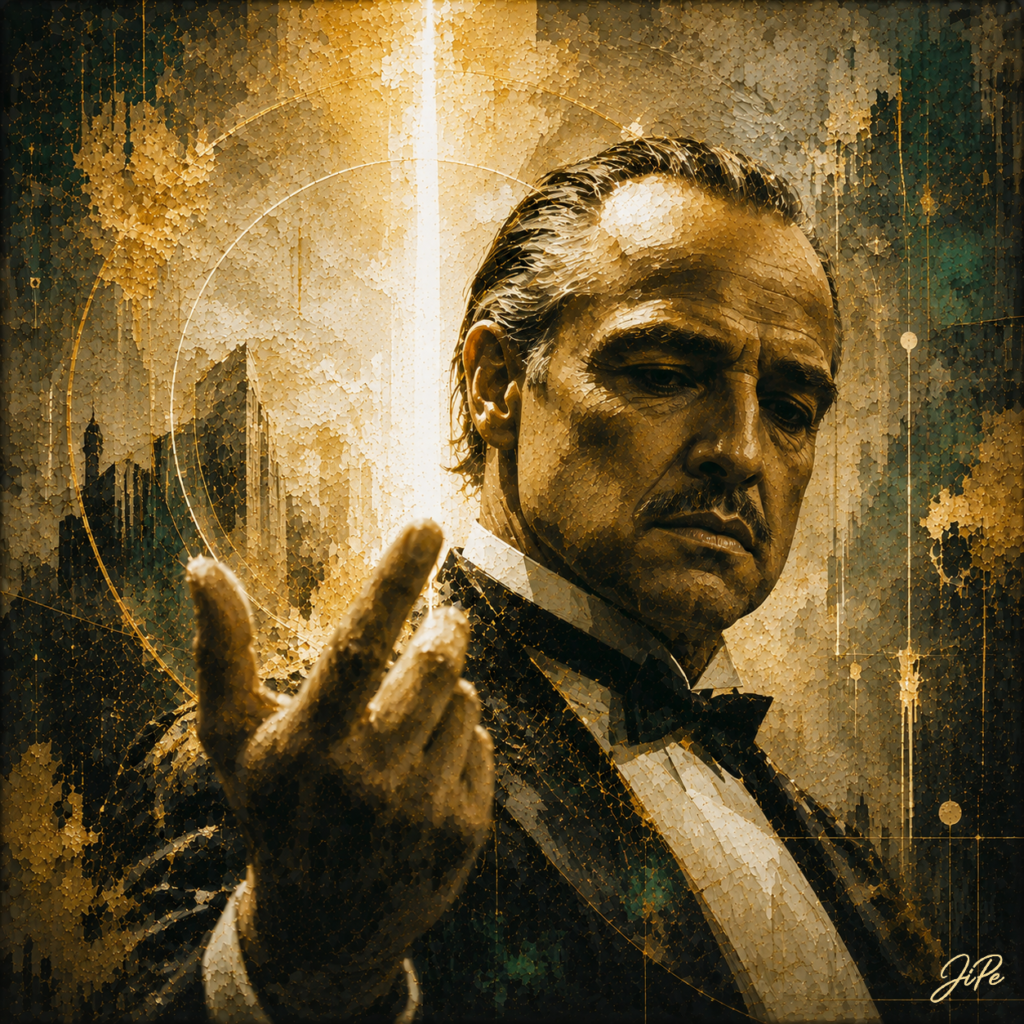
The Golden Hand of the Godfather holds power in a state of absolute restraint. Marlon Brando’s presence carries the weight of one of cinema’s most recognizable performances: his portrayal of Don Vito Corleone in The Godfather became inseparable from the cultural memory of the film, while Brando himself remains one of the defining actors of twentieth-century cinema. The fame of actor and character has become so intertwined that a gesture, a silhouette, or a lowered gaze can summon an entire mythology.
Here, authority does not need movement. The monumental figure seems governed by silence, while the extended hand occupies the uncertain territory between invitation, judgment, generosity, and command. Light concentrates around the body with ceremonial intensity, yet darkness prevents that illumination from becoming reassuring. Power remains visible but psychologically inaccessible.
The title, The Golden Hand of the Godfather, deepens this ambiguity. A hand may offer protection or demand allegiance; it may create bonds while quietly establishing obligation. Brando’s immense cinematic presence intensifies that tension between performance and archetype.
Perhaps true power begins at precisely this threshold: not in what the hand takes, but in what others are willing to place within it.