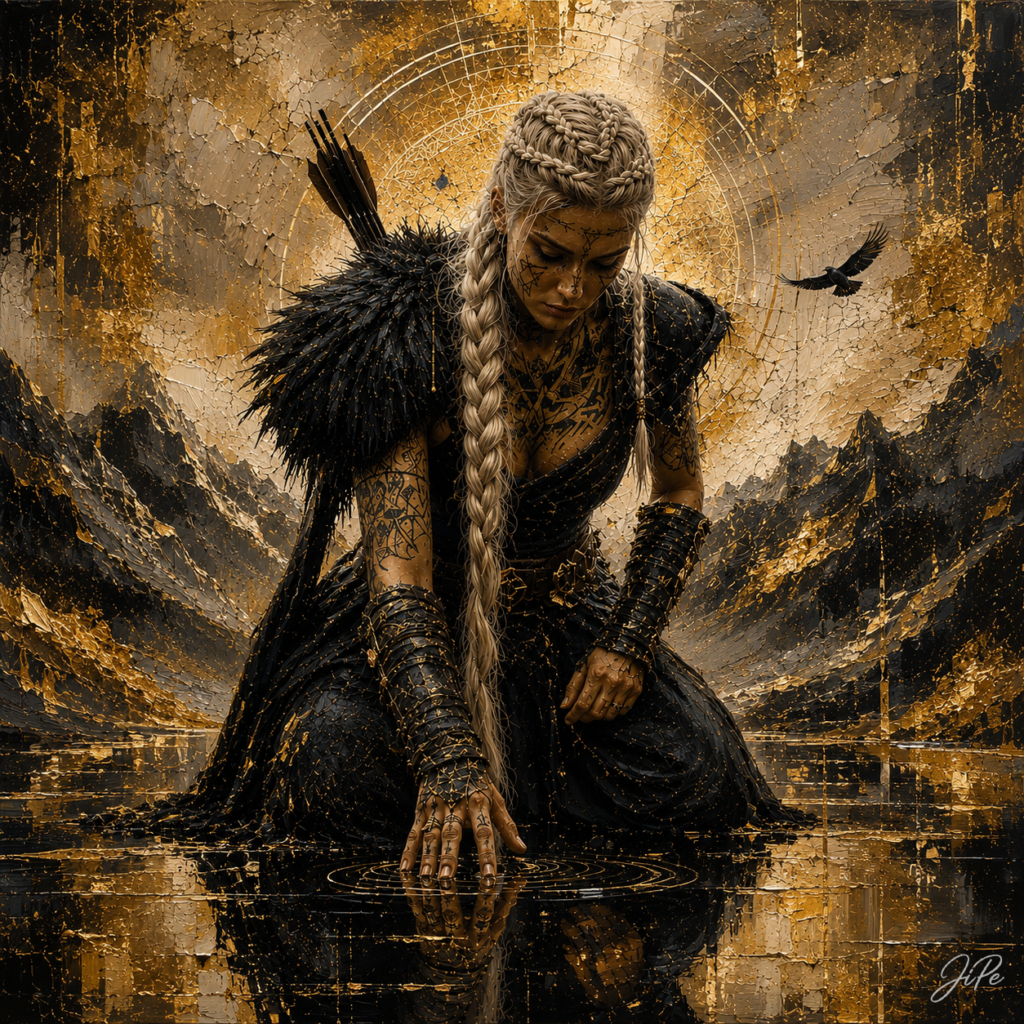
The Warrior’s Reflection

The Warrior’s Reflection is a profound meditation on strength, humility, memory, and the silent dialogue between the warrior and the soul. Blending contemporary symbolic realism with monumental figurative painting, the work moves beyond the traditional depiction of a warrior as a figure of conquest. Instead, it presents an individual who has discovered that the greatest battles are not fought against external enemies, but within oneself. Through its richly textured surfaces, luminous gold, sacred geometry, and restrained emotional intensity, the painting becomes an exploration of the moment when power gives way to reflection and victory becomes understanding.
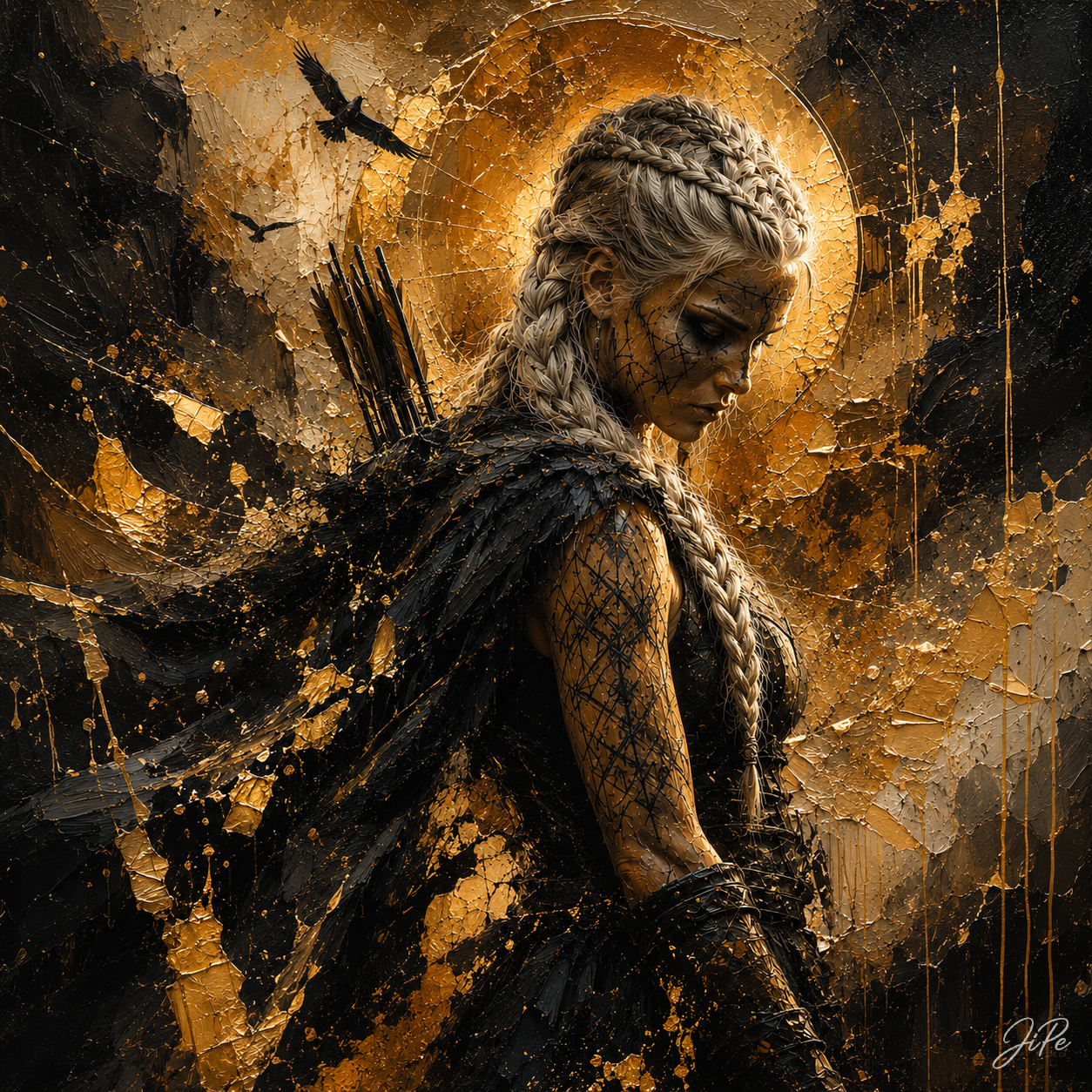
At first glance, the viewer encounters a striking female warrior kneeling before a mirror-like surface of water. Her elaborate braided hair, dark garments adorned with feathered shoulders, ritual markings, and quiver of arrows immediately evoke the visual language of ancient Norse mythology and timeless heroic traditions. Yet despite her formidable appearance, she is not depicted in combat. There is no raised weapon, no triumphant gesture, no visible opponent. Instead, she lowers herself toward the water with extraordinary care, touching its surface with the tips of her fingers.
This single gesture defines the entire painting.
The ripple expanding beneath her hand becomes both a physical event and a philosophical symbol. It reminds us that every action, every memory, and every decision creates consequences that extend far beyond the moment itself. The water does not merely reflect her image—it reflects her journey. It becomes a metaphor for consciousness itself, where the past, present, and future converge in quiet contemplation.
The title, The Warrior’s Reflection, therefore carries multiple meanings simultaneously. It refers not only to the literal reflection in the water but also to the act of self-examination. Reflection becomes both image and thought. The painting suggests that genuine courage begins where certainty ends, in the willingness to confront one’s own history without illusion.
The central figure embodies a fascinating paradox. She is unmistakably powerful, yet her posture is one of humility rather than dominance. Her head is bowed. Her shoulders, though armored by feathers and layered garments, appear relieved of aggression. The weapons remain untouched behind her back, suggesting that the true instrument of transformation is no longer the bow but awareness itself.
This deliberate reversal of traditional heroic imagery elevates the painting beyond historical representation. The warrior becomes an archetype of inner resilience—a guardian whose greatest achievement is not defeating others but understanding herself. She represents every individual who has survived hardship and reached the quiet moment when action gives way to wisdom.
Her elaborate braided hair functions as an additional symbolic element. Across many ancient cultures, braided hair represented lineage, discipline, identity, memory, and continuity between generations. Here it appears almost architectural, emphasizing order amidst emotional complexity. Every strand reflects patience, ritual, and inherited knowledge, reinforcing the idea that identity is woven over time rather than discovered in a single moment.
The intricate markings covering her face, arms, and hands further deepen this narrative. Rather than decorative ornamentation, they resemble sacred inscriptions or lived experiences permanently etched into the body. They transform the warrior into a living manuscript, suggesting that every scar, every lesson, and every sacrifice contributes to the architecture of identity.
Behind the figure unfolds a luminous halo composed of delicate sacred geometry rendered in radiant gold. This circular structure immediately recalls ancient cosmological diagrams, celestial maps, and spiritual mandalas. It serves not merely as compositional balance but as an invisible framework connecting the human figure to universal order.
Unlike traditional religious halos that emphasize sanctity bestowed from above, this radiant geometry appears to emerge naturally around the warrior, implying that enlightenment is earned through experience rather than granted through perfection. It represents the invisible wisdom accumulated through endurance, reflection, and transformation.
The surrounding landscape extends this symbolic language into monumental space. Dark mountains rise on either side of the composition like ancient guardians, framing the figure within an environment of timeless permanence. Their weathered forms evoke geological endurance, reminding viewers that nature measures time differently than humanity. Against this immense backdrop, the kneeling figure appears simultaneously small and infinitely significant.
The landscape does not dominate the warrior; instead, it reflects her internal state. The mountains become emotional architecture—symbols of trials overcome, burdens carried, and truths that cannot be rushed. Their rugged forms contrast beautifully with the smooth reflective water, creating a visual dialogue between permanence and change.
The reflective surface itself occupies extraordinary conceptual importance. Water has long served as one of humanity’s richest symbols, representing memory, intuition, purification, rebirth, and unconscious thought. Within this painting, it functions as all of these simultaneously. It becomes a threshold between visible reality and inner awareness.
As the warrior touches its surface, concentric circles radiate outward with mathematical precision. These expanding ripples become visual metaphors for human influence. Every action leaves traces. Every choice echoes beyond itself. Every moment of understanding transforms not only the individual but the world surrounding them.
One of the painting’s most subtle yet significant details is the solitary raven flying quietly across the distant sky. Throughout mythology, ravens have symbolized wisdom, prophecy, guardianship, and communication between earthly and spiritual realms. Here the raven introduces an additional layer of silent observation.
It neither interrupts nor participates directly in the scene. Instead, it witnesses. Its presence reminds viewers that reflection itself is never entirely private. Memory exists within larger cycles of nature, history, and collective experience. The raven therefore becomes an emblem of enduring knowledge carried across generations.
Gold functions throughout the composition not simply as color but as meaning. Rich layers of textured gold leaf appear embedded within the environment itself, illuminating fractured surfaces, weathered landscapes, and sacred geometry. Rather than overwhelming the darker palette, the gold emerges selectively, suggesting that illumination reveals itself gradually through patience and contemplation.
Its cracked surfaces immediately recall the philosophy of kintsugi, in which fractures are repaired with precious metal rather than concealed. Within The Warrior’s Reflection, this symbolism becomes especially poignant. Strength is portrayed not as flawless invulnerability but as visible resilience. Every crack becomes evidence of survival rather than weakness.
Materiality plays an essential role in communicating this idea. Thick painterly textures create sculptural surfaces that resemble ancient stone, weathered frescoes, and archaeological remains. The painting appears simultaneously contemporary and timeless, as though it has survived centuries while preserving its emotional immediacy.
These tactile surfaces reinforce the work’s central message: transformation is cumulative. Identity is built layer by layer through experience, memory, hardship, and renewal. Nothing is erased. Everything contributes.
From an art historical perspective, The Warrior’s Reflection synthesizes influences from several traditions while maintaining a distinctly contemporary voice. The monumental composition recalls Romantic landscape painting, where nature served as both physical environment and psychological metaphor. The symbolic richness reflects the legacy of nineteenth-century Symbolism, while the expressive textures and mixed-media aesthetic connect the work to contemporary abstract and material-based painting.
The painting also resonates with mythological portraiture, particularly traditions that elevate individual figures into universal archetypes. Yet unlike heroic portraits celebrating conquest or divine intervention, this work celebrates introspection. Its heroism is emotional rather than military.
Psychologically, the painting invites reflection upon one of humanity’s most enduring paradoxes: that true strength often emerges only after the desire to prove strength has disappeared. The warrior’s bowed posture communicates acceptance rather than defeat. She has reached a moment where listening becomes more powerful than speaking, where observation surpasses action.
This quiet emotional intelligence distinguishes the work from conventional heroic imagery. The painting rejects spectacle in favor of contemplation, reminding viewers that the deepest transformations rarely occur during moments of conflict. Instead, they unfold afterward—in silence, in memory, and in honest confrontation with oneself.
Perhaps the greatest achievement of The Warrior’s Reflection lies in its extraordinary stillness. Every compositional element supports this atmosphere of meditative balance. The restrained color palette of black, gold, ivory, and muted earth tones creates visual harmony. Geometry stabilizes emotion while painterly textures preserve spontaneity. Monumentality coexists with intimacy.
The viewer becomes less an observer than a participant. Standing before the painting feels remarkably similar to standing beside the warrior herself, watching the expanding circles spread across the water. Time appears suspended. The silence becomes almost tangible.
Ultimately, The Warrior’s Reflection is not a painting about battle, but about what remains after battle has ended. It is about the courage required to look inward, to acknowledge one’s past without regret, and to recognize that wisdom is rarely found in victory alone. It emerges through reflection, humility, and the willingness to let experience reshape identity.
The work invites viewers to pause before continuing their own journeys. Like the warrior reaching toward the still water, we are reminded that the deepest answers often appear only when movement ceases. In that fragile moment between action and understanding, strength discovers its truest form—not in conquest, but in quiet self-knowledge.