
The Queen of Quiet Light
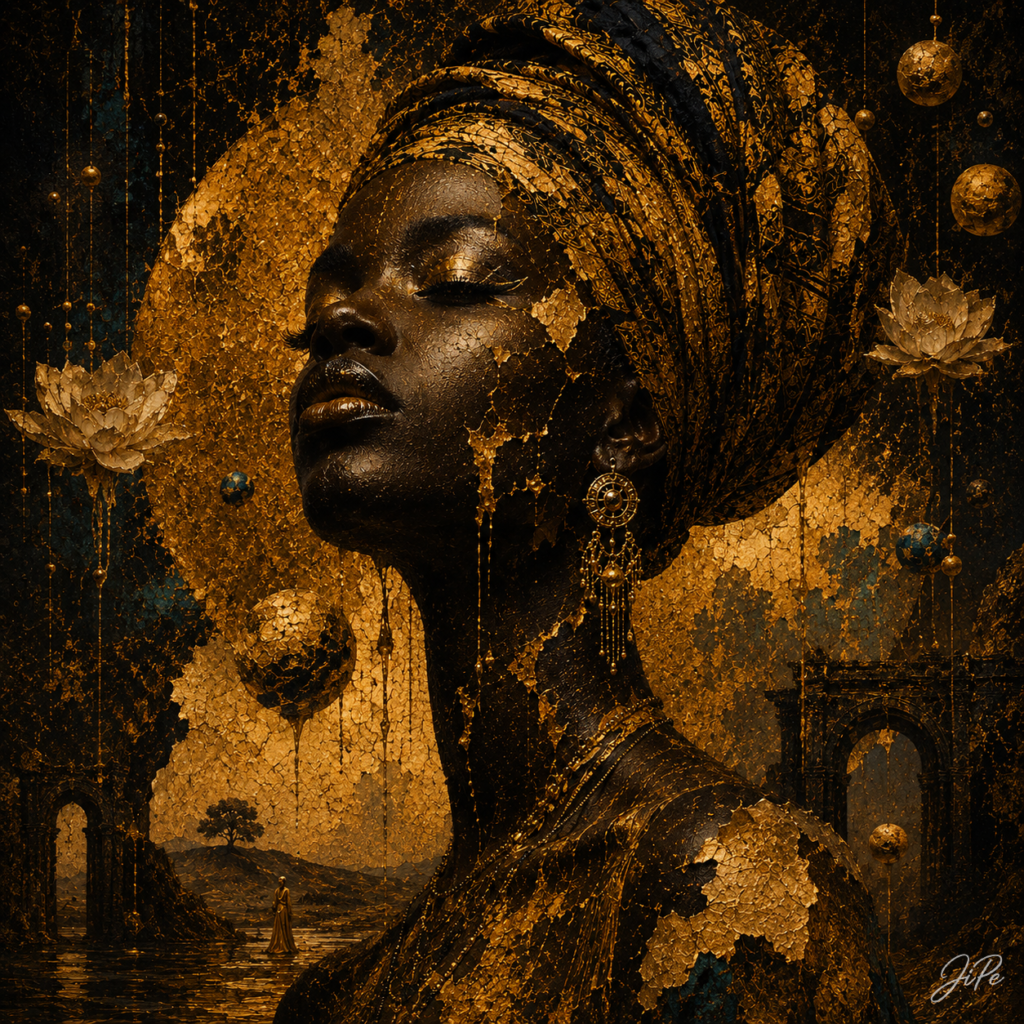
The Queen of Quiet Light is an exploration of inner sovereignty, spiritual resilience, and the profound strength found in stillness. Rather than portraying power as dominance or conquest, the work presents authority as a deeply internal state—one cultivated through wisdom, endurance, and self-knowledge. The painting invites viewers into a realm where silence possesses its own language and where light does not overwhelm darkness but gently transforms it from within.
Rooted in the traditions of visionary symbolism and contemporary surrealism, the composition unfolds as both a portrait and an allegorical landscape. Every element—from the monumental figure and celestial forms to the floating architecture and delicate lotus blossoms—functions as part of an interconnected visual philosophy. The result is an image that transcends narrative, encouraging prolonged contemplation rather than immediate explanation.
At the center of the composition stands an elegant female figure whose eyes remain peacefully closed. She is neither asleep nor withdrawn. Instead, she appears immersed in a state of complete inner presence. Her posture radiates calm certainty, suggesting a consciousness that has moved beyond distraction and conflict into profound equilibrium.
She does not command through force.
She governs through stillness.
Her silence becomes her greatest expression.
The portrait possesses a remarkable sculptural quality. The skin appears simultaneously human and ancient, its surface fractured with luminous veins of gold that trace every imperfection with extraordinary delicacy. These radiant fissures evoke the philosophy of kintsugi, transforming signs of damage into symbols of beauty and renewal. Rather than concealing history, the work celebrates it, suggesting that every experience—whether joyful or painful—contributes to the formation of wisdom.
The fractures become visual memories.
Each line represents endurance.
Each golden repair speaks of transformation rather than loss.
This philosophy extends beyond the figure herself and becomes the foundation of the entire composition. Nothing within the painting appears untouched by time, yet nothing appears diminished by it. Age, memory, and imperfection become sources of illumination rather than decline.
The queen’s elaborate headdress rises like an architectural monument, blending intricate textile traditions with celestial ornamentation. It is more than ceremonial attire; it functions as an extension of thought itself. The flowing structure resembles both a sacred crown and a cosmic landscape, suggesting that true nobility originates not from inherited status but from cultivated consciousness.
Around her, suspended celestial spheres drift silently through space. These floating planets establish a cosmic rhythm that expands the portrait beyond earthly existence. Their presence implies that the figure exists within a universal order rather than an isolated environment. Time, space, and consciousness appear interconnected through invisible forces that transcend ordinary perception.
Behind the figure radiates a monumental golden disc whose fractured surface recalls ancient mosaics, weathered icons, and celestial eclipses simultaneously. Throughout art history, the halo has represented sanctity, enlightenment, and transcendence. Here, however, it acquires a broader symbolic meaning. It becomes a visual manifestation of inner illumination—light discovered through experience rather than granted by external authority.
The light does not surround her.
It seems to emerge because she has become one with it.
This quiet luminosity defines the emotional atmosphere of the entire painting.
The surrounding landscape unfolds as a symbolic threshold between worlds. Ancient gateways rise from the darkness, suggesting passages between memory and possibility, mortality and eternity, the visible and the invisible. Rather than functioning as architectural ruins alone, these portals become metaphors for moments of transformation—the countless passages every individual crosses throughout life.
Each doorway invites reflection.
Every threshold suggests becoming.
Nothing remains fixed.
The distant solitary tree positioned upon the horizon introduces another layer of symbolic meaning. Across numerous cultural traditions, the tree has represented life, endurance, knowledge, and continuity. Standing alone beneath the immense celestial sky, it becomes an image of resilience rooted in simplicity. Though physically small within the monumental composition, it quietly anchors the emotional center of the landscape.
Nearby, lotus blossoms emerge suspended within the composition, floating effortlessly between earth and sky. Traditionally associated with purity, spiritual awakening, and enlightenment, the lotus flourishes despite growing from dark waters. Within this work, these blossoms reinforce one of the painting’s central ideas: beauty and wisdom arise not despite adversity but because of it.
The queen herself reflects this same transformation.
She has not escaped darkness.
She has learned to illuminate it.
The carefully restrained palette of deep charcoal, warm bronze, rich ochre, and radiant gold creates extraordinary visual harmony. Darkness is never treated as emptiness or despair. Instead, it functions as fertile space—a realm from which light quietly unfolds. Gold becomes the visual language of revelation, tracing the contours of architecture, skin, celestial bodies, and sacred geometry with remarkable precision.
Throughout the composition, gold symbolizes something far more profound than material wealth.
It represents insight.
Memory.
Compassion.
The invisible value accumulated through living.
The painterly textures play an equally important role in shaping the work’s emotional depth. Layered surfaces resemble weathered frescoes, ancient murals, and gilded manuscripts, giving the image the appearance of something simultaneously contemporary and timeless. The tactile quality of cracked pigment and luminous metallic accents creates a dialogue between permanence and fragility, reinforcing the painting’s meditation on transformation.
From an art historical perspective, The Queen of Quiet Light synthesizes influences from Symbolism, Surrealism, Byzantine iconography, Romantic landscape traditions, and visionary realism. Yet the work resists direct historical classification. Instead, it establishes a contemporary symbolic language that draws upon universal archetypes while remaining distinctly personal in its emotional resonance.
The monumental portrait recalls classical sculpture.
The floating celestial forms evoke metaphysical painting.
The architectural fragments suggest forgotten civilizations.
Together they become a unified meditation on the invisible architecture of the soul.
Psychologically, the painting may be understood as an allegory of individuation. The queen embodies the fully integrated self—a consciousness that has reconciled vulnerability with strength, memory with hope, silence with expression. Her closed eyes imply that true perception often begins only after external distractions have faded.
She no longer searches for light.
She has become its quiet reflection.
The title, The Queen of Quiet Light, encapsulates the essence of the work. The queen is not defined by a kingdom of territory or conquest but by an inner realm shaped through patience, resilience, compassion, and wisdom. The ”quiet light” is neither dramatic nor overwhelming. It is the enduring glow of self-understanding—the gentle illumination that persists even after life’s greatest storms have passed.
This light cannot be possessed.
It cannot be demanded.
It can only be cultivated.
Perhaps the painting’s greatest achievement lies in its refusal to dramatize transcendence. Rather than depicting an ecstatic revelation, it presents enlightenment as something remarkably gentle. The transformation has already occurred. What remains is serenity—a state in which inner harmony becomes more powerful than spectacle.
The viewer is therefore invited not simply to admire the queen but to recognize something familiar within her stillness. The painting becomes a mirror, reflecting the possibility that every individual carries the capacity to transform suffering into wisdom, uncertainty into clarity, and silence into profound presence.
Ultimately, The Queen of Quiet Light is a celebration of quiet strength. It reminds us that the deepest forms of power are rarely loud, that true radiance emerges from authenticity rather than perfection, and that the most enduring kingdoms are those built within the human spirit.
In a world defined by constant movement and noise, this work offers something increasingly rare:
A moment of stillness.
A moment of reflection.
A reminder that the brightest light is often the one that shines without asking to be seen.