
The Last Muse of an Empire

The Last Muse of an Empire is a contemplative meditation on the fragile relationship between beauty and power, memory and ambition, permanence and inevitable decline. Through an elegant fusion of monumental classical forms, contemporary symbolic language, and luminous painterly realism, JiPe constructs a timeless allegory in which the collapse of an empire becomes not merely a historical event but a profoundly human reflection on creativity, legacy, and the endurance of the artistic spirit. Rather than celebrating imperial grandeur, the painting quietly asks what survives after power fades—and suggests that it is not conquest, but imagination, that ultimately outlives history.
At the centre of the composition sits a solitary female figure draped in flowing ivory fabric, her relaxed yet introspective posture conveying an emotional stillness that contrasts dramatically with the monumental fragments surrounding her. Behind her rises the shattered head of an immense classical sculpture, its fractured surface marked by luminous veins of gold that transform destruction into beauty. The figure does not appear defeated by the ruins of civilisation. Instead, she inhabits them with remarkable serenity, becoming both witness and guardian of a world that has already passed into memory.
The title immediately introduces a powerful narrative. A muse has traditionally symbolised inspiration—the invisible force that gives birth to poetry, philosophy, music, architecture, and art itself. By calling her The Last Muse, JiPe implies that she represents the final surviving source of creative consciousness after an empire has exhausted its political and material ambitions. She is not simply the last inhabitant of a fallen civilisation; she is the final bearer of its imagination. In this sense, the work suggests that while monuments crumble and rulers vanish into history, the creative impulse remains humanity’s most enduring inheritance.
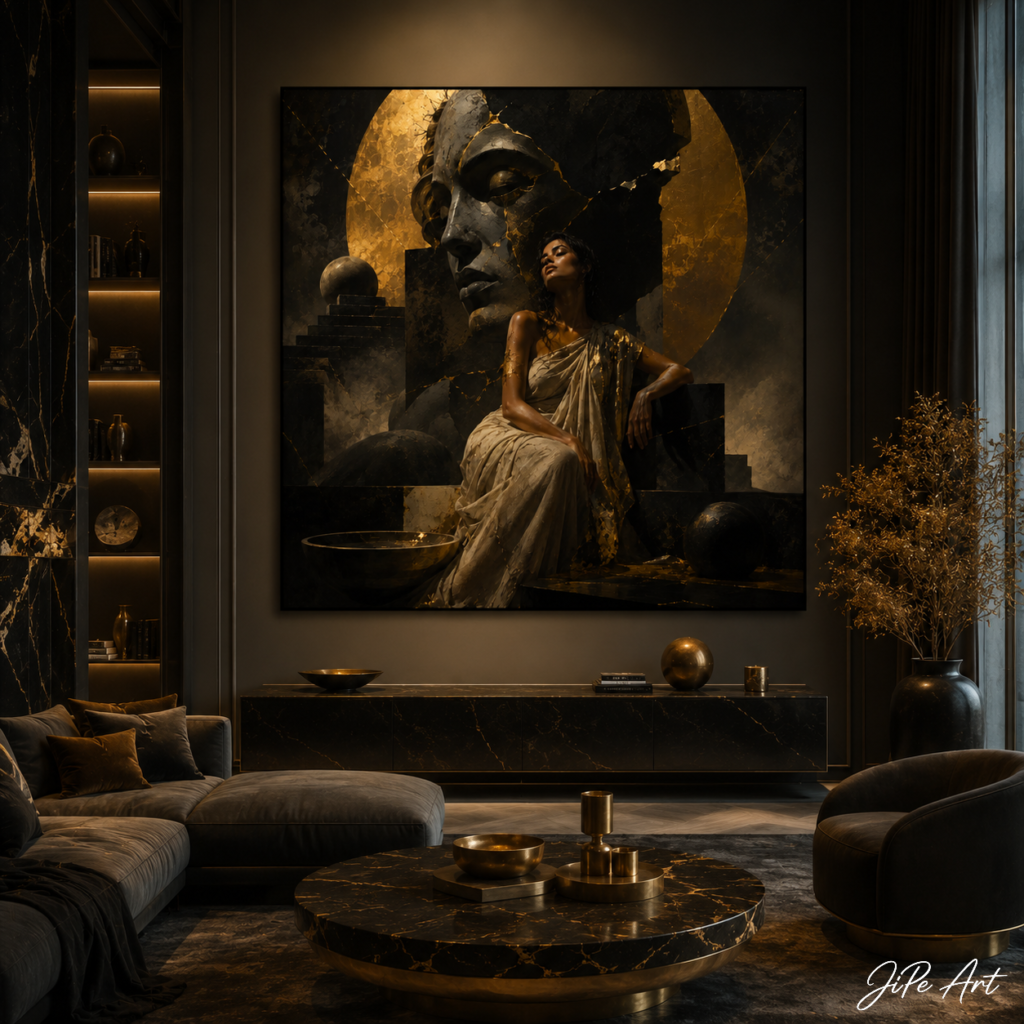
The composition masterfully explores the tension between monumentality and intimacy. The colossal sculpted face dominates the background with overwhelming physical presence, while the seated figure occupies only a fraction of its scale. Yet emotionally, it is the living woman who commands the viewer’s attention. This deliberate reversal transforms the monumental ruins into silent witnesses rather than protagonists. Stone embodies permanence, but consciousness belongs to the fragile human figure. JiPe subtly reminds us that history may preserve monuments, but meaning survives only through those who continue to remember.
One of the painting’s most striking symbolic devices is the fractured sculpture itself. Classical sculpture has long represented ideals of perfection, permanence, rationality, and civilisation. Here, however, that perfection has been broken apart. Massive fissures divide the face into fragments, exposing vulnerability within what once appeared eternal. Rather than concealing these fractures, JiPe illuminates them with brilliant veins of gold inspired by the philosophy of kintsugi, where brokenness becomes a source of renewed beauty rather than irreversible loss.
These golden fractures function on multiple symbolic levels. They acknowledge the inevitability of decline while simultaneously suggesting that history’s greatest lessons emerge through collapse rather than triumph. Every civilisation eventually fractures, but within those fractures new perspectives, philosophies, and artistic expressions are born. The empire may have fallen, yet its wisdom continues to radiate through the very wounds that mark its disappearance.
Gold occupies a central role throughout the composition. It extends beyond decorative ornamentation to become a visual language of transcendence. JiPe consistently employs luminous gold as a symbol of consciousness, revelation, and spiritual continuity. Here it weaves together sculpture, architecture, fabric, and atmosphere, creating an invisible network that binds the living figure to the ancient world surrounding her. Gold becomes the thread connecting past and present, mortality and eternity, memory and imagination.
The circular golden disc positioned behind the monumental head introduces another essential symbolic layer. Throughout history, circular forms have represented cosmic order, infinity, divine perfection, and the cyclical nature of existence. Rather than functioning simply as a halo, this radiant sphere transforms the entire architectural environment into a sacred psychological space. The empire depicted here is not geographical but metaphysical—a civilisation of ideas, beauty, and consciousness existing beyond historical chronology.
The seated figure herself embodies extraordinary ambiguity. She appears neither queen nor servant, neither goddess nor ordinary woman. Instead, she occupies an archetypal role that transcends historical identity. Her calm expression and relaxed posture suggest contemplation rather than mourning. She does not grieve for the fallen empire because she understands its inevitable place within the larger rhythms of existence. Her silence becomes wisdom rather than resignation.
The draped garment further reinforces this timeless quality. Reminiscent of Greco-Roman sculpture yet rendered with contemporary painterly sensitivity, the flowing fabric creates an elegant dialogue between antiquity and modernity. Light glides across its folds with remarkable subtlety, allowing the material itself to become an active participant in the composition. The fabric seems almost alive, softly reflecting the surrounding gold while maintaining its own luminous purity.
Architectural elements throughout the painting contribute to its symbolic complexity. Dark geometric platforms, ascending stairways, and carefully positioned spheres create a visual language rooted in order, philosophy, and metaphysical architecture. These structures resist functioning merely as decorative scenery. Instead, they suggest stages of consciousness, intellectual ascent, and the layered construction of civilisation itself. The staircase disappearing into darkness recalls humanity’s endless pursuit of knowledge, while the spheres evoke celestial harmony and universal order.
The atmosphere surrounding the figures remains intentionally restrained. Rather than overwhelming the viewer with elaborate environmental detail, JiPe allows shadow and silence to dominate much of the space. This controlled use of negative space produces extraordinary emotional depth. Darkness here is not emptiness but contemplation. It allows every illuminated surface to acquire greater psychological significance while reinforcing the sense that the painting exists outside measurable time.
From a technical perspective, The Last Muse of an Empire demonstrates JiPe’s characteristic mastery of painterly realism combined with contemporary symbolic abstraction. Rich surface textures evoke weathered stone, aged plaster, oxidised bronze, and cracked marble without becoming hyperrealistic. Visible brushwork preserves the handcrafted quality of the image, while layered textures suggest centuries of accumulated history. The result is a work that feels simultaneously archaeological and visionary.
Art historically, the painting establishes an intriguing dialogue with several traditions. Its monumental sculptural presence recalls Classical Antiquity, while its introspective emotional atmosphere echoes Symbolist painters who transformed visible reality into psychological allegory. The fractured monument evokes Romantic meditations on ruined empires, recalling artists fascinated by the sublime beauty of decay. Simultaneously, the minimal architectural staging and controlled colour palette align the work with contemporary visionary art, where symbolism often supersedes narrative.
Perhaps most compelling is the painting’s reflection upon civilisation itself. Throughout history, empires have sought permanence through conquest, architecture, and political authority. Yet nearly all have eventually disappeared. JiPe shifts attention away from military or political narratives and instead asks what truly defines a civilisation. His answer appears remarkably clear: art, memory, imagination, philosophy, and the human capacity to create meaning endure long after institutions collapse.
Psychologically, the painting invites viewers to consider their own relationship with legacy. Every individual builds personal empires—careers, identities, relationships, ambitions, beliefs—that inevitably evolve or disappear. Like the monumental sculpture, these structures eventually fracture. Yet the creative spirit represented by the muse remains capable of transforming endings into new beginnings. In this sense, the work becomes not simply a meditation on historical decline but an intimate reflection on personal transformation.
The contrast between living flesh and ancient stone reinforces this philosophical tension. While stone appears monumental, it remains vulnerable to time. Human life, though fleeting, possesses the unique ability to reinterpret, imagine, and recreate. Creativity therefore becomes more enduring than material permanence. The empire falls; the muse continues.
Within JiPe’s broader artistic language, The Last Muse of an Empire exemplifies his ongoing fascination with monumental symbolism, fractured identity, sacred geometry, and luminous gold as metaphysical light. Yet this work introduces a particularly refined emotional restraint. Rather than relying upon dramatic action or overt narrative, it achieves remarkable power through stillness. Every gesture, every shadow, and every fracture contributes to an atmosphere of quiet philosophical contemplation.
The painting ultimately argues that beauty possesses a unique resilience. Political systems rise and collapse. Monuments weather. Historical narratives change. Yet the human need to seek beauty, meaning, and transcendence remains remarkably constant across cultures and centuries. The muse therefore becomes more than the final guardian of one civilisation; she becomes the eternal embodiment of artistic consciousness itself.
Standing before The Last Muse of an Empire, viewers encounter a world suspended between memory and eternity. The work does not mourn the fall of an empire. Instead, it celebrates what survives beyond it. In the silence of ruined monuments, within fractured stone illuminated by gold, JiPe reveals a profound truth: history may preserve kingdoms, but it is imagination that preserves humanity. Long after every empire has vanished into dust, the muse remains—patient, luminous, and endlessly creating the future from the fragments of the past.