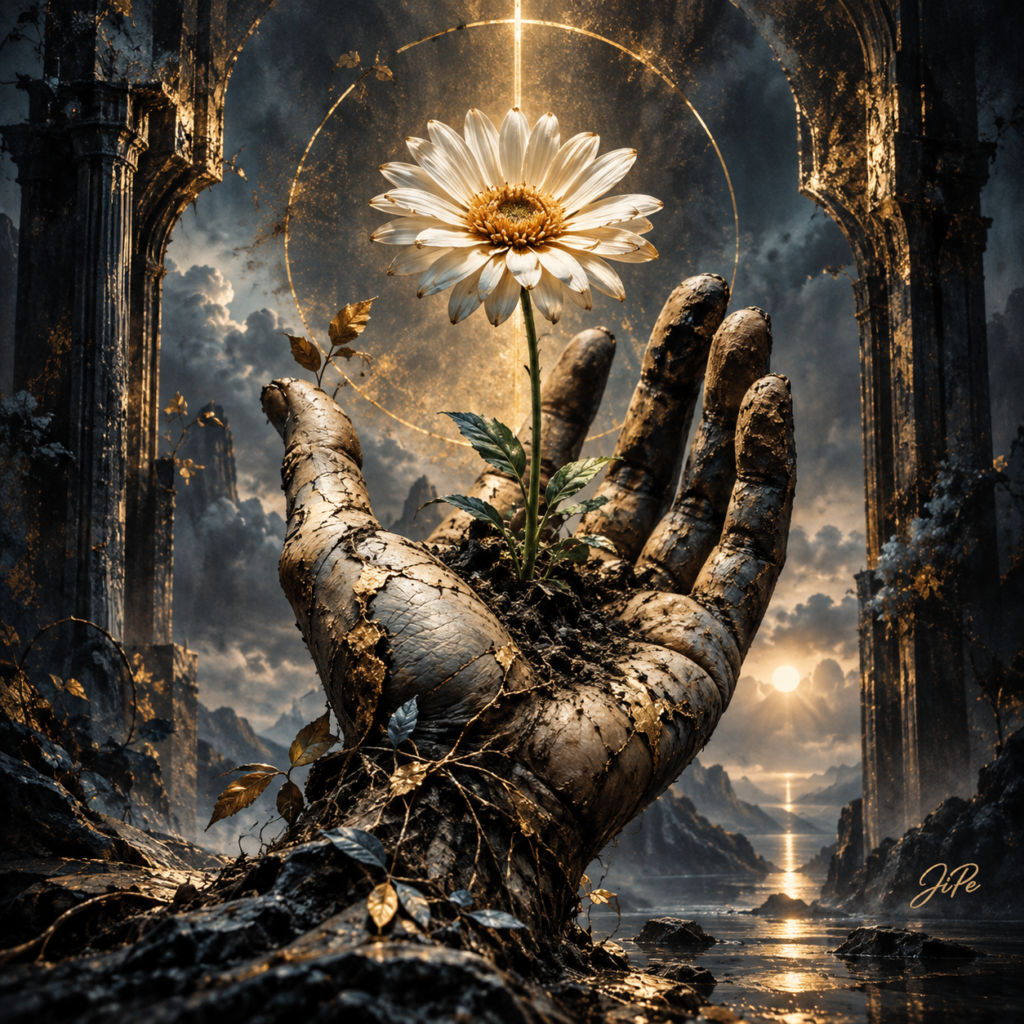
In The Last Flower of Creation, a solitary bloom rises from an immense, weathered hand, held within a world that seems to have outlived its own history. The encounter carries an extraordinary tenderness, yet its stillness is touched by uncertainty. Something delicate persists amid the remnants of a vast and seemingly exhausted existence, its quiet presence made more poignant by the immensity surrounding it.
The monumental scale of the hand contrasts with the flower’s fragile vitality, creating a tension between the power to create and the inability to preserve. Beyond them, ancient spaces recede into silence, while light gathers around the bloom with an almost reverential restraint. It offers no promise of renewal, yet refuses to surrender entirely to the darkness. The atmosphere suggests a moment suspended between an ending already written and a possibility not yet extinguished.
The title, The Last Flower of Creation, introduces the unsettling thought that beauty may become most profound when nothing remains to witness it. The hand might suggest protection, remembrance, or the final gesture of a presence whose identity has long since disappeared.
Yet the flower’s existence complicates the certainty of an ending. Is it the last surviving trace of a vanished world, or the first fragile expression of something still waiting to begin? Perhaps creation and disappearance have always been closer than we imagine.