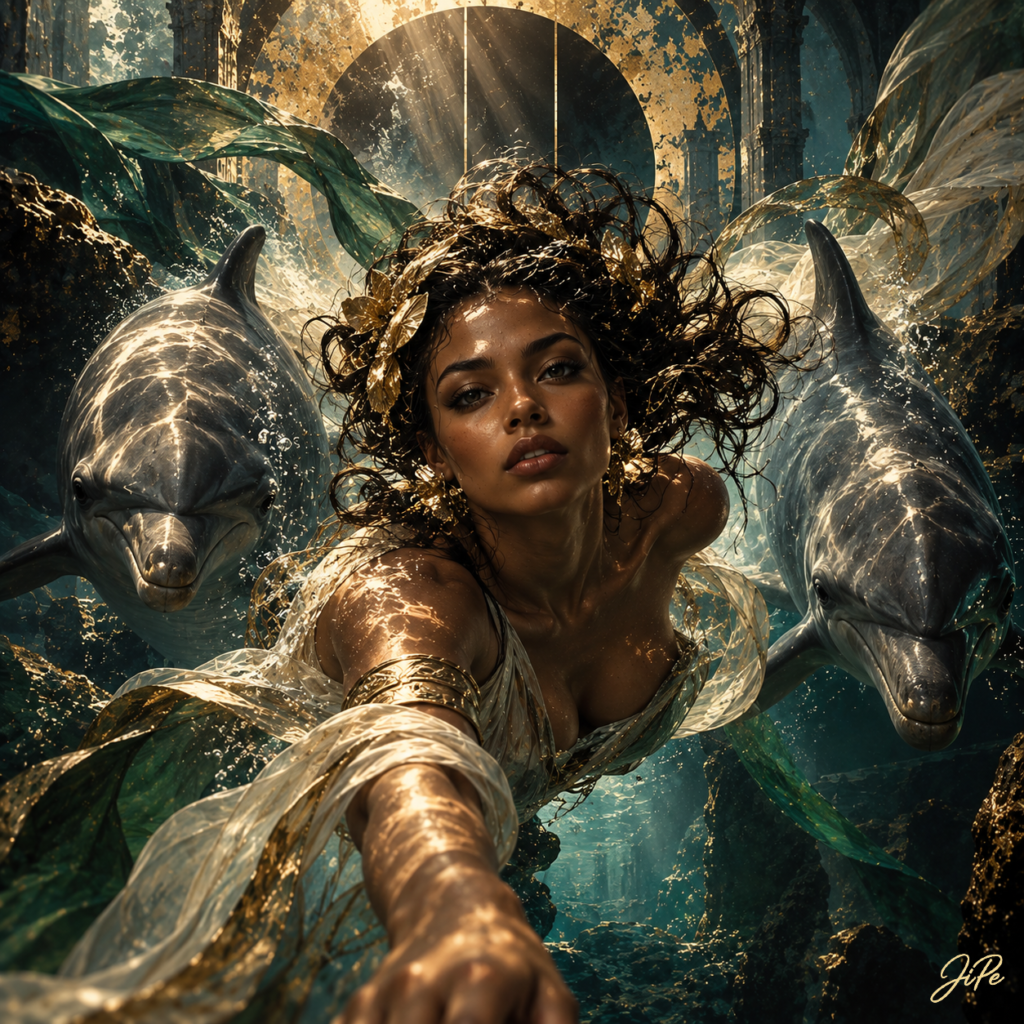
In The Last Daughter of Atlantis, a solitary woman emerges from a submerged realm with an expression poised between recognition and uncertainty. Her outstretched presence creates an unexpected intimacy within an immense, almost forgotten world, as though the distance between past and present has momentarily dissolved. There is urgency in her movement, yet her gaze remains composed, carrying the quiet gravity of something that has endured beyond its appointed time.
The surrounding depths possess a strange luminosity, where light seems less an intrusion than a lingering memory of the world above. Ancient spaces recede into obscurity, suggesting a civilisation whose disappearance has not entirely extinguished its presence. The closeness of the living figures contrasts with the vast silence beyond them, creating a delicate tension between belonging and abandonment, survival and loss.
The title, The Last Daughter of Atlantis, introduces the possibility of an inheritance that can no longer be shared. To remain when everything familiar has vanished may be a form of preservation, but also an immeasurable solitude. The woman’s gesture suggests connection without revealing whether she seeks rescue, recognition, or something that cannot be recovered.
Perhaps the deepest mystery is not how an entire world disappeared, but what continues to live within the one who remembers it. And if she finally reaches beyond the boundaries of her lost kingdom, will she be leaving Atlantis behind, or carrying its silence into another world?